Home Audio Guru · Buying Guide
Best Home Audio Systems for Every Room and Budget
Whether you want cinematic bass for movie night, all-day multi-room streaming, or a turntable setup that makes vinyl sing, the right home audio system changes how a room feels. Below is a hands-on, no-nonsense guide to the systems worth your money right now, plus everything you need to know before you buy — from how sound formats actually work, to room acoustics, to the setup habits that make any system, expensive or budget, sound noticeably better than it does straight out of the box.
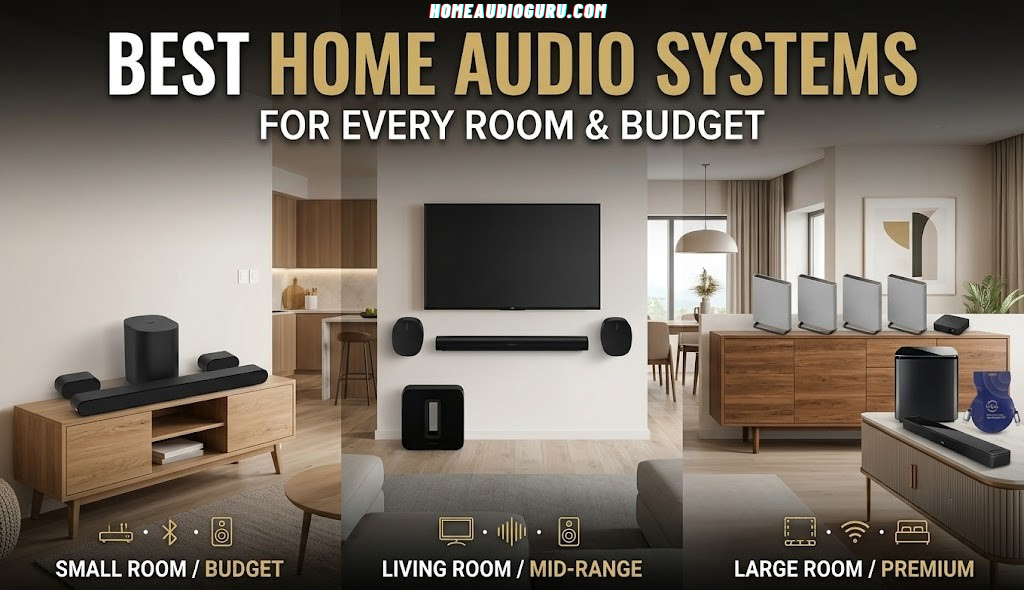
What to Consider Before Buying a Home Audio System
Shopping for a home audio system today means wading through more product categories, acronyms, and price tiers than most people expect going in. Two products that look similar on a retailer’s search results page can serve completely different households — one built for a couple who mostly stream shows on a weeknight, another built for a family that hosts movie nights and wants the walls to shake a little during action scenes. Getting this decision right starts with being honest about which household you actually are, not which one the marketing photos are aimed at.
“Home audio system” covers a lot of ground. It might mean a soundbar and subwoofer tucked under the TV, a full 5.1 surround setup wired into the walls, a pair of powered bookshelf speakers next to a turntable, or a mesh of wireless speakers streaming the same song through every room in the house. Before comparing specific products, it helps to know which category actually fits how you live.
The Main Types of Home Audio Systems
Soundbars with a subwoofer are the easiest upgrade from built-in TV speakers. A single bar sits below or above the screen, a wireless sub handles bass, and setup usually takes ten minutes. They’re the right call for apartments, rentals, and anyone who wants dramatically better dialogue and movie sound without running wires.
Surround and home theater-in-a-box systems add dedicated rear and center channels for a genuinely enveloping experience. These suit a den or dedicated media room where you’re willing to place a few extra speakers for the payoff of real front-to-back sound.
Multi-room wireless systems are built around one thing: the same audio, synced, in every room you own. They’re less about home theater bass and more about lifestyle — cooking with music in the kitchen that follows you to the patio.
Shelf and stereo hi-fi systems, often paired with a turntable, prioritize music fidelity over movie theatrics. If you care about how a record actually sounds rather than how an explosion shakes the floor, this is the category to shop.
In-wall and in-ceiling speaker systems trade visible hardware for a completely clean look, with speakers recessed into the wall or ceiling and wired back to a hidden amplifier or receiver. They suit renovation projects or new builds where wiring can be run before walls are closed up, but they’re a poor fit for a rental or a room where you don’t want to commit to permanent installation.
Soundbar-only systems, without a separate subwoofer, are worth mentioning as their own mini-category. They’re the most compact and least expensive option, and a reasonable choice for very small rooms or secondary TVs where deep bass isn’t a priority, but most buyers find the addition of even an entry-level sub makes a bigger difference than any other single upgrade to a soundbar-only setup.
Key Features Worth Paying For
Worth Prioritizing
- Wireless subwoofer (no cable running across the room)
- Dolby Atmos or object-based surround support
- Multiple HDMI eARC / optical inputs
- Wi-Fi + Bluetooth, not Bluetooth alone
- App-based room correction or EQ tuning
Easy to Overspend On
- Excessive channel counts for a small room
- Proprietary ecosystems that lock you into one brand
- Ultra-high wattage ratings that a small living room will never use
- Voice-assistant features you won’t actually use daily
If you’re setting up a system for the first time, it’s worth reading through our full guide on how to set up a home audio system before you buy anything — knowing where speakers will physically live changes which product makes sense.
Start With the Room, Not the Spec Sheet
It’s tempting to shop by watt count or channel count first and figure out placement later. That’s backwards. A 7.1.4 Atmos system crammed into a 200-square-foot apartment will never sound the way the marketing photos suggest, because there’s no physical space for reflected sound to develop the way it’s designed to. Meanwhile, a modest 2.1 soundbar setup in the right small room can sound more impressive than a bloated system fighting its own walls.
Before comparing products, walk your actual room. Note where the TV sits, where seating is relative to the walls, whether there’s a hard floor that will make bass boom or soft furnishings that will absorb it, and whether running speaker wire to the back of the room is even realistic. Every answer narrows the field in a way that no spec sheet can.
Wired vs. Wireless Rear Channels
One of the biggest practical decisions in any surround setup is whether rear speakers connect wirelessly to the main unit or need a physical wire back to a receiver. Wireless rear channels have become good enough that latency and dropout are rarely an issue anymore, and for renters or anyone who doesn’t want visible cable runs, they’re the obvious choice. Wired rears still have a slight edge in guaranteed sync and can be marginally more reliable in homes with a lot of competing Wi-Fi traffic, but for the vast majority of living rooms, wireless is the right trade-off.
How Much Power Do You Actually Need?
Wattage numbers on packaging are notoriously inflated and rarely measured the same way between brands, so comparing “300W” from one system to “300W” from another tells you almost nothing reliable. A more useful mental model: for a typical living room under about 300 square feet, almost any dedicated soundbar-and-sub system will get loud enough that volume is not the limiting factor — clarity, bass control, and channel separation are. Save the power-chasing for genuinely large or open-plan rooms where sound has to travel further before it reaches the listener.
Streaming and Voice Assistant Support
Most current systems support Wi-Fi streaming directly from services like Spotify or Apple Music without needing a phone in the loop, which matters more day-to-day than people expect — it means the music keeps playing even if someone leaves the room with their phone. Built-in voice assistants are a nice-to-have rather than a deciding factor for most buyers; if you already have smart speakers you like elsewhere in the house, a system without its own assistant baked in is perfectly fine.
Ecosystem Lock-In: A Real Cost to Weigh
Many of the best multi-room and expandable systems work best — sometimes only — with more speakers from the same brand. That’s a reasonable trade-off if you’re planning to build out a whole-home system over time, since compatibility and app integration will be seamless. It’s a worse trade-off if you just want one great speaker for one room and have no interest in expanding, in which case a standalone system with no ecosystem ambitions might actually serve you better and cost less.
How We Chose These Picks
Every system on this list was evaluated against the same practical questions we’d ask if we were spending our own money: Does it solve a real problem for a specific type of room and household? Is setup realistic for someone without a home theater installer on speed dial? Does the price match what you actually get, rather than what a spec sheet implies? And does the manufacturer have a track record of supporting the product with updates rather than abandoning it after a year?
We deliberately avoided filling this list with near-identical variations of the same product tier. Instead, each pick represents a distinct use case — budget, premium, multi-room, movie-first, music-first, and vinyl — so that whichever category best matches your actual living situation, there’s a genuinely considered recommendation waiting rather than a slight variation on the same generic soundbar.
We also weighed real usage patterns over lab-perfect specs. A system that measures slightly better on a frequency response chart but requires a complicated multi-step setup, or locks you into an ecosystem you’ll resent later, isn’t automatically the better buy. The goal throughout has been matching products to the people and rooms most likely to get lasting value out of them.
Finally, we tried to be honest about trade-offs rather than presenting every pick as flawless. Each recommendation below includes what it does well and where it falls short, because the most useful buying guide is the one that tells you what you’re giving up at a given price point, not just what you’re gaining.
A Short Course in Room Acoustics
Even the best home audio system is shaped enormously by the room it’s placed in, and understanding a few basics of how sound behaves indoors will help you get more out of whatever you choose.
Hard Surfaces Reflect, Soft Surfaces Absorb
Rooms with hard floors, bare walls, and large windows tend to sound bright and sometimes harsh, because sound waves bounce around with little to slow them down. Rooms with carpet, curtains, upholstered furniture, and bookshelves absorb more of that reflected energy, producing a warmer, more controlled sound. Neither is inherently better, but knowing which category your room falls into helps explain why the same system can sound different from one house to the next, and it’s worth factoring into how much you rely on a system’s built-in EQ or room-correction feature.
Bass Behaves Differently Than Everything Else
Low frequencies are far less directional than mid and high frequencies, which is why a single subwoofer can adequately fill a room even when placed off to one side, and why bass response varies so much depending on where exactly the subwoofer sits — moving a sub even a few feet can noticeably change how boomy or tight the bass sounds due to how low-frequency waves interact with room dimensions.
The “Sweet Spot” Matters Less Than It Used To
Older stereo systems were famous for having one ideal listening position where imaging and balance came together correctly, with sound quality dropping off noticeably elsewhere in the room. Modern systems with wider dispersion designs and app-based room correction have made the usable listening area considerably larger, which is part of why even budget-friendly current systems can sound more consistent throughout a living room than considerably pricier systems from a decade ago.
Ceiling Height and Atmos Performance
Object-based formats like Dolby Atmos rely partly on sound reflecting off the ceiling (for systems using upward-firing drivers rather than in-ceiling speakers) to simulate overhead effects. Standard 8-foot ceilings work fine for this. Unusually high, vaulted, or angled ceilings can reduce how convincingly upward-firing speakers simulate height effects, since the reflection path is longer or less predictable — worth keeping in mind if your room has an atypical ceiling and Atmos performance is a priority.
Furniture Placement Can Matter More Than the Speakers Themselves
Where a couch sits relative to the front speakers, how close it is to a rear wall, and whether it’s centered in the room all affect what a listener actually hears, sometimes more than the specific speakers chosen. A couch pushed directly against a back wall, for example, can create bass buildup that no amount of subwoofer placement will fully resolve. Small adjustments — pulling seating even a foot away from a wall — often solve problems that people initially assume require new equipment to fix.
Accessories Worth Adding
A few inexpensive additions can meaningfully improve how any of these systems perform, without needing to spend more on the core system itself.
- Speaker stands or isolation pads for bookshelf speakers reduce vibration transfer into furniture, which can muddy bass and add unwanted resonance.
- A quality HDMI cable rated for high bandwidth ensures full Atmos and high-resolution audio actually reaches the system rather than being silently downgraded by an older or lower-spec cable.
- A basic sound-level meter app on your phone helps balance channel volumes evenly during manual calibration, rather than guessing by ear alone.
- Cable management sleeves or clips keep wired setups looking intentional rather than like an afterthought, especially in surround systems with several speaker runs.
- A dedicated surge protector is worth the modest cost given how much electronics — amplifiers, subwoofers, and streaming components — are now concentrated in one home theater setup.
Sound Formats and Specs, Decoded
Product listings throw around a lot of acronyms — Dolby Atmos, DTS:X, eARC, THX — and it’s easy to assume they’re all marketing filler. Some matter a lot more than others, so here’s what’s actually worth understanding before you compare specs across systems.
Dolby Atmos vs. DTS:X
Both are object-based surround formats, meaning sound designers place individual effects — a helicopter, a gunshot, rain — anywhere in three-dimensional space rather than assigning them to a fixed channel. Atmos has broader adoption across streaming services and physical media, so a system supporting Atmos will have more compatible content to actually take advantage of it. DTS:X is a capable alternative found on some systems and titles, but Atmos is the safer bet if you can only prioritize one.
eARC vs. Standard ARC vs. Optical
eARC (Enhanced Audio Return Channel) is the connection type that allows a TV to send full, uncompressed high-resolution audio — including Atmos — back to a soundbar or receiver over a single HDMI cable. Standard ARC and optical connections both work but cap the audio quality and format support, meaning a system capable of full Atmos may not actually receive an Atmos signal if it’s connected via an older ARC port or optical cable instead of eARC. If you’re buying a system specifically for its Atmos support, confirm your TV has an eARC-labeled HDMI port, and use it.
Channel Counts, Explained Simply
The numbers in “5.1” or “7.1.4” describe channel layout: the first number is standard speakers (front left, center, front right, rear left, rear right), the number after the first decimal is subwoofers, and a third number, when present, refers to upward-firing or ceiling-mounted height channels used for Atmos effects. A 5.1 system covers the surround basics. A 7.1.2 or higher adds either more rear/side channels or height channels for a more enveloping experience, at the cost of more speakers to place and power.
Frequency Response and Why the Numbers Rarely Tell the Full Story
Frequency response specs (like “45Hz–20kHz”) describe the range of pitches a speaker can reproduce, but two systems with near-identical numbers on paper can sound noticeably different in practice because of cabinet design, driver quality, and internal tuning. Numbers are a rough guide at best — trust listening impressions and reviews over spec-sheet comparisons alone, especially for bass performance, which is heavily influenced by room acoustics regardless of what the subwoofer is rated for.
Wireless Standards: Wi-Fi vs. Bluetooth
Bluetooth is universal and simple but compresses audio and has a shorter effective range, making it fine for casual listening but a step down from Wi-Fi streaming for critical listening. Wi-Fi-based streaming (used by most multi-room systems) supports higher-quality audio, more stable connections, and multi-room grouping that Bluetooth can’t reliably match. If a system offers both, Wi-Fi should be the default connection whenever your source supports it.
How to Read an Online Listing Like Someone Who Already Knows the Answer
Shopping for a home audio system online means relying on photos, bullet points, and star ratings instead of actually hearing the thing first. A few habits make that process far more reliable.
Star Ratings Tell You Reliability, Not Sound Quality
A high average rating mostly reflects that a product works as expected and didn’t arrive broken — it says very little about whether the sound signature suits your taste. Skim a handful of the more detailed reviews, particularly ones that mention specific use cases like “watching action movies” or “listening to jazz,” since those tell you far more about actual sound character than the star average alone.
Photos Reveal Real Dimensions Better Than Spec Sheets
Listed dimensions are easy to skim past, but product photos showing the item next to a TV, a hand, or a piece of furniture give a much more intuitive sense of real-world scale. This matters especially for soundbars, where a bar that’s too long or too tall can look awkward beneath a TV or block its remote sensor.
Read the Q&A Section, Not Just the Reviews
Buyer questions and answers sections often surface exactly the practical details manufacturers leave out of official listings — whether a product works with a specific TV brand’s remote, whether the subwoofer hums at idle, or whether a firmware update fixed an early complaint. These sections are frequently more useful than the review text itself for answering a specific, practical concern.
Watch for Bundle Listings That Aren’t What They Seem
Some listings bundle a soundbar with accessories, extended warranties, or unrelated items at a marked-up price designed to look like a deal. Compare the core product’s standalone price against the “bundle” price before assuming the bundle is actually a better value — sometimes it is, but not always.
Cross-Reference Model Numbers Carefully
Manufacturers frequently release near-identical model variants with slightly different suffixes sold through different retailers, sometimes with minor feature differences. Before buying, confirm the exact model number in the listing matches the one referenced in any review or comparison you’re relying on, since a one-character difference in a model number can mean a genuinely different product.
Taken together, these habits turn online shopping from a guessing game into something much closer to an informed showroom visit — you just have to know where to look.
Quick Comparison Table: Top Home Audio Systems at a Glance
Here’s how our top picks stack up before you dive into the full write-ups below.
| System | Best For | Configuration | Wireless Sub | Ideal Room Size |
|---|---|---|---|---|
| Sonos Ultra Soundbar Set | Best Overall | Soundbar + Sub + Surrounds | Yes | Medium–Large Living Room |
| Budget Soundbar System | Best Budget | Soundbar + Sub | Yes | Bedroom / Apartment |
| Home Theater 5.1 System | Best for Movies | 5.1 Surround | Yes | Dedicated Media Room |
| Multi-Room Speaker Set | Best Multi-Room | Whole-Home Wireless | N/A | Whole House |
| Compact Bookshelf System | Best Compact | Powered Bookshelf Pair | Optional | Small Room / Desk |
| Turntable Audio System | Best for Vinyl | Turntable + Powered Speakers | Optional | Living Room / Study |
| Premium Splurge System | Best High-End | Multi-Channel + Atmos | Yes | Large Room / Home Theater |
| Compact Small-Space System | Best for Apartments | Compact All-in-One | Optional | Studio / Small Apartment |
| Gaming-Friendly System | Best for Gaming | Soundbar / Compact Surround | Optional | Bedroom / Living Room |
| Balanced All-Purpose System | Best All-Rounder | Soundbar + Sub | Yes | Any General-Use Room |
| Add-On Satellite Speakers | Best Expansion Add-On | Satellite Pair | N/A | Existing System Upgrade |
| Outdoor / Patio System | Best Outdoor | Weather-Resistant Speakers | Optional | Patio / Porch |
| Streaming-First System | Best for Streaming | Wi-Fi Native Speaker | N/A | Any Streaming-Only Home |
| Open-Concept System | Best for Open Layouts | High-Output Soundbar/Surround | Yes | Large Open-Plan Living Room |
| Entry-Level Stereo Pair | Best Starter Stereo | Passive/Powered Pair | Optional | First Listening Setup |
1. Sonos Ultra Soundbar Set — Best Overall
If you only read one section of this guide, make it this one. The Sonos Ultra soundbar paired with its matching subwoofer and surround speakers is the system we’d recommend to almost anyone shopping for a serious upgrade over TV speakers. It’s built around Dolby Atmos, so height and movement in a movie’s sound design actually register instead of getting flattened into a wall of noise.
What sets it apart isn’t just raw output — it’s how effortlessly the whole ecosystem works together. Add the sub, add rear speakers, and the system automatically rebalances itself through the companion app, including a built-in room-tuning feature that adjusts the sound profile to your actual walls and furniture.
Pros
- True Dolby Atmos height effects
- Expandable — add sub and surrounds over time
- Excellent dialogue clarity out of the box
- Simple app-based setup and tuning
Cons
- Premium price, especially fully expanded
- Best results require the optional sub and rears
Who This System Is For
This is the pick for someone who watches enough movies and shows to care about sound quality, but doesn’t want to become a home theater hobbyist to get there. It’s also the right choice if you suspect you’ll want to expand later — start with just the bar, live with it for a few months, and add the sub or surrounds whenever the budget allows without needing to replace anything you already bought.
Real-World Performance Notes
Out of the box, dialogue clarity is the standout — a common complaint with built-in TV speakers is that voices get muddy under background music or effects, and that’s largely solved here even before adding the subwoofer. Once the sub is in the mix, bass extends low enough to be felt during action scenes without turning boomy or one-note, which is a common failure point in cheaper subwoofers. With the surround speakers added, the system does a genuinely good job of placing sound behind and beside the listener rather than just spreading a wider version of the front stage.
Streaming music through the system sounds noticeably better than most soundbars manage, with reasonably balanced mids and highs rather than the scooped, bass-heavy tuning some movie-focused bars default to.
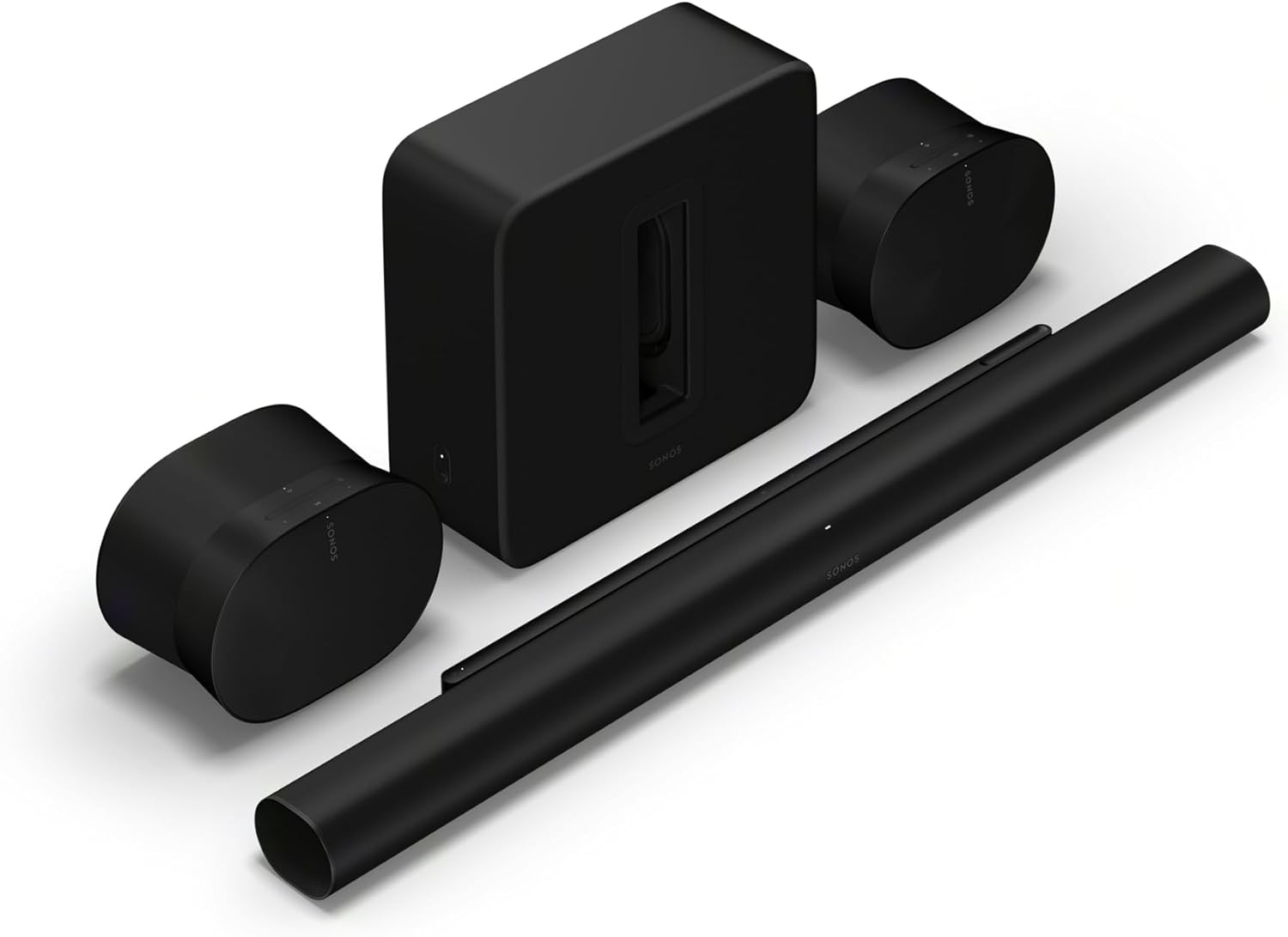
Sonos Ultra Soundbar + Subwoofer Set
Check Price on Amazon2. Best Budget Soundbar System
Not everyone needs — or wants to pay for — a full Atmos rig. This entry-level soundbar and subwoofer combo covers the basics that actually matter: noticeably better dialogue, real bass extension from the wireless sub, and simple Bluetooth pairing for music. It’s the system we point budget-conscious friends toward when they just want their TV to sound like a movie again.
It won’t compete with pricier systems on dynamic range or surround immersion, but for a bedroom, apartment, or secondary TV, it punches well above its price.
If you’re deciding between entry-level bars, it’s worth comparing this one against our Samsung B-Series soundbar review and our Vizio 5.1 Soundbar SE review — both sit in the same price bracket with slightly different strengths.
Who This System Is For
College students, first apartments, guest rooms, or anyone upgrading a secondary TV that doesn’t need the full home-theater treatment. It’s also a smart choice for anyone testing the waters on whether a soundbar upgrade is even worth it before committing to a pricier system.
Real-World Performance Notes
The improvement over built-in TV speakers is immediate and obvious the first time you use it — dialogue stops disappearing under music and effects, and the wireless sub adds genuine low-end weight that TV speakers simply cannot produce. It won’t deliver the precise channel separation of a full surround system, and Bluetooth music playback is serviceable rather than exceptional, but for its price bracket, it consistently over-delivers.
Setup is about as simple as it gets: one cable to the TV, plug in the sub, and most units auto-pair within a minute or two.

Budget Soundbar + Subwoofer Combo
Check Price on Amazon3. Best Home Theater System for Movies
For a dedicated media room, a true 5.1 speaker package still beats a soundbar for one simple reason: physically separate front, center, and rear channels create real directionality that a single bar has to fake. This system pairs a center channel built for dialogue with satellite speakers positioned around the room and a subwoofer that can actually be felt, not just heard.
It takes more effort to install — you’re running speaker wire or committing to speaker placement — but for movie night, the payoff is real. If you’d rather stay in soundbar territory but still want home-theater drama, our Sony HT-S2000 review is a good middle-ground comparison, and our best home theater system under $10,000 roundup covers the higher end of this category in more depth.
Who This System Is For
Anyone with a room they can dedicate, at least partly, to movie watching — a finished basement, a den, or a living room where family members are on board with a few visible speakers. If your household watches a lot of action movies, sports, or anything with a dense sound mix, the difference between this and a soundbar is easy to hear even for people who don’t consider themselves audio enthusiasts.
Real-World Performance Notes
The center channel is doing the heavy lifting for dialogue, and having it as a dedicated speaker rather than a virtual center created by a soundbar’s processing makes a real difference during scenes with a lot of background noise. Rear speakers add a genuine sense of being surrounded rather than just facing a wider soundstage, particularly noticeable during action sequences with vehicles or effects that are supposed to move around the room. The included subwoofer has enough headroom to handle most home theater content without distorting at higher volumes.
The trade-off is installation: this is a run-speaker-wire-or-commit-to-wireless-rear-kit situation, not a plug-and-play soundbar. Budget an afternoon for a clean setup.

5.1 Home Theater Surround System
Check Price on Amazon4. Best Multi-Room Wireless System
This is the pick for people who think about audio the way they think about Wi-Fi — it should just be everywhere. The system syncs multiple wireless speakers across rooms so the same track (or different tracks, room by room) plays without any of the phase or delay issues cheaper multi-room setups run into.
It’s less about home theater bass and more about ambient, all-day sound — mornings in the kitchen, a podcast that follows you into the bathroom, background music on the patio in the evening.
Who This System Is For
Households that think in terms of the whole home rather than one room — people who host, who move between kitchen and living room and outdoor space throughout the day, or who simply want music available without carrying a Bluetooth speaker from room to room. It’s less compelling if you only ever listen to audio in one fixed spot, where a dedicated stereo or soundbar will sound better per dollar.
Real-World Performance Notes
Sync across rooms is tight enough that you can walk between speakers playing the same track without hearing an echo or lag, which is the single most important thing a multi-room system needs to get right. Individual room control through the app is straightforward — different rooms can play different content, or everything can be grouped into one whole-home broadcast with a couple of taps. Sound quality per speaker is good rather than exceptional; the strength of this category is coverage and flexibility, not outright fidelity.

Multi-Room Wireless Speaker System
Check Price on Amazon5. Best Compact Bookshelf System
Small footprint, surprisingly full sound. This powered bookshelf pair is built for desks, small living rooms, or anywhere a full-size floor system would feel like overkill. Because the amplification lives inside the speakers themselves, there’s no separate receiver to find room for — just power and a source.
It’s a great match for streaming music and casual TV use rather than blockbuster movie nights. For a soundbar-style alternative in a similarly compact footprint, our Bose Smart Soundbar review is worth a look.
Who This System Is For
Apartment dwellers, home offices, dorm rooms, or anyone who wants meaningfully better sound than a laptop or a single Bluetooth speaker without dedicating floor space to a full system. It’s an especially good fit for a desk setup where the speakers can flank a monitor at close range.
Real-World Performance Notes
Because the amplifier lives inside one of the speakers, there’s no separate box to find shelf space for — just power and a source cable or Bluetooth connection. At near-field listening distances, the pair produces a fuller, more three-dimensional sound than most people expect from something this compact, with reasonably tight bass for the cabinet size. It’s not going to replace a subwoofer-equipped system for movies, but for music and everyday TV audio in a small room, it’s a clear step up from anything built into a laptop or television.

Compact Powered Bookshelf Speakers
Check Price on Amazon6. Best Turntable Audio System
For anyone who wants their record collection to sound as good as it looks, this system pairs a turntable with powered speakers built to handle a phono signal properly, rather than relying on a receiver you have to buy separately. It’s a genuinely simple way to get into vinyl without piecing together a stereo from three different brands.
Music fidelity is the whole point here — expect a warmer, more detailed sound with records and lossless streaming than a typical soundbar setup will ever deliver.
Who This System Is For
Vinyl collectors, new or returning, who want a setup that just works without researching phono preamps and speaker impedance matching separately. It’s also a good option for someone who wants a stereo system with real character for a study or living room, rather than a home-theater-first setup.
Real-World Performance Notes
Because the speakers are designed specifically to accept a phono-level signal, there’s no need for a separate receiver or preamp — plug the turntable in and the gain staging is already handled correctly, which avoids the thin, quiet sound that happens when a turntable is connected to speakers that expect a stronger line-level signal. Sound character leans warm and detailed rather than aggressive, which suits the kind of unhurried listening vinyl tends to invite. Most models in this category also accept a Bluetooth or aux connection, so digital streaming isn’t an afterthought.

Turntable + Powered Speaker System
Check Price on Amazon7. Best Premium Splurge System
This is the system for the person who’s done compromising. A full multi-channel Atmos-ready setup with high-output amplification, built for a genuinely large room or a dedicated home theater where you want the sound to fill the space, not just fill the couch cushions in front of the TV.
It’s overkill for a small apartment, but in the right room it’s the closest thing to a commercial theater experience you’ll get at home. If this is close to your budget ceiling, our best home theater system under $10,000 guide walks through several systems in this same tier.
Who This System Is For
Buyers with a dedicated home theater room, a genuinely large living space, or an open-plan layout where sound has to travel further before it reaches the seating area. This isn’t the system to buy hoping it will fix a small room’s acoustics — in a modest space, a mid-tier system placed well will often sound better than this one crammed in without room to breathe.
Real-World Performance Notes
Where this system earns its price is headroom — the ability to play at genuinely high, cinema-like volumes without strain, distortion, or the amplifier running out of steam. Channel separation across a full Atmos-style layout is precise enough that individual effects can be tracked moving through the room rather than just generally sensed. It’s the system for buyers who’ve already lived with a mid-tier setup and know specifically what they wish it did better.

Premium Multi-Channel Home Theater System
Check Price on Amazon8. Best for Small Apartments and Studios
Not every space has room for a soundbar the width of a TV stand plus a subwoofer plus a pair of surrounds. This system is built with a smaller footprint in mind — a compact main unit that still manages to deliver clear dialogue and reasonably full sound without dominating a small living room or studio apartment.
It’s a sensible pick if you’ve ruled out full-size soundbar systems purely on space grounds rather than sound-quality grounds, and would rather not compromise on placement just to fit a system designed for a bigger room.

Compact Small-Space Audio System
Check Price on Amazon9. Best for Gaming and Fast-Paced Audio
Gaming places different demands on a sound system than movies — footstep detail and directional cues matter more than dialogue clarity, and low input lag matters more than dynamic range. This system is a solid match for a living room or bedroom setup where gaming is at least as important as watching TV, with punchy, responsive sound that keeps pace with fast on-screen action.

Gaming-Friendly Audio System
Check Price on Amazon10. Best Balanced All-Rounder
Some households genuinely don’t have one dominant use case — movies some nights, music while cooking, background audio for a podcast on a Sunday morning. This system doesn’t specialize hard in any one direction, which is exactly the point: it handles dialogue-heavy TV, music playback, and casual gaming competently without excelling narrowly in just one.
If you’ve read through this whole guide and still aren’t sure which specialized pick fits, a balanced all-rounder like this is a safe default that won’t leave any single use case badly underserved.

Balanced All-Purpose Audio System
Check Price on Amazon11. Best Add-On Satellite Speakers
If you already own a soundbar or receiver and just need a matched or compatible pair of satellite speakers to round out a rear-channel setup, this is a practical, less expensive way to get there instead of replacing an entire system. It’s worth confirming wireless compatibility with your existing hardware before buying, since satellite speakers generally perform best when paired within the same ecosystem.

Add-On Satellite Surround Speakers
Check Price on Amazon12. Best for Outdoor and Patio Listening
Weather-resistant construction and durable materials make this system a better fit for a covered patio, porch, or three-season room than most indoor-focused speakers, which aren’t built to handle humidity or temperature swings. Sound quality is tuned for open-air listening, where bass naturally disperses more than it does indoors, so expect a slightly different tonal balance than an equivalent indoor system.

Outdoor / Patio Audio System
Check Price on Amazon13. Best for Streaming-First Households
Built around Wi-Fi streaming rather than physical inputs, this system is the right pick for a household that’s fully moved to streaming services and rarely, if ever, connects a physical source. Direct app-based control and native support for major streaming platforms means less reliance on Bluetooth pairing and more consistent audio quality overall.

Streaming-First Wireless Audio System
Check Price on Amazon14. Best for Large Open-Concept Living Rooms
Open-concept layouts — where the living room bleeds into a kitchen or dining area with no walls to contain sound — need more raw output and wider dispersion than a typical enclosed room. This system is built with that kind of space in mind, prioritizing coverage and volume headroom so sound reaches every seating area rather than concentrating in one spot near the TV.

Open-Concept Living Room Audio System
Check Price on Amazon15. Best Entry-Level Stereo Pair
For anyone who wants to dip a toe into dedicated stereo listening without committing to a full hi-fi setup, this entry-level speaker pair is an approachable, affordable starting point. It won’t match a dedicated turntable system or premium bookshelf pair on outright fidelity, but it’s a genuine step up from a single Bluetooth speaker or a laptop for anyone building their first real listening setup.

Entry-Level Stereo Speaker Pair
Check Price on AmazonChoosing an Ecosystem You Won’t Outgrow
Beyond the individual product picks, it’s worth thinking about which broader ecosystem you’re buying into, especially if there’s any chance you’ll expand the system later.
Expandable Soundbar Ecosystems
Systems built around a modular soundbar-plus-accessories approach let you start small and add a subwoofer or surround speakers as budget allows, without replacing anything already purchased. This is the most forgiving path for anyone unsure how far they want to go — buy the bar now, decide on the rest later, with everything guaranteed to work together.
Whole-Home Multi-Room Platforms
If the long-term vision is audio in every room, committing early to one multi-room platform pays off, since most of these ecosystems don’t mix cleanly with competitors’ speakers. Buying one room at a time within the same platform is far less frustrating than trying to bridge two different wireless standards together later.
Traditional Receiver-and-Speaker Setups
For hi-fi and turntable-based systems, the traditional approach — a receiver or powered speakers paired with separately chosen components — offers the most long-term flexibility, since components can be swapped individually as needs or budgets change, rather than being locked into one brand’s proprietary ecosystem.
A Note on Longevity and Support
Wireless home audio systems increasingly depend on companion apps and firmware updates to function fully, which means a system’s long-term usability is tied to the manufacturer continuing to support it. Established brands with a track record of multi-year software support are generally a safer long-term bet than newer or lesser-known brands, even if the newer option looks competitive on specs and price today.
It’s a reasonable question to ask directly, even in an Amazon Q&A section: how long has this manufacturer historically supported previous generations of this product line with updates? The answer is rarely printed on the box, but it’s often the single best predictor of how satisfied you’ll be with the system three or four years down the road, long after the initial unboxing excitement has faded.
Keeping Your System Sounding Its Best Over Time
A home audio system is a long-term purchase in most households, often staying in place for five years or more. A few habits keep it performing the way it did on day one.
- Keep firmware updated. Manufacturers regularly release updates that improve calibration algorithms, fix connectivity bugs, and occasionally add new format support.
- Re-run room calibration after rearranging furniture. Moving a couch or adding a rug changes how sound reflects around the room, and most systems’ tuning software can only correct for the room as it existed at the last calibration.
- Dust vents and grilles periodically. Subwoofers and powered speakers rely on airflow to keep amplifiers cool, and dust buildup can quietly shorten component life.
- Avoid running at maximum volume for extended periods. Occasional loud movie scenes are fine; hours of near-maximum output shortens driver lifespan across almost any speaker.
Setup & Placement Tips That Actually Change the Sound
Buying the right system is half the equation — placement does the rest. A few habits make a bigger difference than most people expect:
- Keep the soundbar at ear height when seated, or as close to it as the TV stand allows.
- Don’t push the subwoofer into a corner unless bass sounds boomy — corners reinforce low frequencies, sometimes too much.
- Angle rear surrounds slightly downward if wall-mounted above ear level, so sound isn’t firing over your head.
- Run the room-tuning feature if your system has one — most people skip this step and lose real performance.
For a full walkthrough of cabling, app pairing, and calibration, our dedicated how to set up a home audio system guide covers every step in order.
Common Setup Mistakes Worth Avoiding
A surprising number of home audio complaints trace back to setup, not the equipment itself. Placing a soundbar inside an enclosed TV cabinet muffles sound significantly compared to open-air placement in front of or below the screen. Mounting rear surround speakers too high without angling them downward sends sound over listeners’ heads instead of toward them. And skipping the initial calibration step — whether that’s an app-guided microphone test or a simple manual EQ pass — leaves real performance on the table that the hardware is fully capable of delivering.
It’s also worth checking that your TV’s audio output settings match what the system expects. Many TVs default to a compressed audio format for compatibility, which can quietly cap the dynamic range a capable system is otherwise ready to reproduce. A quick check of the TV’s sound settings menu after connecting a new system is a five-minute step that’s easy to skip and easy to regret.
Home Audio Systems by Budget
Budget shapes this decision more than any spec sheet. Here’s how we’d break it down:
| Budget Tier | What You Get | Where to Look |
|---|---|---|
| Under $500 | Solid soundbar + sub, or entry stereo receiver + bookshelf pair | Best home stereo system under $500 |
| $500–$1,500 | Expandable soundbar ecosystems, better bookshelf/turntable pairings | Picks #1, #5, #6 above |
| $1,500–$10,000 | Full surround, Atmos, premium multi-room | Best home theater system under $10,000 |
It’s worth noting that budget tiers aren’t strictly about better sound as you spend more — they’re about what problem you’re solving. A $400 soundbar solves “the TV is too quiet and muddy.” A $2,000 surround system solves “I want an actual home theater experience.” A $6,000+ premium system solves “I have a large dedicated room and nothing less will fill it properly.” Spending beyond the problem you actually have rarely translates into proportionally better everyday enjoyment.
Buying a Bundled System vs. Building One Piece by Piece
Nearly every pick in this guide is available as a matched bundle — soundbar, sub, and surrounds sold and priced together. It’s worth understanding when that’s genuinely the smarter route and when it isn’t.
When Bundles Make Sense
Bundled systems are engineered and tuned as a single product, meaning the manufacturer has already handled channel balancing, wireless pairing, and tonal matching between components. For most buyers, especially first-time home theater buyers, this removes a lot of guesswork and risk of components that technically connect but never sound quite right together. Bundles are also frequently discounted compared to buying each component separately at full price.
When Piecemeal Buying Makes Sense
Building a system component by component makes more sense for buyers who already know specifically what they want — a particular receiver’s amplifier class, a specific speaker brand’s tonal signature, or a subwoofer sized for a specific room. It also suits gradual upgraders who want to keep existing speakers they already like while swapping out just one weak link, such as replacing an underpowered receiver while keeping speakers that still sound good.
A Middle Path: Start With a Core Bundle, Then Customize
A practical approach for many households is to buy a core bundle for guaranteed compatibility and easy setup, then treat any future component swaps as informed upgrades rather than starting from scratch — for example, keeping a bundled soundbar and subwoofer long-term while eventually swapping to a better-matched turntable or streaming source as those needs evolve.
There’s no wrong answer between these two paths, only a better or worse fit for how much you already know about what you want and how much you enjoy the process of building a system piece by piece versus simply wanting it to work well on the first try.
Matching a System to Real Household Scenarios
Specs and categories only go so far. Here’s how the recommendations above map onto situations real households actually face.
“We just moved into a rental and can’t run any wires.”
Start with an expandable soundbar system. Everything connects wirelessly aside from one HDMI cable to the TV and a power outlet for the sub, which makes it fully rental-friendly and easy to take with you when you move again.
“We have young kids and can’t have loose cables or delicate speakers around.”
A soundbar-and-sub combo again wins here — fewer components, no floor-standing speakers to knock over, and typically simpler, kid-proof placement below or above the TV, out of easy reach.
“We host often and want music in the kitchen, living room, and backyard.”
This is the exact scenario a multi-room wireless system is built for. Committing to one ecosystem across all three spaces means guests hear consistent, synced audio no matter which room they’re in.
“We have a finished basement we use almost exclusively for movie nights.”
This is where a dedicated 5.1 or premium multi-channel system earns its cost. A basement is often already a controlled, dedicated space, exactly the environment where true surround separation and higher volume headroom deliver a noticeably better experience than in a shared, multi-purpose living room.
“We inherited a record collection and want to actually enjoy it.”
A turntable-and-powered-speaker system removes the guesswork of matching a turntable to a receiver and speakers separately, and gets a satisfying, warm sound from vinyl without a steep learning curve.
“We work from home and want better sound at a desk without clutter.”
A compact powered bookshelf pair fits this better than either a soundbar or a full system — enough sound quality improvement to matter for music and video calls, without dedicating real estate to a subwoofer or extra speakers.
“We already have a soundbar and just want better bass.”
Check whether your current soundbar supports an add-on subwoofer from the same manufacturer before replacing the whole system — many expandable ecosystems sell the subwoofer as a standalone accessory specifically for this situation, which is almost always cheaper and less disruptive than replacing a soundbar you’re otherwise happy with.
Final Verdict: Which System Is Right for You?
If you want one answer without overthinking it, the Sonos Ultra soundbar set is the safest, most satisfying upgrade for most living rooms — it scales from “just the bar” to a full Atmos setup as your budget allows. If you’re working with a tighter budget, the entry-level soundbar combo covers the essentials without the premium price tag. And if movies aren’t the priority — music is — the turntable system or compact bookshelf pair will serve you better than any soundbar ever will.
Whichever direction you go, the system that gets used every day beats the system that impressed you in a showroom. Buy for the room you actually have, not the one you wish you had.
One more thing worth remembering: almost every system on this list sounds meaningfully better with ten minutes of thoughtful placement and calibration than an expensive system does when it’s shoved in a corner and never tuned. If you’re only going to do one thing after unboxing whatever you choose, run the setup and calibration step before judging the sound. It’s the single highest-return five minutes in the entire process.
Frequently Asked Questions
What’s the difference between a soundbar and a full home audio system?
A soundbar is a single speaker, sometimes paired with a wireless subwoofer, designed to be an easy, low-effort upgrade over built-in TV speakers. A full home audio system uses physically separate front, center, and rear speakers, which allows sound designers’ directional effects to actually come from the direction they’re meant to, rather than being simulated by a single bar’s internal processing. The trade-off is installation effort and, usually, a higher price, in exchange for noticeably more immersive movie and music playback.
Do I need Dolby Atmos for a good home theater experience?
No — plenty of excellent-sounding systems don’t support Atmos and still deliver satisfying movie and music playback. But for anyone who watches a lot of Atmos-mixed content, which is now common on major streaming platforms, the added sense of height and overhead movement is a genuinely noticeable upgrade rather than a marketing gimmick. Think of it as a meaningful bonus to look for within your budget, not a feature to stretch your budget uncomfortably to reach.
How much should I spend on a home audio system?
For most living rooms, somewhere between $300 and $800 covers a genuinely satisfying soundbar-and-subwoofer setup that solves the “TV sounds thin and muddy” problem completely. Dedicated home theater rooms, where movie and music playback is a real priority rather than a background feature, often justify spending $1,500 or more to get real surround separation and headroom. Above that tier, spending buys you diminishing but real improvements in dynamics, build quality, and long-term flexibility rather than a dramatically different core experience.
Can I add surround speakers later instead of buying everything at once?
With expandable ecosystems, yes — many soundbar systems are specifically designed to let you start with just the bar and add a matching subwoofer or rear surround speakers whenever your budget allows, without needing to replace what you already own. This is one of the most practical ways to spread out a home theater upgrade over time instead of committing to the full price on day one. Just confirm before buying that the specific bar you’re considering supports this kind of modular expansion, since not every budget model does.
Is a wireless subwoofer as good as a wired one?
For nearly all home use cases, yes. Modern wireless subwoofers use dedicated, interference-resistant connections rather than general Bluetooth, so dropouts and lag are rarely an issue in practice. The real advantage is placement flexibility — a wireless sub can go wherever it sounds best in the room rather than wherever a cable happens to reach, which often means better bass response for the same equipment simply because it’s easier to position correctly.
What size room does a 5.1 system need?
5.1 systems generally perform best in rooms roughly 150 to 400 square feet, where rear speakers can be placed behind or beside the main seating area without being awkwardly close or requiring impractically long wire or wireless runs. In smaller rooms, the benefit of true rear channels shrinks because listeners sit close enough to the front speakers that directional cues matter less. In much larger or open-plan spaces, you may need higher-output speakers or an additional subwoofer to fill the space evenly.
Do multi-room systems work with existing speakers I already own?
Some multi-room ecosystems allow you to integrate existing wired speakers through a dedicated amplifier component, effectively bringing an older passive speaker into the wireless system. That said, most multi-room platforms are tuned and optimized around their own matched speakers, so performance and setup simplicity are generally best when you stick within one ecosystem’s own product line rather than mixing brands.
Is a turntable system worth it if I mostly stream music?
Yes, as long as the powered speakers you choose support Bluetooth or Wi-Fi streaming in addition to the turntable’s phono input. That combination gives you a single system that handles both vinyl and everyday digital streaming well, rather than needing separate speakers for each source. It’s a more space- and cost-efficient setup than buying a dedicated turntable rig and a separate streaming speaker.
How do I reduce echo or boomy bass in a small room?
Start by running the system’s built-in room-tuning or calibration feature if it has one, since this alone resolves a large share of boomy-bass complaints. Beyond that, avoid placing the subwoofer directly in a room corner, which acoustically reinforces bass frequencies and can push already-strong low end into boomy, one-note territory. Soft furnishings like rugs, curtains, and upholstered furniture also help tame excessive reflections in small, hard-surfaced rooms.
Should I choose a soundbar or bookshelf speakers for a bedroom?
If the TV is the primary use case in the bedroom, a soundbar is the simpler, more purpose-built choice, since it’s designed specifically to pair with a screen and handle movie and show dialogue well. If music listening matters as much as or more than TV audio in that room, a compact powered bookshelf pair generally delivers richer, more balanced sound for music specifically, at the cost of being slightly less optimized for dialogue-heavy TV content.
Will a home audio system work with any TV brand?
Almost universally, yes, as long as the TV has at least an optical audio output or, ideally, an HDMI eARC port, both of which are standard on the vast majority of TVs sold in recent years. The one thing worth double-checking is whether your TV’s remote or CEC (Consumer Electronics Control) feature can control the soundbar’s volume directly, which some systems support out of the box and others require a brief pairing step to enable.
How long does a typical home audio system last before needing replacement?
With reasonable care, most systems remain fully functional for five to ten years, with the amplifier and drivers themselves rarely being the limiting factor. The more common reason people replace a system earlier is feature obsolescence — wanting Atmos support, better streaming integration, or a currently-supported companion app — rather than the hardware actually failing.
Accessibility and Everyday Comfort Features
A few features worth checking for, especially in multi-person households with different hearing needs or viewing habits.
Dialogue Enhancement Modes
Many current systems include a dedicated dialogue boost or “voice” mode that raises the frequency range where speech sits without simply raising overall volume. This is genuinely useful for anyone who finds movie dialogue harder to follow under music and effects, and it’s worth testing during a return window if it’s a priority for your household.
Night Mode / Dynamic Range Compression
Night listening modes narrow the gap between the quietest and loudest moments in a soundtrack, so dialogue stays audible without explosions needing to be uncomfortably loud to compensate. It’s a small feature that matters a lot for late-night viewing in shared living spaces or apartments with thin walls.
Standby Power Use
Always-on wireless systems draw a small amount of power even in standby to stay ready for voice commands or instant wake, which adds up modestly over a year but is rarely significant enough to change a buying decision. If minimizing standby power draw matters to you, look specifically for an eco or low-power standby mode in the system’s settings, which most current systems include.
Warranty, Returns, and Buying With Confidence
Home audio purchases in this price range are worth protecting with a bit of due diligence before you buy, not just after something goes wrong.
Check the Return Window Before Unboxing Everything
Sound is subjective enough that what looks great on paper doesn’t always match your room or your ears once it’s set up. Most retailers offer a 30-day return window on electronics, but that clock typically starts at delivery, not at whatever day you finally get around to setting the system up. If you know you won’t unbox and test a system immediately, factor that into your buying timeline.
Manufacturer Warranty Lengths Vary More Than You’d Expect
Standard warranty coverage on home audio equipment typically runs one year, though some manufacturers extend coverage to two years on premium products, and subwoofers in particular sometimes carry a separate, shorter warranty than the rest of the system due to how hard their internal amplifiers work. It’s worth checking this per product rather than assuming every component in a bundled system is covered identically.
Registering Your System
Registering a new system with the manufacturer, even when not strictly required, often unlocks faster support response times and ensures you’re notified promptly about firmware updates or, in rare cases, safety recalls. It takes a few minutes during initial app setup and is easy to skip, but worth doing.
Buying Open-Box or Refurbished
Certified refurbished units from reputable sellers can be a smart way to access a pricier system at a meaningfully lower cost, typically with a shorter but still real warranty period. Just confirm the listing explicitly states “manufacturer certified” or similar, since uncertified open-box listings carry more risk around missing accessories or undisclosed wear.
Where Home Audio Is Heading
A few shifts in the category are worth knowing about, even if they don’t change what to buy today.
Voice and AI-Assisted Tuning
Room calibration used to require a dedicated microphone accessory and a fairly technical setup process. Increasingly, systems handle this through the same microphones used for voice assistants or through a smartphone’s built-in microphone, walking users through a simple guided process instead of a specialist step. This has made genuinely good room tuning accessible to far more buyers than it used to be.
Wireless Is Steadily Replacing Wired, Even at the High End
Wireless rear-channel and subwoofer connections were once considered a compromise reserved for budget systems, with serious home theater setups expected to run speaker wire throughout. That distinction has largely faded — even premium systems increasingly default to wireless connections for anything other than the main front speakers, reflecting how much wireless audio reliability has improved.
Software-Defined Sound Profiles
More systems now offer selectable sound profiles — a “movie” mode that emphasizes dialogue and impact, a “music” mode with flatter, more neutral tuning, and sometimes a “night” mode that compresses dynamic range so quiet dialogue and loud effects sit closer together in volume for late-night viewing without waking the household. These software profiles add real everyday flexibility that used to require physically different equipment to achieve.
Longer Software Support Windows
As more of a system’s actual performance depends on software rather than fixed hardware, manufacturers have started committing to longer explicit software support windows, similar to how smartphones are marketed. It’s a trend worth watching for and, when available, factoring into a purchase decision alongside the usual specs.
Ready to Upgrade Your Sound?
A better home audio system is one of the fastest ways to change how a room feels — movies hit harder, music fills the space properly, and you stop reaching for the volume button hoping for a miracle. Start with the pick that matches your room and budget above, and if you haven’t set one up before, our step-by-step setup guide will walk you through the rest. However you decide, the difference between the room you have now and the room you’ll have with a properly matched, properly placed system is bigger than most people expect until they hear it for themselves.
Shop the Top Pick on Amazon
Pingback: What Does Dolby Atmos Mean? Full Explainer