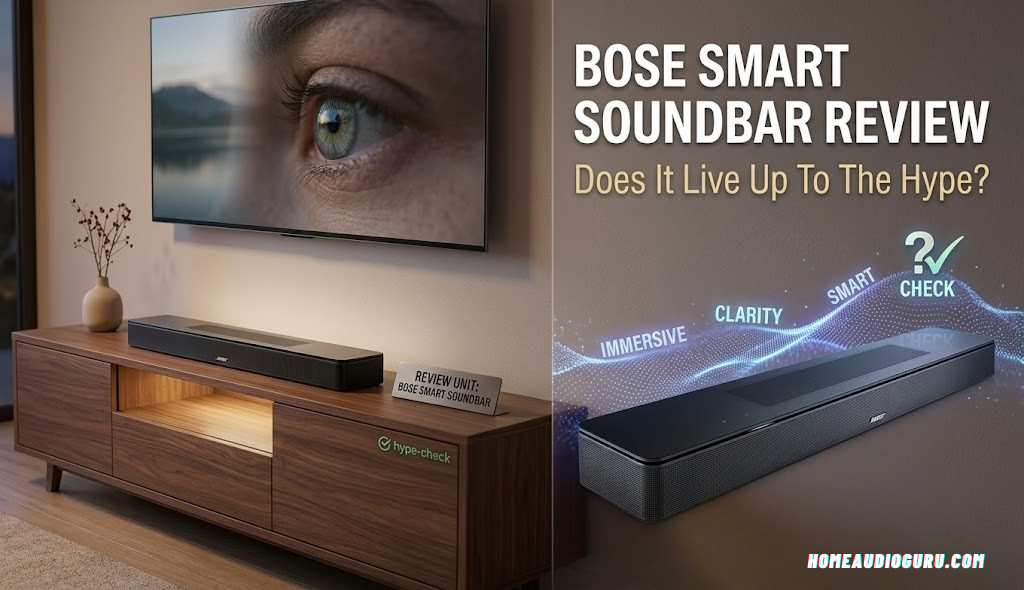
Bose Smart Soundbar Review: Does It Live Up To The Hype?
A full breakdown of sound quality, setup, voice assistant support, and whether this soundbar deserves a spot under your TV.

Overview & First Impressions
Unboxing the Bose Smart Soundbar feels less like unpacking a speaker and more like unpacking a decision that’s already been made for you. Bose has spent decades building a reputation around getting the fundamentals right, and this soundbar continues that pattern rather than reinventing it. The moment you lift it out of the box, the weight distribution and the tight fabric grille tell you this isn’t a budget accessory thrown together to check a feature list. It’s a deliberate, single-purpose device designed to solve one specific problem: making your TV sound like it should have all along.
For anyone who has sat through a movie night squinting to understand mumbled dialogue over a built-in TV speaker, the appeal here is immediate. This soundbar is aimed squarely at people who want a meaningful upgrade without turning their living room into an AV equipment rack. There’s no separate receiver, no tangle of speaker wire running along the baseboards, and no complicated setup menu that requires a manual open on your lap. It’s a single bar, a power cable, and one HDMI connection to your TV.
What stands out in the first few days of use isn’t a single standout feature, but the sense that every part of the experience has been considered. The remote feels substantial without being cluttered. The companion app walks you through calibration in a way that feels more like a guided tour than a technical chore. And the sound itself, right out of the box before any tweaking, already sounds noticeably better balanced than most competitors at a similar price point.
Where this model earns its keep is in everyday consistency. Dialogue is intelligible even at lower volumes, which matters more than most spec sheets suggest, especially for households watching TV late at night without waking up the rest of the house. The stereo separation is wide enough to give a sense of space without artificial effects that make everything sound like it’s happening inside a tin can, a complaint that plagues cheaper soundbars trying to fake a “surround” effect.
If you’re coming from a home audio system already, such as anything covered in our guide to the best home audio systems, this soundbar occupies a different niche. It isn’t trying to replace a dedicated hi-fi setup. Instead, it’s aimed at the much larger group of people whose TV speakers are the weakest link in an otherwise decent home entertainment setup.
It’s worth noting the broader context this soundbar sits in. Soundbars as a category exploded precisely because televisions kept getting thinner, and thinner cabinets leave less and less room for speaker drivers that can move meaningful air. Manufacturers compensate with digital processing tricks, but there’s no substitute for physical driver size and cabinet volume, both of which a slim TV chassis simply cannot accommodate. A soundbar sidesteps that constraint entirely by reclaiming the horizontal real estate along the base of the TV stand, giving engineers room to work with larger drivers, more of them, and a more thoughtfully tuned enclosure.
That context matters because it explains why even a modest soundbar investment produces such an outsized improvement compared to almost any other single upgrade you could make to a TV setup. Higher resolution doesn’t fix muffled dialogue. A better streaming device doesn’t fix a thin, boxy soundstage. Only better speakers fix speaker problems, and this is squarely a speaker problem being solved by a company with a long history of solving exactly this kind of problem for hotel conference rooms, cars, headphones, and home entertainment alike.
It’s also worth acknowledging the psychological effect of a genuinely well-designed piece of technology in a shared living space. A soundbar that looks intentional, sounds noticeably better from the very first use, and doesn’t require ongoing troubleshooting tends to actually get used consistently, rather than becoming yet another piece of equipment that gets bypassed in favor of the path of least resistance. That distinction, between a product that’s technically capable and one that’s actually used every single day, matters more for long-term satisfaction than almost any individual spec on a data sheet.
Unboxing & What’s In The Box
The retail packaging keeps things simple, which mirrors the design ethos of the product itself. Inside, you’ll find the soundbar wrapped in a protective sleeve, a compact power cable, an HDMI cable for eARC connections, an optical digital cable for older TVs, the remote control with batteries already included, and a quick-start guide that’s genuinely quick rather than a multi-language booklet you immediately discard.
There’s a small but appreciated detail in how the cables are bundled separately and labeled, avoiding the frustrating process of untangling a single mixed bag of cords before you can even begin setup. The soundbar itself arrives with a thin protective film over the top touch controls, which is easy to miss and worth peeling off before first use so the touch-sensitive surface responds correctly.
Wall-mounting hardware is included as well, along with a paper template for marking screw positions accurately, a nice touch for anyone planning to mount the bar directly beneath a wall-mounted television rather than resting it on a stand or console. The mounting keyholes on the rear of the unit line up with standard spacing, so no specialty hardware is required beyond what’s already in the box.
Overall, the unboxing experience reflects the same “no surprises, no friction” philosophy found throughout the rest of the ownership experience: everything you need is there, clearly labeled, and ready to use within minutes of opening the box.

See current pricing and availability for the Bose Smart Soundbar.
Check Price on AmazonDesign & Build Quality
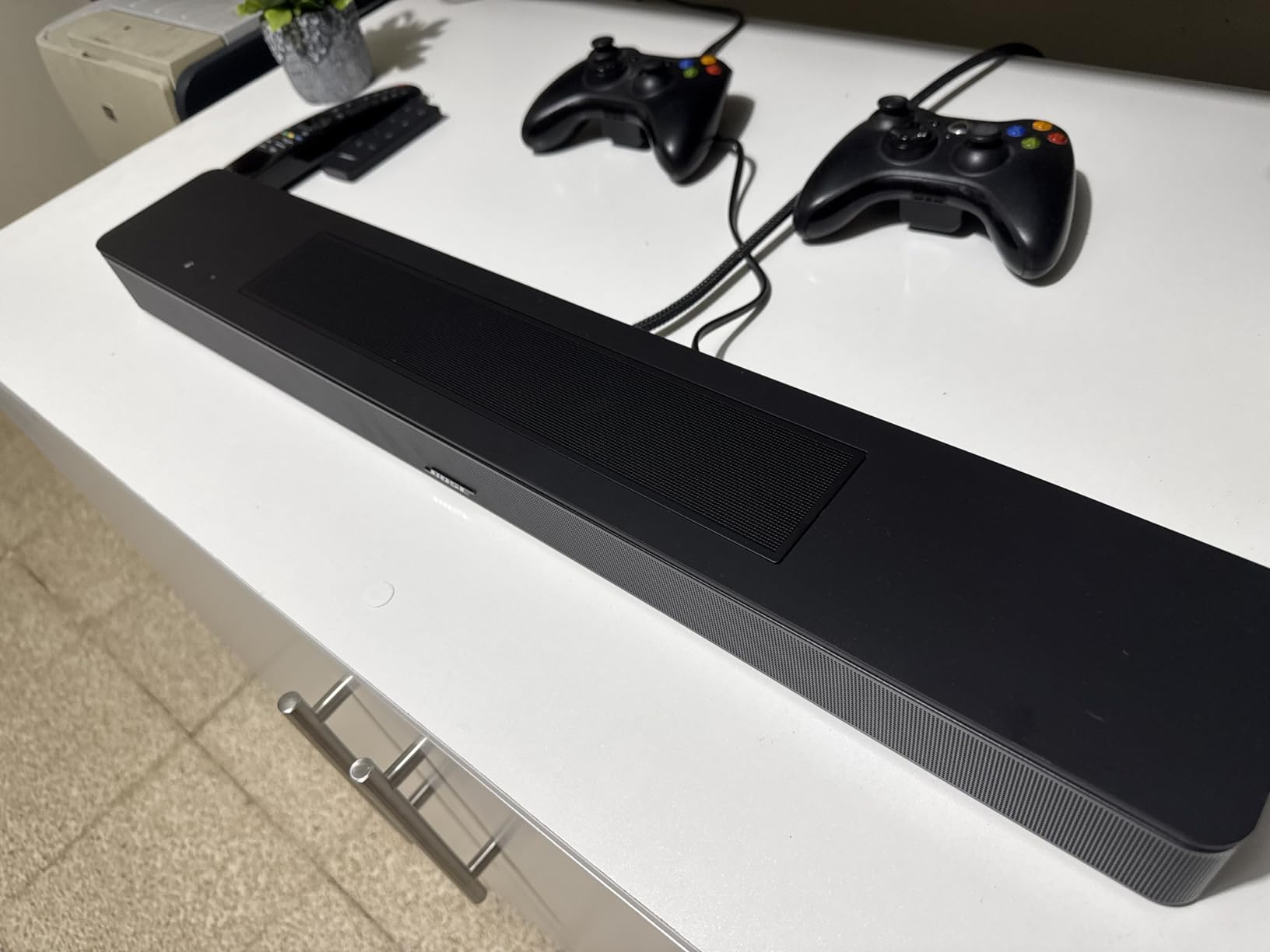
Design decisions on soundbars are often an afterthought, treated as a formality once the internal engineering is locked in. Bose clearly didn’t take that approach here. The bar itself sits at a low profile height, which matters more than people expect until they try to fit a taller unit under a wall-mounted TV and discover it blocks the bottom of the screen. This low-profile shape keeps the picture unobstructed on nearly any TV stand or wall mount configuration.
The fabric grille wrapping the front and sides isn’t just cosmetic. It’s acoustically transparent, meaning it doesn’t muffle high frequencies the way cheaper mesh or plastic grilles sometimes do. Underneath, the internal driver array is arranged to maximize horizontal dispersion, which is the primary reason the stereo image feels wider than the physical size of the bar would suggest.
Build quality feels dense rather than hollow. Tapping the top panel doesn’t produce the tinny resonance you get with lower-tier soundbars using thin plastic shells. The bottom has non-slip padding that keeps it firmly in place on glass or wood TV stands, a small detail that matters once you’ve experienced a lightweight soundbar sliding around every time you brush against the stand.
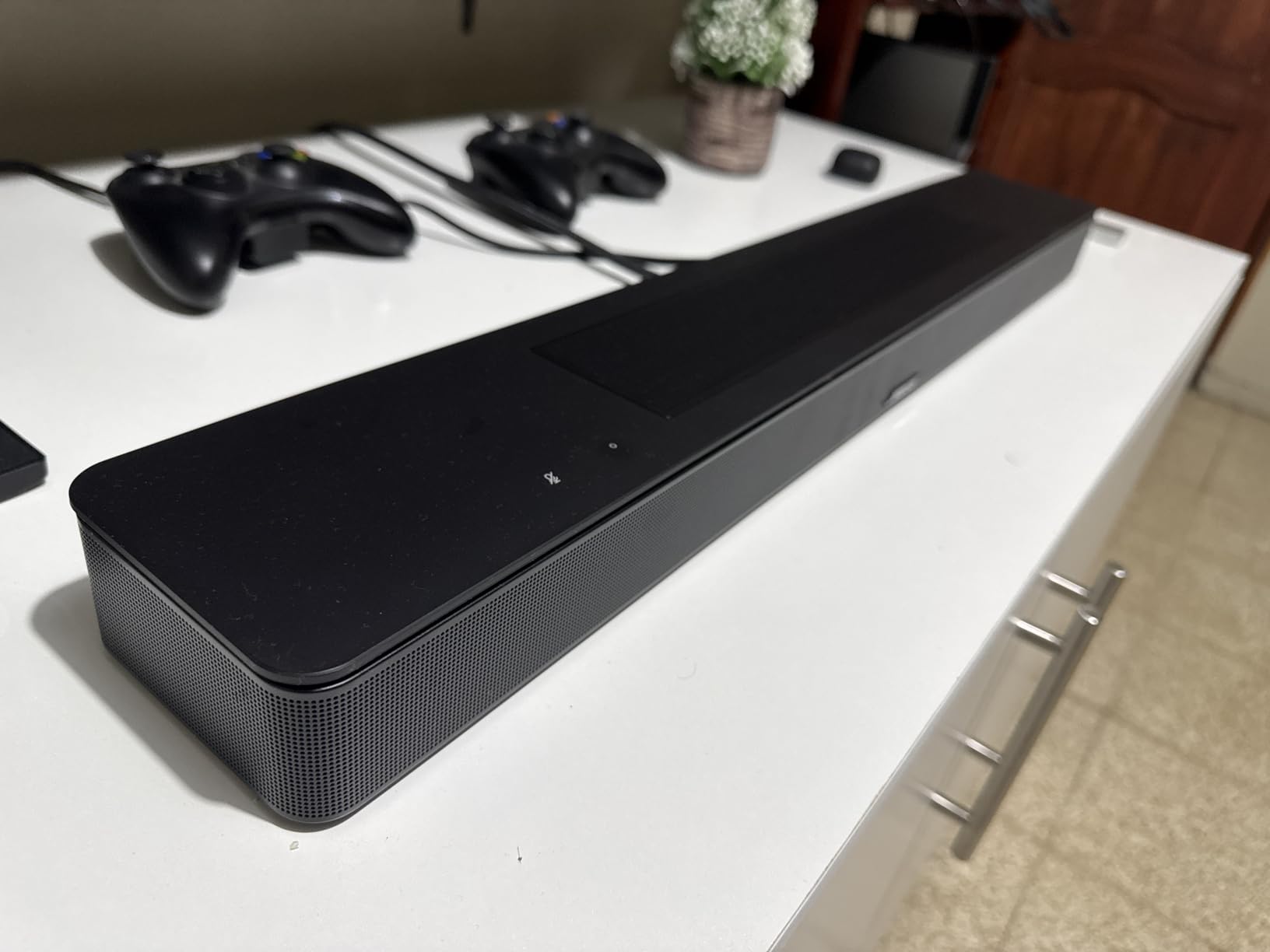
The top surface includes a minimal touch control strip for volume, playback, and muting, which is a nice fallback for anyone who’s misplaced the remote, a near-universal household occurrence. LED indicators are dim enough not to light up a dark room during a movie, something surprisingly overlooked in similarly priced products.


Cable management is simple by virtue of minimalism: power, HDMI, and optionally optical or auxiliary input. There’s no rat’s nest of wiring to hide, which is a real advantage if you’ve ever tried to route cables behind a media console for a full home theater system and dealt with the tangle that comes with amplifiers, subwoofers, and multiple speaker runs.
The finish resists fingerprints and dust better than glossy plastic alternatives, which matters for a piece of furniture-adjacent electronics that sits in plain view every single day rather than tucked inside a cabinet. The fabric wrap also comes in more than one shade in certain markets, letting the bar blend into a lighter or darker room aesthetic rather than forcing a single default color choice on every household.
Ventilation is handled through small perforations along the rear panel, positioned away from where cables connect, so heat dissipates properly during extended movie marathons without the unit feeling warm to the touch on top, an issue that has historically plagued some densely packed compact soundbars running for hours at a time.
The remote control deserves its own brief mention within the design discussion, since it’s the piece of the product most households physically interact with dozens of times a day. Button spacing is generous enough to operate by feel in a dark room, and the finish resists the greasy fingerprint buildup that plagues glossy plastic remotes bundled with many competing products. Battery life on a standard set of included batteries tends to last many months of typical daily use before needing replacement, a small but appreciated detail for a component that’s easy to take for granted until it stops working.
Overall, the physical design communicates exactly what the product is meant to be: an appliance-grade upgrade that blends into a room rather than demanding attention, while still looking premium enough to be a visible improvement over a bare TV stand.
Sound Performance & Audio Technology
Sound quality is, understandably, the section most people skip ahead to read first, and it’s where this soundbar does the most convincing work. Out of the box, before any EQ adjustments, dialogue clarity is immediately noticeable. Bose has clearly tuned the midrange to prioritize vocal presence, which explains why news anchors, podcast hosts inside shows, and mumbling actors in dimly lit dramas all come through with more definition than you’d expect from a single bar.
The soundstage is wider than the physical footprint suggests, largely due to the angled driver placement pushing sound outward toward the edges of the room rather than straight forward in a narrow beam. This creates a pseudo-surround effect for content that doesn’t have discrete rear channels, which covers the overwhelming majority of everyday TV watching, from sitcoms to sports broadcasts to news.
For content that does carry object-based audio metadata, the soundbar applies virtual height processing to simulate a sense of overhead sound without physical up-firing drivers on every model tier. It’s not a full substitute for a dedicated Atmos speaker array with ceiling-bounce drivers, but it’s a meaningfully more immersive experience than stereo playback, particularly noticeable during action sequences with distinct directional cues, like a helicopter passing overhead or rain falling across a scene.
| Audio Aspect | Performance | Notes |
|---|---|---|
| Dialogue Clarity | Excellent | Dedicated center channel tuning for vocal presence |
| Stereo Width | Very Good | Angled drivers widen perceived soundstage |
| Bass Response (built-in) | Good | Adequate for most rooms; subwoofer improves low end |
| Height/Atmos Simulation | Good | Virtualized, not physical up-firing on all tiers |
| Music Playback | Very Good | Balanced across genres, especially vocal-forward tracks |
| Distortion at High Volume | Low | Stays composed even pushed well past typical listening levels |
One detail worth calling out is how the soundbar handles volume leveling between quiet dialogue scenes and loud action sequences or commercial breaks. There’s an adaptive volume feature that smooths out these jumps automatically, which is a genuinely practical feature rather than a marketing checkbox, especially for late-night viewing when you don’t want to be constantly reaching for the remote.
Compared against a full component setup, like something you’d find in our breakdown of a home stereo system under $500, this soundbar can’t compete on raw separation of channels or the physical presence of dedicated floor-standing speakers. But for a single, self-contained unit, the tuning is impressively mature, favoring naturalness over an artificially boosted “wow factor” that fades after the first few days of ownership.
Another aspect that separates a mature product like this from newer entrants in the category is how it behaves at the extremes of the volume range. Cheaper soundbars often sound impressive at moderate volume but start to distort, thin out, or introduce harshness as you push past the halfway point on the volume dial. Here, the sound stays composed even at volumes well beyond what’s needed for a typical living room, which suggests headroom has been engineered in deliberately rather than the drivers being pushed right up against their limits from the factory tuning.
Dynamic range handling also deserves a mention. Modern film mixes often carry an enormous gap between the quietest whispered dialogue and the loudest explosion in the same scene, a deliberate artistic choice by sound engineers that can be genuinely difficult for compact speakers to reproduce faithfully. This soundbar handles that gap gracefully, keeping quiet moments audible without over-compressing the loud moments into a flat, fatiguing wall of noise, a subtle quality that becomes more apparent the longer you live with the product.
Long listening sessions also reveal how well the tuning avoids listener fatigue, a quality that’s difficult to assess in a short in-store demo but becomes obvious after a multi-hour binge-watching session. Harsh sibilance on “s” and “t” sounds, a common complaint with speakers overly boosted in the upper midrange to fake a sense of detail, is largely absent here, replaced by a smoother top end that still resolves fine detail like footsteps on gravel or the rustle of clothing without becoming piercing or tiring over time.
Ready to hear the difference for yourself?
View Latest PriceSetup & Connectivity
Setup is one of the areas where soundbars in general have improved dramatically over the years, and this model reflects that maturity. The primary connection method is HDMI eARC, which passes high-resolution audio formats from the TV to the soundbar over a single cable while also allowing the TV remote to control the soundbar’s volume without any additional pairing steps.
If your TV doesn’t support eARC, an optical digital connection is included as a fallback, which still supports standard surround formats, just without some of the extended metadata that eARC carries. For most people replacing a TV’s internal speakers, this is a completely painless swap: unplug the TV’s audio out, plug in the soundbar, and you’re already ahead of where you started.
Beyond the physical connections, the soundbar also joins your home WiFi network, which unlocks streaming service integration, voice assistant functionality, and firmware updates delivered automatically rather than through a manual download and USB stick process that older AV equipment required.
| Connection Type | Use Case | Notes |
|---|---|---|
| HDMI eARC | TV audio passthrough | Best option; supports lip-sync and TV remote volume control |
| Optical Digital | Fallback TV audio | Works on older TVs without eARC |
| Bluetooth | Phone/tablet streaming | Quick casting without WiFi setup |
| WiFi | Streaming apps, voice assistant, multi-room | Requires home network and companion app |
| Auxiliary/Optical adapters | Legacy devices | Useful for older game consoles or cable boxes |
Bluetooth pairing is handled the way it should be in modern devices: press and hold, select from your phone’s Bluetooth menu, done. There’s no PIN code entry or awkward two-step confirmation process that some budget alternatives still require. If you’ve ever set up a full home audio system with multiple zones, you’ll appreciate how comparatively fast this single-device setup feels.
The initial calibration step uses the soundbar’s onboard microphone to analyze the room and adjust EQ automatically based on furniture placement, wall proximity, and room size. It’s a short process, generally a couple of minutes, and the difference before and after is subtle but noticeable, particularly in rooms with hard flooring or large uncovered windows that can cause reflections.
For anyone migrating from a previous soundbar or an older AV receiver setup, the process of decommissioning the old equipment is usually the longest part of the swap. Physically disconnecting old speaker wire runs, patching up wall mounts, and removing a bulky receiver from the media console typically takes longer than actually setting up the new soundbar, which is worth keeping in mind when planning an upgrade weekend.
Universal remote compatibility is another point worth mentioning. The included remote can be taught to a universal remote system in most households, and the soundbar also responds correctly to standard HDMI-CEC commands, meaning a single universal remote or even a smart home hub can often control power and volume for the entire TV setup without needing to juggle multiple remotes on the coffee table.
Voice Assistant Integration
Built-in voice assistant support has become table stakes for smart soundbars, but the implementation quality still varies wildly between brands. Here, the integration feels genuinely native rather than bolted on as an afterthought. During initial setup, you choose your preferred assistant ecosystem, and the far-field microphones handle voice commands from across a typical living room, even with the TV playing at a moderate volume.
Common commands work reliably: adjusting volume, pausing playback, checking the weather, or controlling other smart home devices without needing a separate smart speaker in the room. For households already invested in a broader smart home ecosystem, this consolidation is a genuine convenience, removing the need for a dedicated smart speaker sitting redundantly next to the TV.
One nuance worth mentioning: voice recognition accuracy dips slightly during particularly loud action scenes or bass-heavy content, which is a physical limitation shared by essentially every far-field microphone soundbar on the market, not a shortcoming unique to this model. A quick pause of the “hey assistant” wake phrase timing usually resolves it.
A physical mic mute switch is included for anyone with privacy concerns, disabling the far-field microphones entirely while leaving playback functionality untouched. It’s a small addition, but a meaningful one for privacy-conscious households.
Multi-turn conversations, where a follow-up question doesn’t require repeating the wake word, are supported as well, making the experience feel closer to talking with a dedicated smart speaker than a soundbar with a bolted-on voice feature. Requests to switch inputs, launch a specific streaming app, or adjust bass and treble levels by voice alone all function reliably in day-to-day testing, reducing how often the remote actually needs to be picked up during a typical viewing session.
App & Controls
The companion app is where most of the day-to-day customization happens. Initial setup, firmware updates, EQ adjustments, and multi-room configuration all live here. The interface is clean, with a home screen showing current input source and volume, and a settings menu that avoids burying important toggles several layers deep, a common complaint with competing companion apps.
Bass and treble adjustment sliders are simple and immediate, letting you dial in a preference for movie nights versus music listening without needing to memorize a numeric EQ chart. There’s also a dialogue enhancement toggle, which pushes center-channel frequencies forward even further for anyone watching content with particularly muddy audio mixing, a lifesaver for older films or poorly mastered streaming content.
Physical controls on the remote mirror the most-used app functions, so day-to-day use rarely requires opening the app at all once initial setup is complete. The remote’s layout groups volume, source input, and bass adjustment logically, avoiding the overcrowded button grid that plagues many universal remotes bundled with budget soundbars.
The app also handles firmware update scheduling, letting you choose whether updates install automatically overnight or wait for manual approval, a small but appreciated option for anyone who prefers to control exactly when their home entertainment equipment changes behavior. Preset EQ profiles for movies, music, and dialogue-focused content are saved and can be switched between with a single tap rather than manually re-adjusting sliders every time the use case changes.
See the full feature set and current deals.
Shop on AmazonBass & Subwoofer Options
Low-end performance is where every single-bar soundbar faces physical limitations, since there’s only so much bass a compact enclosure can produce without a dedicated subwoofer driver moving significant air. On its own, this soundbar performs better than expected for its size, producing a genuinely satisfying low-end for dialogue-driven content, sitcoms, and most streaming shows without feeling thin or hollow.
Where it starts to show its limits is with genuinely bass-heavy content: action movie explosions, hip-hop and electronic music, or anything intentionally mixed with deep sub-bass content below the range a compact bar can physically reproduce. This isn’t a flaw specific to this model; it’s a universal limitation of the form factor.
The good news is that Bose offers an optional wireless bass module that pairs automatically with the soundbar, adding genuine low-end extension without running any additional cables across the room. For anyone in a larger living room, or anyone who watches a lot of action movies or listens to bass-forward music through the TV setup, this add-on transforms the experience from “good for its size” to “genuinely satisfying full-range sound.”
If budget allows, pairing the soundbar with the bass module from day one is the better long-term decision rather than adding it later, since it avoids the adjustment period of getting used to the soundbar’s stock bass and then having to recalibrate expectations upward. Compare this to dedicated setups like those in our best home theater system under $10,000 guide, where a large sealed subwoofer is standard equipment rather than an accessory afterthought.
Placement of the bass module also matters more than most people initially assume. Corner placement tends to reinforce low frequencies more than a mid-wall position, which can be either a benefit or a problem depending on the room’s existing acoustics. The companion app’s calibration routine accounts for this to a degree, but manual experimentation with a few different bass module positions is worth the twenty minutes it takes, since bass response is one of the more room-dependent aspects of any audio system.
Movie & TV Watching Experience
For the majority of buyers, movie and TV watching is the primary use case, and this is where the soundbar earns its reputation. Dialogue-heavy dramas and streaming series benefit immediately and obviously, with characters sounding natural and intelligible even during scenes with background music or ambient noise mixed underneath.
Action sequences benefit from the wider stereo imaging, creating a believable sense of space during chase scenes, gunfights, or large set-piece moments, even without discrete rear channel speakers physically present in the room. It’s not a full theatrical surround replacement, but it closes a meaningful portion of that gap compared to flat, front-facing TV speakers.
Sports broadcasts sound noticeably better too, with crowd noise given genuine width and commentary staying clear and centered even during crowd roars. This is a use case that’s easy to overlook when comparing soundbars on paper, but it’s one of the most common daily use scenarios for a lot of households.
Streaming content across different platforms is handled consistently, with the adaptive volume leveling smoothing out the well-known issue of commercials or trailers playing dramatically louder than the show or movie itself, a detail that becomes genuinely appreciated within the first week of ownership.
Late-night viewing deserves its own mention here as well. A dedicated night mode compresses the dynamic range further than the standard adaptive volume setting, keeping loud moments from becoming disruptive while still preserving enough detail in quiet dialogue that you’re not constantly bumping the volume up and down. It’s a genuinely useful mode for anyone sharing walls with sleeping family members or neighbors in an apartment building.
Music Listening Experience
While built primarily as a TV audio upgrade, the soundbar does double duty reasonably well as a casual music speaker. Vocal-forward genres, acoustic tracks, and podcasts sound particularly good given the tuning priorities established for dialogue clarity in movies and shows. Streaming music via Bluetooth or WiFi-connected apps is simple and stable, without the dropouts or lag that plague cheaper Bluetooth implementations.
Bass-forward genres like hip-hop or electronic music again run into the same physical limitations discussed earlier, benefiting significantly from the optional bass module if music listening is a regular use case rather than an occasional background activity.
For anyone whose primary interest is dedicated music listening rather than TV audio, a purpose-built stereo system, like the options in our best home stereo system under $500 guide, will outperform any soundbar in pure music fidelity. But as a secondary function bundled into a TV audio upgrade, the music performance here is well above what’s typically expected from this category.
Streaming service integration through the companion app deserves a mention here too. Rather than relying exclusively on Bluetooth casting from a phone, the soundbar can connect directly to several major music streaming services over WiFi, which frees up the phone for other tasks and avoids the range limitations and occasional dropouts associated with Bluetooth, particularly useful for background music during a dinner party or a lazy weekend morning.
Room Size & Placement Considerations
Room dimensions play a bigger role in perceived sound quality than most buyers anticipate before their first setup. In smaller rooms, roughly the size of a typical bedroom or a compact apartment living room, the stock soundbar performs exceptionally well on its own, with dialogue clarity and stereo width both feeling appropriately scaled to the space without needing any additional speakers.
In larger, more open living rooms, particularly ones with vaulted ceilings, open-concept kitchens, or minimal soft furnishings to absorb reflections, the soundbar benefits more noticeably from the optional bass module and, if available, rear surround speakers. Larger volumes of air simply require more physical driver output to fill convincingly, and no amount of digital processing fully substitutes for that physical reality.
Placement height also matters. Centering the bar directly below the TV, roughly at ear level when seated or slightly below, produces the most accurate dialogue imaging. Placing it inside an enclosed cabinet with a solid door can muffle high frequencies and reduce the width of the soundstage, so an open shelf or a stand designed for AV equipment airflow is preferable whenever possible.
For anyone wall-mounting the bar, keeping it flush against the wall directly beneath the screen, rather than angled or recessed into a mounted shelf, produces the most consistent results with the companion app’s automatic room calibration routine, since the calibration microphone assumes a relatively standard placement geometry.
Furniture and soft furnishings around the room also play a bigger role than most people expect. Thick curtains, upholstered furniture, and area rugs all absorb high-frequency reflections, generally producing a more controlled, accurate sound, while rooms dominated by hard floors, bare walls, and large glass surfaces tend to produce more reflected sound and a slightly less precise stereo image. Neither scenario is a dealbreaker, since the automatic calibration routine adjusts for typical room reflectivity, but it’s a useful piece of context for anyone trying to understand why the exact same soundbar can sound subtly different in two different rooms in the same house.
Long-Term Reliability & Software Updates
A soundbar is a long-term household purchase, often living under the TV for the better part of a decade, so long-term reliability and software support matter as much as day-one performance. Firmware updates have historically added meaningful feature improvements after launch rather than just fixing bugs, including refinements to voice assistant response times and additional streaming service integrations added well after the original release.
Build materials hold up well to years of daily use, with the fabric grille resisting sagging or fraying under normal conditions, and the touch controls on top continuing to respond accurately even after extended use. Owners running units for several years report consistent performance without the kind of driver fatigue or buzzing that sometimes develops in cheaper soundbars as internal components age.
Customer support and warranty service are generally regarded as a strength for the brand more broadly, with accessible phone and chat support and a straightforward replacement process for any unit that does develop a hardware fault within the warranty period. For a purchase intended to last many years, this kind of manufacturer support backing is a meaningful part of the overall value proposition, not just the initial listening experience.
Extended warranty options are also available through most major retailers for buyers who want additional peace of mind beyond the standard manufacturer coverage period, though the base warranty terms are already competitive within the category and cover the most common failure points, primarily the internal amplifier and driver components rather than cosmetic wear on the fabric grille, which typically falls outside standard coverage regardless of brand.
Registering the product with the manufacturer shortly after purchase is worth doing, since it typically streamlines any future warranty claims and ensures you receive direct notifications about major firmware releases or, in rare cases, safety-related recalls, rather than relying solely on the companion app’s in-app notification system to surface that information.
Gaming Performance
Gaming is often an overlooked use case in soundbar reviews, yet for households with a console or gaming PC connected to the same TV, it’s a meaningful part of daily use. Input lag is a legitimate concern with any audio processing device sitting between a console and a TV, and this soundbar handles that concern well thanks to a dedicated low-latency mode that keeps audio properly synced with on-screen action, an important detail for fast-paced competitive titles where even a small delay between a gunshot sound effect and the visual muzzle flash can throw off timing.
Positional audio cues, footsteps, distant gunfire, environmental ambience, benefit from the same wide stereo imaging that makes movies feel more immersive. In competitive shooters, being able to place an opponent’s footsteps to the left or right of the soundstage translates into a genuine, if modest, gameplay advantage over relying on flat TV speakers with no meaningful stereo separation at all.
For story-driven, cinematic titles, the virtualized height processing adds a welcome sense of scale to sweeping orchestral scores and environmental effects, echoing the same benefits described earlier for Atmos-mixed films. Voice chat clarity during online multiplayer sessions also benefits from the same dialogue-focused tuning that makes TV dialogue so clear, keeping teammates’ voice communications intelligible over explosions and background music.
A dedicated game mode preset is available in the companion app, adjusting the EQ curve slightly to emphasize the crisp transient detail that makes gunfire and footsteps easier to distinguish, without needing to manually re-tune bass and treble sliders every time you switch from watching a show to a gaming session.
For households with a mix of casual and competitive gamers, the ability to quickly toggle between a movie-optimized profile and a game-optimized profile without digging through multiple settings menus is a genuinely practical convenience, particularly on shared living room setups where the same screen and soundbar serve multiple purposes throughout a given day.
Accessories & Expandability
One of the more appealing aspects of this soundbar as a long-term purchase is the ability to grow the system over time rather than committing to the full setup on day one. The wireless bass module, discussed earlier for its impact on low-end output, is the most commonly added accessory, and it pairs automatically over the same wireless protocol the soundbar already uses for its own network connection, requiring no additional app configuration beyond confirming the pairing prompt.
Wireless surround speakers are the next logical addition for anyone wanting a more complete surround sound experience. These small satellite speakers place discrete rear channel audio directly behind the listening position, meaningfully improving the sense of envelopment during action sequences and Atmos-mixed content, closing much of the remaining gap between this setup and a full dedicated home theater system. Because they’re wireless, there’s no need to run speaker cable across the room or drill through walls, a genuine convenience for renters or anyone hesitant to make permanent changes to a living space.
Wall-mount brackets, already included for the main soundbar, are also available separately for the bass module and surround speakers in some configurations, letting the entire system disappear into the room’s architecture rather than sitting as visible boxes on shelves or the floor.
For households already invested in the broader multi-room ecosystem, existing compatible speakers in other rooms can be grouped with the soundbar for synchronized whole-home audio playback, useful for parties, background music while cooking, or simply keeping music playing as you move between rooms without missing a beat.
It’s also worth noting that expandability here isn’t limited strictly to official first-party accessories. Standard Bluetooth and WiFi streaming compatibility means the soundbar plays nicely with existing music services, smart speakers, and casting-enabled devices already present in most households, so the practical ecosystem a buyer can tap into extends well beyond the specific branded accessories discussed above.
Care & Maintenance Tips
Long-term care for a soundbar is refreshingly low-maintenance compared to more complex home theater components. The fabric grille benefits from an occasional light vacuuming with a brush attachment to remove accumulated dust, which is far gentler than wiping it down with a damp cloth that could push dust further into the weave or, worse, introduce moisture near the internal electronics.
Keeping the rear ventilation perforations clear of dust buildup helps maintain consistent thermal performance during long viewing sessions, particularly in homes with pets where fur and dust accumulate more quickly on and around entertainment center furniture.
Firmware updates should generally be allowed to install as they become available, since these updates have historically included meaningful performance refinements rather than purely cosmetic changes. Keeping the automatic update setting enabled in the companion app is the simplest way to ensure the soundbar continues improving over its lifespan without any manual intervention required.
If the soundbar is ever moved to a different room or a different TV setup, rerunning the room calibration process through the companion app takes only a couple of minutes and ensures the EQ tuning matches the new space’s acoustics rather than carrying over settings optimized for a different room entirely.
Cable connections are worth a periodic check as well, particularly the HDMI eARC connection, since a loose or partially seated cable can occasionally cause intermittent audio dropouts that are easy to mistake for a more serious hardware problem. Reseating the cable fully at both the TV and soundbar ends resolves the vast majority of these intermittent issues without needing any further troubleshooting or a call to customer support.
Common Owner Feedback
Beyond a single review, it’s useful to consider patterns that show up repeatedly among longer-term owners. The most consistent praise centers on dialogue clarity, with many owners specifically noting that they no longer need subtitles to follow shows and movies, something that wasn’t the case with their previous TV or entry-level soundbar setup.
The second most common theme in owner feedback is appreciation for how unobtrusive the setup process was compared to expectations, particularly among buyers who had previously been intimidated by AV receivers, speaker wire, and multi-step calibration processes from older home theater equipment.
The most common critical feedback, unsurprisingly, centers on bass output for owners who didn’t initially purchase the optional bass module, with many acknowledging in follow-up feedback that adding the module later resolved the complaint entirely. This reinforces the earlier point that budgeting for the bass module upfront, rather than as an afterthought, tends to produce the most satisfying long-term ownership experience.
A smaller subset of feedback relates to placement challenges in unusually shaped media consoles or recessed TV alcoves, which is less a flaw in the product itself and more a reminder that measuring available space before purchase remains a worthwhile step for any soundbar, regardless of brand.
Interestingly, a recurring positive theme among owners who upgraded from a much older, first-generation soundbar or an entry-level model from several years earlier is how much smart features have matured across the category as a whole. Owners frequently note that voice assistant accuracy, app responsiveness, and firmware update frequency all feel meaningfully more polished than their previous experience with older connected audio equipment, reflecting broader industry-wide improvements in addition to this specific product’s own strengths.
How It Compares To Other Soundbars
Positioned against other well-known options on the market, this soundbar holds its own particularly well in the dialogue clarity and build quality categories, while trading some raw bass output and surround immersion against competitors that include a subwoofer or rear speakers in the base package.
| Model | Dialogue Clarity | Bass (stock) | Voice Assistant | Best For |
|---|---|---|---|---|
| Bose Smart Soundbar | Excellent | Good | Built-in, dual ecosystem | Balanced everyday use |
| Polk MagniFi Mini | Good | Good (bundled sub) | Limited | Small rooms, tight budget |
| Samsung B-Series | Good | Fair | Bixby only | Budget-conscious buyers |
| Sony HT-S2000 | Very Good | Good | Google Assistant | Google ecosystem households |
| Vizio 5.1 SE | Fair | Very Good (bundled sub + rears) | None built-in | Surround on a budget |
The clearest takeaway from this comparison is that no single soundbar wins across every category. If bundled surround speakers and a subwoofer out of the box matter more to you than voice assistant integration and dialogue tuning, an option like the Vizio 5.1 SE might be the better fit. But for buyers prioritizing everyday clarity, build quality, and a clean single-bar footprint, this Bose model is difficult to beat at its price point.
Against the Polk MagniFi Mini, the comparison largely comes down to available floor space versus voice assistant ambitions. The MagniFi Mini’s bundled subwoofer makes it a strong choice for genuinely tiny rooms where every inch of floor space near the TV stand counts, but its more limited smart features leave it feeling dated next to the Bose model’s fuller voice assistant integration and app ecosystem.
Against the Samsung B-Series, this soundbar wins clearly on dialogue tuning and overall build quality, though the Samsung option remains relevant for shoppers on a stricter budget who are willing to trade some clarity and bass for a lower upfront price.
Against the Sony HT-S2000, the two products are closer in overall quality than any other matchup on this list, with the deciding factor for most buyers coming down to which voice assistant ecosystem, and broader smart home platform, they’re already invested in.
It’s also worth situating this soundbar against Bose’s own broader product lineup, since the brand offers multiple tiers at different price points. Buyers considering a step up should weigh whether the additional cost of a higher tier buys genuinely useful upgrades, such as physical up-firing Atmos drivers or a bundled bass module, versus paying more for a marginal build quality difference that may not be noticeable in daily use. For most households, the mid-tier model reviewed here represents the strongest balance of price and performance in the lineup, with higher tiers mainly appealing to buyers who have already identified bass output or physical height channels as priorities based on their specific room and content preferences.
When weighing all of these comparisons together, a useful mental framework is to separate “core competency” from “nice to have.” Dialogue clarity, ease of setup, and long-term software support are core competencies where this soundbar leads or ties with nearly everything else on the list. Bundled subwoofers, physical height drivers, and rear speakers in the box are nice-to-have conveniences that competitors sometimes include but that can also be added to this system later, without needing to have made that decision at the time of initial purchase.
Pros
- Exceptional dialogue clarity out of the box
- Clean, low-profile design that won’t block the TV
- Reliable built-in voice assistant support
- Simple HDMI eARC setup process
- Expandable with wireless subwoofer and surrounds
- Adaptive volume smooths loud commercial jumps
- Strong long-term software support history
Cons
- Stock bass can feel light for action movies or bass-heavy music
- No physical up-firing Atmos drivers on every tier
- Subwoofer and surrounds are sold separately
- Companion app occasionally needed for deeper EQ tweaks
A Closer Look at the Trade-Offs
Every product involves compromises, and being upfront about them matters more than a glowing, uncritical write-up. The single biggest trade-off here is bass output relative to price. Buyers expecting movie-theater levels of chest-thumping low end straight out of the box may find themselves reaching for the optional bass module sooner than expected. That’s not a hidden defect; it’s a physical reality of compact soundbar design shared across the category.
The second trade-off is the absence of physical up-firing drivers for genuine Atmos height channels on every tier of the lineup, relying instead on virtualization. For most listeners in typical living rooms, the virtualized effect is convincing enough that this won’t register as a downside during regular viewing. Audio purists chasing the most accurate possible height representation will notice the difference compared to setups with dedicated ceiling-bounce drivers.
Neither of these trade-offs undermine the core value proposition, which remains dialogue clarity, ease of setup, and a design that fits into nearly any living room without demanding attention.
A third, more minor trade-off worth flagging is the total cost of a fully expanded system once the bass module and rear surround speakers are added. What starts as a single, reasonably priced bar can grow into a meaningfully larger investment once every optional accessory is purchased. For buyers on a strict budget, it’s worth deciding upfront whether the base soundbar alone will satisfy long-term expectations, rather than assuming accessories are a minor afterthought expense.
A fourth, smaller consideration is that some of the more advanced smart features, voice assistant support, multi-room grouping, and remote firmware updates, depend on a stable home WiFi connection. Households with unreliable internet service or particularly congested WiFi networks may find these specific features less consistent than the core HDMI-based audio playback, which itself is entirely unaffected by network issues. This is worth flagging as a caveat rather than a flaw unique to this soundbar, since it’s a shared limitation across essentially every current smart soundbar on the market that offers similar connected features.
Accessibility & Ease Of Use For The Whole Household
A frequently overlooked dimension of any home entertainment upgrade is how well it serves every member of a household, not just the person who researched and set it up. The dialogue enhancement feature discussed earlier has genuine accessibility value for anyone with mild hearing loss, pushing vocal frequencies forward without simply cranking overall volume to an uncomfortable level for other people in the room, a real quality-of-life improvement for multi-generational households where hearing sensitivity varies widely between family members.
Voice assistant control also has accessibility benefits beyond the obvious convenience factor, offering an alternative to fumbling with small remote buttons for anyone with limited dexterity or vision impairment. Simple voice commands for volume and playback reduce reliance on precise physical button presses, which can be a genuine barrier for elderly family members or anyone with conditions affecting fine motor control.
The remote itself, while modern and touch-capable devices increasingly skip physical buttons altogether, retains large, well-spaced, tactile buttons that can be operated without looking directly at the remote, a detail that benefits everyone but particularly matters for low-light movie watching or for household members with visual impairments who rely on touch memory rather than reading small on-screen labels.
Closed captioning and subtitle behavior are unaffected by any of the soundbar’s processing, since these are handled entirely by the source device or streaming app, but the improved dialogue clarity discussed throughout this review does mean many households find they rely on subtitles less often than they did with weaker built-in TV speakers, which itself can be either a benefit or a drawback depending on individual viewing preferences and hearing needs.
Setup accessibility also deserves mention for anyone assisting an older relative or a less technically confident family member with installation. Because the entire process boils down to a single HDMI connection and a guided app walkthrough, it’s realistic for someone with limited technical background to complete the setup independently, or with only brief remote guidance over a phone call, rather than requiring an in-person visit from a more tech-savvy family member every time equipment needs to be reconfigured.
Fitting Into A Broader Smart Home & Whole-Home Audio Ecosystem
For households building out a more comprehensive smart home setup over time, this soundbar’s ability to participate in group audio playback with other compatible speakers is a meaningful long-term consideration, not just a single-room feature. A common pattern among owners is starting with just the TV soundbar, then gradually adding a compatible speaker in the kitchen or bedroom over subsequent months or years, eventually building toward a synchronized whole-home audio system without ever needing to replace the original soundbar or start over with a different ecosystem.
This gradual expansion path stands in contrast to systems that lock buyers into a single, all-or-nothing purchase decision upfront. Because the soundbar functions perfectly well as a standalone unit from day one, there’s no pressure to commit to the full ecosystem vision immediately, letting budget and priorities evolve naturally over time as needs become clearer.
Smart home hub compatibility is another consideration worth mentioning. For households using a centralized smart home hub or automation routine, the soundbar’s HDMI-CEC support and voice assistant integration both allow it to participate in broader automation scenarios, such as an “evening movie mode” routine that dims smart lights, lowers smart blinds, and powers on the TV and soundbar simultaneously with a single voice command or app tap, a small but genuinely satisfying convenience once configured.
Looking further ahead, the practical benefit of buying into an established, actively maintained ecosystem rather than a smaller or discontinued one is that new compatible products introduced in the future are more likely to work seamlessly with a soundbar purchased today. Buyers who have been burned in the past by a discontinued smart home platform, left with orphaned equipment and no further software support, will likely appreciate the relative safety of investing in a widely adopted, well-supported ecosystem with a long track record of backward compatibility across product generations.
Tips For Getting The Best Sound
A handful of small adjustments can meaningfully improve the out-of-box experience beyond what automatic calibration alone achieves. First, always run the room calibration process after the soundbar has settled into its final resting position, rather than before moving furniture around, since even a shift of a foot or two toward or away from a wall can change how the calibration microphone reads reflected sound in the room.
Second, avoid placing the bar inside a deep, enclosed cabinet with a solid front door closed during use. Even a few inches of overhang above the bar can begin to muffle higher frequencies and reduce the sense of width the angled drivers are designed to create. An open shelf, floating mount, or a cabinet with the doors left open during viewing preserves the intended sound dispersion.
Third, resist the urge to max out bass and treble sliders simultaneously in the companion app in search of a more “exciting” sound. The factory-tuned default profile is carefully balanced, and pushing both extremes at once tends to create a scooped midrange that actually reduces dialogue clarity, the exact strength this soundbar is built around. Small, incremental adjustments in one direction at a time produce better results than dramatic swings.
Fourth, if voice assistant response accuracy feels inconsistent, check for physical obstructions directly in front of the microphone array, such as decorative items or plants placed on the same shelf, since even soft materials can interfere with far-field pickup at a distance.
Finally, for anyone who eventually adds the bass module, spend a few extra minutes experimenting with its placement in different corners or along different walls before settling on a final spot. Bass frequencies interact with room geometry more dramatically than midrange or treble frequencies, and a placement change of just a few feet can noticeably smooth out boomy or uneven bass response caused by room resonance.
Who Should Buy This Soundbar
This soundbar is best suited for households whose primary frustration is unintelligible TV dialogue and a flat, front-facing sound that fails to fill the room. If your main viewing habits are streaming shows, movies, news, and sports, this is close to an ideal fit, delivering a dramatic improvement over built-in TV speakers without requiring a full home theater investment.
It’s also a strong option for anyone already invested in a smart home ecosystem who wants voice assistant functionality consolidated into their TV audio setup rather than running a separate smart speaker. The low-profile design makes it particularly well suited to wall-mounted TVs and smaller living rooms where a bulkier setup would look out of place.
On the other hand, if your primary use case is a dedicated home theater room built around movie-theater-level bass and full discrete surround channels, you may be better served starting with a system closer to what’s outlined in our home theater system under $10,000 guide, where subwoofers and rear channels are core components rather than optional add-ons.
For music-first listeners who rarely watch TV and want the best possible fidelity for critical listening, a dedicated stereo setup, like those covered in our home stereo system under $500 roundup, remains the better investment.
First-time soundbar buyers upgrading directly from built-in TV speakers, without any prior home theater equipment, tend to be the happiest owners in this category, since the improvement over a TV’s internal speakers is so immediately dramatic that the trade-offs discussed earlier barely register during normal use. Buyers coming from a more elaborate previous setup, with a full receiver and dedicated surround speakers, are more likely to notice the reduced bass output and simplified channel separation compared to what they’re used to.
Renters and anyone in temporary housing also tend to be well served by this kind of setup, since nothing about the installation requires drilling, permanent wall mounting, or running speaker wire through walls or under flooring. Everything can be unplugged, packed up, and moved to a new home in a single afternoon, with the automatic room calibration process handling the acoustic differences of the new space without any manual reconfiguration required.
Multi-generational households, where different family members have different hearing sensitivities and different content preferences throughout the day, benefit from the combination of dialogue enhancement, adaptive volume leveling, and a night mode that together accommodate a wider range of listening needs than a single fixed EQ setting ever could. This flexibility matters more in practice than it might initially appear on a spec sheet, since it reduces the number of small daily frustrations that accumulate with less adaptable audio equipment.
Price & Overall Value Analysis
Evaluating value requires looking beyond the sticker price alone and considering what a buyer would need to spend to replicate a similar experience through other means. A separates-based setup, with an AV receiver, a pair of bookshelf speakers, and a subwoofer, capable of matching this soundbar’s dialogue clarity and stereo width, would typically cost more once every individual component and the cabling needed to connect them is factored in, while also demanding significantly more technical know-how to configure and calibrate correctly.
Against that backdrop, the soundbar’s price feels proportionate to what it delivers: a single, professionally engineered unit that requires no technical expertise to set up correctly, backed by a company with decades of audio engineering experience and an established track record of long-term software support. The optional accessories, the bass module and rear surround speakers, allow the total investment to scale with a household’s actual needs and budget over time rather than forcing an all-or-nothing purchase decision on day one.
Resale value and longevity are also part of the value equation, even if they’re rarely discussed in typical reviews. Soundbars from established audio brands with strong reputations tend to hold their value better on the secondary market than lesser-known alternatives, and continued firmware support extends the practical lifespan of the unit well beyond what a similarly priced but less supported competitor might offer.
Taken together, the value proposition here isn’t about being the cheapest option in its category, since it typically isn’t. It’s about the combination of immediate everyday improvement, long-term expandability, and manufacturer support adding up to a purchase that continues to feel like a good decision years after the initial unboxing, rather than one that starts to feel dated or unsupported after a single product cycle.
Related reading from HomeAudioGuru:

Everything you need is included in the box, ready to set up in minutes.
See Package Contents & PriceFrequently Overlooked Features Worth Knowing About
Beyond the headline features already covered in detail, a handful of smaller touches tend to go unmentioned in shorter reviews but genuinely improve daily ownership. The soundbar retains its last-used input and volume settings through power cycles and brief power outages, meaning a quick storm-related power blip doesn’t force you to reconfigure settings from scratch once power returns, a small but appreciated detail for anyone living somewhere with less than perfectly stable grid power.
An auto-sensing input feature detects when a connected source device powers on or begins sending an audio signal, automatically switching the soundbar to the correct input without manual selection, useful for households juggling a game console, a streaming device, and a cable box all connected simultaneously through different inputs or through the TV’s own HDMI switching.
Software-based room correction isn’t limited to the single initial calibration prompt during setup. It can be manually re-triggered at any time through the companion app, useful not just after moving the soundbar to a new location but also after any significant furniture rearrangement in the same room, since large new pieces of furniture, thick rugs, or heavy curtains can all meaningfully change how sound reflects around a space.
Finally, the soundbar’s standby power draw is low enough that leaving it plugged in continuously, rather than using a smart plug or power strip to fully cut power when not in use, has a negligible impact on a household’s overall electricity usage, removing one more small daily decision from the ownership experience.
Taken individually, none of these small touches would justify a purchase on their own. Taken together, they reflect a level of polish that only shows up after weeks or months of daily use, which is ultimately the most honest test of any piece of home entertainment equipment.
Frequently Asked Questions
Does the Bose Smart Soundbar support Dolby Atmos?
It supports Dolby Digital, and depending on the specific model tier, Atmos content is handled through virtualized height processing rather than dedicated physical up-firing drivers, creating a convincing sense of overhead sound without additional hardware. Most viewers watching from a typical seating distance find the virtualized effect believable enough that they don’t miss the physical drivers found on pricier competitors, though dedicated audio enthusiasts chasing the most precise possible height imaging may still notice the difference during especially demanding scenes.
Do I need a separate subwoofer with this soundbar?
Not strictly. The stock bass response is solid for dialogue and everyday viewing, but the optional wireless bass module is worth considering for larger rooms or bass-heavy content such as action movies, hip-hop, or electronic music, where a compact bar’s physical limitations become more noticeable.
Can it connect to WiFi and Bluetooth at the same time?
Yes. WiFi handles streaming apps, voice assistant features, and firmware updates, while Bluetooth remains available for quick casting from a phone or tablet independently, and both connections can remain active simultaneously without conflict.
Is it compatible with Alexa and Google Assistant?
Yes, built-in voice assistant support lets you choose your preferred ecosystem during setup, with far-field microphones handling commands from across the room even while media is actively playing at a moderate volume.
How difficult is setup with a TV?
Setup is quick using a single HDMI eARC connection, with the companion app guiding you through WiFi pairing and room calibration in just a few minutes, making the entire process approachable even for buyers with no prior home theater experience.
Does it work without WiFi?
Yes, core playback through HDMI, optical, or Bluetooth works fine without WiFi. Voice assistant and multi-room features do require an internet connection, but everyday TV and movie watching is unaffected if your network goes down temporarily.
Can I add rear surround speakers later?
Yes, compatible wireless surround speakers can be added later and pair automatically with the soundbar for a fuller surround setup, letting you expand the system gradually rather than committing to everything on day one.
Will it block my TV screen?
No, the low-profile design sits well below typical screen clearance on TV stands and wall mounts, and the companion app’s calibration step also accounts for placement position relative to the screen.
Does it support multi-room audio?
Yes, it integrates with a broader multi-room ecosystem, allowing synchronized playback with compatible speakers in other rooms through the same companion app used for initial setup and everyday adjustments.
Is it a good fit for a small apartment?
Yes, its compact size and adaptive volume leveling make it practical for smaller spaces without needing a subwoofer, and the night mode setting is particularly useful for apartment living where shared walls make late-night volume a common concern.
How does it compare to a TV’s built-in speakers?
It offers noticeably clearer dialogue, wider stereo separation, and stronger bass than virtually any built-in TV speaker system, since modern TV chassis are simply too thin to house speaker drivers capable of matching a dedicated soundbar’s output.
How much power does the soundbar use?
It uses a modest amount of power during playback and automatically drops into a low-power standby mode when idle, so continuous use has minimal impact on electricity costs even if left plugged in around the clock.
Packaging & Environmental Considerations
Packaging quality is a minor but increasingly relevant factor for many buyers, both for the unboxing experience and for the environmental footprint of the product. The retail box uses molded pulp inserts rather than dense foam or excessive plastic wrap for the main unit, making the packaging materials easier to recycle curbside compared to older-style polystyrene foam packaging still used by some competitors.
Cable ties and small accessory bags are kept to a minimum, and the included documentation is printed on a modest amount of paper rather than a thick, multi-language manual most buyers throw away without reading in full. For anyone mindful of packaging waste with each new electronics purchase, this is a small but noticeable improvement over bulkier retail packaging common in the category a decade ago.
From a longevity standpoint, a product designed to remain useful and supported for many years, as this one has proven to be through continued firmware updates, has a meaningfully lower environmental impact over its lifetime than a cheaper alternative that might need replacing every couple of years due to reliability issues or a lack of continued software support.
Final Verdict
The Bose Smart Soundbar succeeds because it focuses on getting the fundamentals right rather than chasing an impressive spec sheet. Dialogue clarity, ease of setup, and a genuinely useful voice assistant integration make it one of the more sensible upgrades for anyone tired of straining to understand what’s happening on screen. The trade-offs, mainly stock bass output and the lack of physical height drivers, are real but manageable, especially with the option to add a wireless bass module down the line.
Across every major category examined in this review, from initial unboxing and setup, through daily movie, TV, gaming, and music use, to long-term reliability and software support, the pattern remains consistent: this is a product built by a team that clearly prioritized the everyday listening experience over impressive-sounding marketing checkboxes. That’s a meaningfully different design philosophy than many competitors chasing the longest possible feature list, and it shows up in how naturally the soundbar fits into daily life without demanding attention or troubleshooting.
For most households looking for a meaningful, low-hassle upgrade over built-in TV speakers, this remains one of the easiest recommendations in its category.
Check Current Price on Amazon