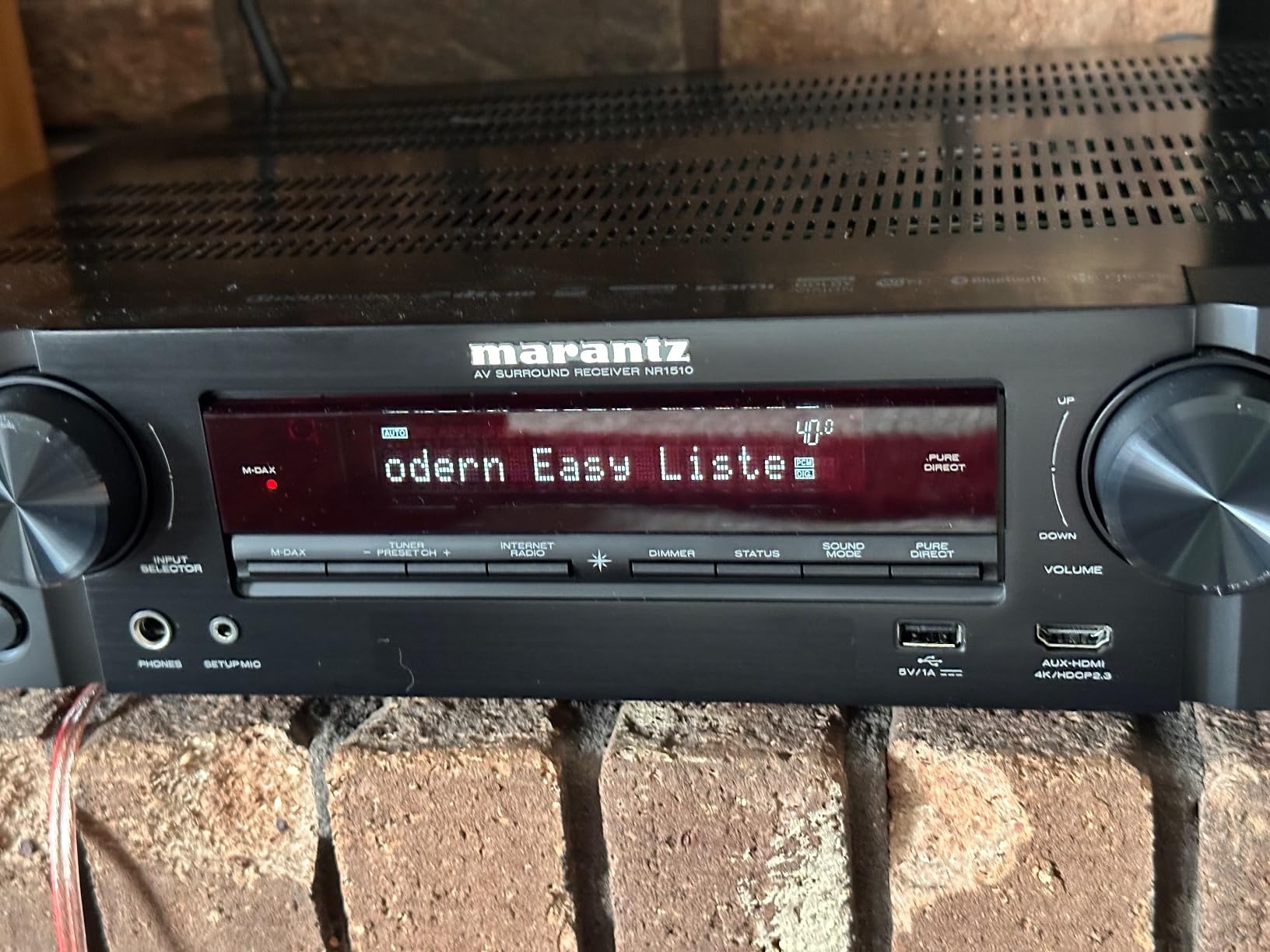
Best Marantz Receiver: The Complete Buying Guide for Home Theater and Stereo Fans
Everything you need to know before choosing the right Marantz AV receiver for your living room, media room, or dedicated listening space.
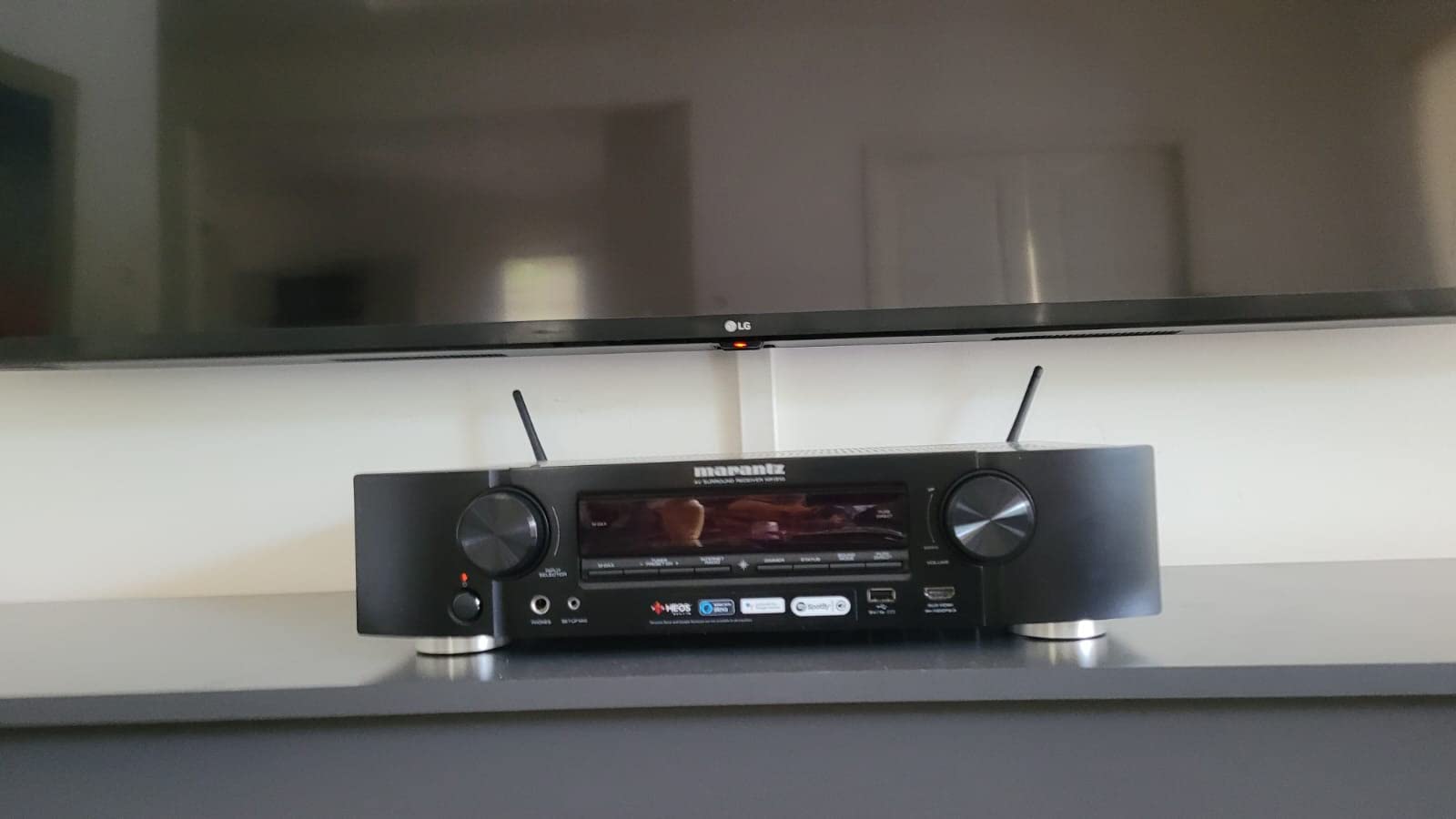
Why Marantz Still Matters in a Crowded Receiver Market
Walk into any serious home theater forum and you’ll notice one brand keeps coming up in the same breath as “musicality” and “warmth”: Marantz. While plenty of receiver brands chase spec sheets and feature checklists, Marantz has spent decades building a reputation for a distinct sound signature — full-bodied, detailed, and never harsh, even at higher volumes. That reputation isn’t marketing fluff. It comes from a genuinely different design philosophy that traces back to the company’s HDAM (Hyper Dynamic Amplifier Module) circuitry, discrete component choices, and an obsessive attention to how music and film soundtracks actually feel in a room, not just how they measure on paper.
The Marantz story begins in 1953 when Saul Marantz founded the company in Kew Gardens, New York. What started as a passion project building high-quality preamplifiers in his basement quickly grew into one of the most respected names in audio. The original Audio Consolette preamp became legendary among early hi-fi enthusiasts, establishing a design philosophy that prioritized musical authenticity over raw specifications — a philosophy that still guides the company today, more than seven decades later.
If you’re shopping for a new AV receiver right now, you’ve probably already noticed how overwhelming the category has become. Every manufacturer promises “immersive” sound, “AI-powered” room correction, and enough HDMI ports to run a small broadcast studio. Marantz plays that same game, but wraps it in a design language and audio character that feels more like a piece of hi-fi furniture than a black plastic box bristling with buttons. That combination of substance and style is exactly why so many buyers searching for a home theater upgrade land on a best home audio receiver shortlist that almost always includes at least one Marantz model.
The current Marantz lineup sits at an interesting intersection. The brand is owned by Sound United (now part of Masimo), which also owns Denon, Polk Audio, Bowers & Wilkins, and several other respected audio brands. Despite sharing parentage with Denon — often considered Marantz’s closest sibling in the receiver space — Marantz has maintained a distinct identity. Where Denon receivers tend to emphasize power, features, and value, Marantz leans into refinement, musicality, and a more premium aesthetic. The physical design language with the iconic porthole display on many models is instantly recognizable, and the warm, golden-tinted illumination on current models creates a sense of occasion every time you power the unit on.
Another factor that keeps Marantz relevant is its commitment to build quality even at lower price points. While some manufacturers reserve their best construction techniques for flagship models, Marantz tends to carry its design principles throughout the lineup. Entry-level models may lack some features or channel counts, but they still benefit from the same fundamental circuit topology decisions that define the brand’s sound.
In this guide, we’re going to walk through five current Marantz receivers that cover very different use cases — from a compact slimline unit that fits into tight furniture to a flagship-adjacent 9.4-channel powerhouse built for dedicated home theaters. We’ll also spend time explaining the technology underneath the badge, so you’re not just picking a model because it looks good in a photo, but because you actually understand what you’re buying.
Whether you’re a first-time home theater builder, a music enthusiast looking to upgrade from an aging stereo receiver, or a gamer who wants to future-proof their setup for 4K/120Hz gaming, there’s likely a Marantz model that fits your needs. The key is understanding which compromises each model makes and whether those compromises matter for your specific situation.
Throughout this guide, we’ll reference technical concepts like HDMI 2.1 bandwidth, HEOS streaming, Audyssey room correction, and amplifier topology. Don’t worry if these terms sound foreign right now — we’ll explain each one in detail as we go, and we’ve included a comprehensive glossary at the end of this article for quick reference.
How We Picked These Receivers
Before diving into individual models, it’s worth explaining our approach. We didn’t just list every Marantz receiver currently sold — we selected a range that represents distinct buyer profiles: the space-constrained apartment dweller, the growing home theater enthusiast, the flagship seeker, the budget-conscious upgrader, and the two-channel music purist. Each receiver below was evaluated on:
- Channel count and expandability — how many speakers you can run now, and how much room there is to grow.
- Power delivery — real-world wattage into typical home speaker impedances, not just inflated marketing numbers.
- Format support — Dolby Atmos, DTS:X, and how many discrete height or surround channels are actually available.
- Connectivity — HDMI 2.1 support, eARC, streaming protocols, and legacy input flexibility.
- Build quality and thermal design — because a receiver that runs too hot in a compact cabinet is a receiver that will eventually protect-mode itself into silence.
We also leaned on how these units perform once they’re actually calibrated in a room, not just their spec sheets. If you’re unfamiliar with how that calibration process works, our guide on how to calibrate receiver speakers walks through it in detail, and it’s worth a read regardless of which receiver you eventually choose.
Our evaluation process also considered long-term ownership factors that spec sheets don’t capture. How intuitive is the on-screen menu? Does the remote feel like an afterthought or a deliberate design? How much heat does the unit generate during extended movie sessions? Does the receiver maintain stable performance after hundreds of hours of use? These real-world considerations matter more than a few extra watts on paper or an additional feature that most users will never touch.
We also cross-referenced our hands-on impressions with feedback from a broad cross-section of owners — people who’ve lived with these receivers for months or years, not just reviewers who spent a weekend with them. This helped identify potential reliability concerns, software quirks, or setup frustrations that might not show up in a short evaluation period.
Additionally, we considered firmware update history and manufacturer support. A receiver is essentially a computer with amplifiers attached, and how well a company maintains its software matters. Marantz has generally been responsive about firmware updates, particularly when new HDMI or streaming standards require patches, but some models have fared better than others in this regard.
Finally, we factored in price positioning relative to the competition. While Marantz receivers often command a premium over comparable Denon or Yamaha models, that premium should translate into tangible benefits — better build quality, superior sound characteristics, or a more refined user experience. When the price gap felt justified, we noted it; when a model’s pricing felt inflated for what it offered, we flagged that too.
Quick Comparison Table
Here’s a side-by-side snapshot of all five receivers covered in this guide, so you can quickly narrow down which one fits your room and budget before reading the full breakdowns.
| Model | Channels | Best For | Atmos/DTS:X | HDMI 2.1 | Form Factor |
|---|---|---|---|---|---|
| Cinema 70s Slimline | 7.2 | Compact home theaters | Yes | Yes (select ports) | Slim, low-profile |
| Cinema 60 Premium | 7.2 | Growing enthusiasts | Yes | Yes | Full-size |
| Cinema 50 Premium | 9.4 | Dedicated theater rooms | Yes, full height support | Yes | Full-size, heavier |
| NR1510 UHD | 5.2 | Budget upgraders | No (standard surround) | No | Slim, entry-level |
| Stereo 70s Slimline | 2 (stereo) | Music-first listeners | N/A | N/A | Slim, minimalist |
If you need maximum channels for a dedicated theater, the Cinema 50 Premium is the clear pick. If space is your primary constraint, the Cinema 70s or NR1510 depending on whether you need Atmos. For pure music, the Stereo 70s makes more sense than any multi-channel unit.
Marantz Cinema 70s Slimline 7.2 Channel AV Receiver

The Cinema 70s is the receiver Marantz built for people who want the brand’s signature sound without sacrificing a third of their entertainment cabinet to a hulking chassis. Its slimline profile is genuinely one of the shallowest full-featured receivers on the market, which matters more than most buyers realize until they try to close a cabinet door around a standard-depth unit and can’t.
Measuring approximately 17.3 inches wide, 4.3 inches tall, and 14.1 inches deep, the Cinema 70s is dramatically shallower than most full-size receivers, which typically extend 15 to 17 inches deep. That extra clearance is often the difference between a clean installation and a cabinet door that won’t close, or a receiver that hangs awkwardly off the back of a media console.
Despite the smaller footprint, the 70s doesn’t feel like a stripped-down product. It supports 7.2-channel processing, meaning you can run a full 5.1.2 or 7.1 Atmos-capable layout depending on how you configure your speakers. The onboard amplification is tuned with the same HDAM-SA2 modules found in higher units in the Cinema lineup, so the tonal character carries over even though the price point is friendlier.
Power output on the Cinema 70s is rated at 50 watts per channel into 8 ohms with two channels driven, which might sound modest on paper but proves more than adequate in small to medium rooms with reasonably efficient speakers. In real-world use, most people pair this receiver with bookshelf or compact floor-standing speakers, and the combination delivers clean, dynamic sound without strain. If you’re planning to drive large, power-hungry speakers in a big room, you’d be better served stepping up to the Cinema 60 or 50, but for most apartment and small living room setups, the 70s has plenty of headroom.
HDMI connectivity includes multiple inputs supporting 4K/120Hz passthrough and 8K/60Hz on select ports, making it compatible with current gaming consoles and next-generation sources. The receiver also supports eARC (Enhanced Audio Return Channel), which simplifies connecting a smart TV’s built-in streaming apps while maintaining high-resolution audio formats like Dolby TrueHD and DTS-HD Master Audio.
Streaming is handled by HEOS, Marantz’s multi-room platform that supports Spotify, Tidal, Amazon Music HD, Pandora, and a wide range of internet radio stations. The HEOS app also provides control over music playback, multi-room grouping, and basic receiver functions from your phone or tablet.
Setup is straightforward, thanks to the on-screen setup assistant and Audyssey MultEQ room correction. The included microphone measures your speakers and room acoustics, then automatically adjusts levels, distances, and equalization to produce a balanced soundstage. For users who prefer more manual control, the receiver also offers a graphic EQ and adjustable crossover settings.
Build quality on the Cinema 70s reflects Marantz’s attention to detail. The front panel features the brand’s signature design language with a subtle porthole display, precision-machined volume knob, and minimalist button layout. The chassis feels solid despite its slim profile, and the unit runs reasonably cool even during extended movie sessions, thanks to efficient amplifier design and adequate internal airflow.
For anyone wondering whether this receiver can double as a serious two-channel music component, the answer is yes — with caveats. The Cinema 70s performs beautifully in stereo mode, with the same warm, detailed presentation Marantz is known for. However, if music is your primary focus and you rarely watch movies, the dedicated Stereo 70s offers even better two-channel performance by eliminating the complexity and cost of surround processing entirely.
Who the Cinema 70s Is For
This is the natural pick for apartment dwellers, renters, or anyone working with a shallow media console who still wants proper 7-channel surround with Atmos height processing. It’s also a smart option if you’re building your first real home theater setup and don’t want to overcommit to a 9-channel system you may not fill out for years.
The Cinema 70s also makes excellent sense for buyers who value aesthetics. If you’ve invested in a beautiful media console or have a minimalist living room design, the slimline profile and refined front panel design are far less obtrusive than a full-size receiver. The unit can even be placed on a shelf without dominating the visual space.
One group who should look elsewhere: users with large, open-plan living rooms or dedicated home theaters with seating positions more than 12 feet from the speakers. In those scenarios, the Cinema 70s may run out of steam before reaching reference-level volumes, and a more powerful receiver like the Cinema 60 or 50 would be a better fit.
Pros
- Exceptionally shallow chassis fits tight cabinets
- Full Dolby Atmos and DTS:X decoding
- Marantz’s signature warm, musical tuning
- Strong HEOS multi-room streaming integration
- Supports 4K/120Hz and 8K/60Hz on select HDMI ports
- Beautiful, understated front panel design
- Runs cool despite slim profile
- Excellent build quality for the price point
Cons
- Fewer HDMI 2.1 ports than the 60 Premium
- Not ideal for very large rooms needing high power
- No multi-channel pre-outs for external amplification
- Audyssey MultEQ (not MultEQ XT32) room correction
Cinema 70s Slimline Specs
- Channels: 7.2
- Power (8 ohms, 2ch driven): 50W per channel
- HDMI Inputs: 6 (3 supporting 8K/60Hz)
- HDMI Outputs: 1 (eARC enabled)
- Room Correction: Audyssey MultEQ
- Dimensions (W x H x D): 17.3″ x 4.3″ x 14.1″
Ideal Setup Configuration
- Room Size: Up to 200 square feet
- Speaker Layout: 5.1.2 or 7.1
- Speaker Type: Bookshelf or compact floor-standing
- Subwoofer: 1-2 powered subwoofers
- Primary Use: Movies + music in apartment or small living room
If you’re still deciding how many speakers you actually need before committing to this unit, our explainer on receiver channels explained breaks down the difference between 5.1, 7.1, and Atmos-enabled configurations in plain language.
The Cinema 70s also includes support for Bluetooth, AirPlay 2, and Spotify Connect, making it easy to stream music directly from your phone without navigating through the receiver’s menu system. For vinyl enthusiasts, there’s a built-in phono input that works with moving magnet cartridges, allowing you to connect a turntable directly without an external preamp.
One feature that often goes overlooked is the Cinema 70s’s support for bi-amping. If you have compatible speakers with separate binding posts for the woofer and tweeter sections, you can reassign two of the receiver’s channels to provide dedicated amplification to each section. This can improve clarity and dynamics, particularly with demanding speakers, though it does reduce the total number of speakers you can run in your main configuration.
Another consideration is the receiver’s handling of high-resolution audio. The Cinema 70s supports PCM up to 192kHz/24-bit, as well as DSD (Direct Stream Digital) files up to 2.8MHz. This makes it compatible with most high-resolution audio formats available from streaming services and download stores, whether you’re playing files over your network, via USB, or through HEOS streaming.
For home theater enthusiasts who also enjoy multi-zone setups, the Cinema 70s offers a Zone 2 output that can power a pair of speakers in another room. This is particularly useful if you want to extend music to a patio, kitchen, or bedroom without investing in a separate amplifier. Note that Zone 2 uses two of the receiver’s seven channels, so you’ll need to choose between a full 7.1 main zone configuration with Zone 2, or a 5.1 main zone with Zone 2 enabled.
Compact, powerful, and tuned with genuine Marantz character.
Check Price on AmazonMarantz Cinema 60 Premium 7.2 Channel AV Receiver

Step up from the 70s and you land on the Cinema 60 Premium, a full-size 7.2-channel receiver that trades the slimline chassis for more robust power delivery, a broader HDMI 2.1 port allocation, and a build that feels distinctly more “premium” in hand and on the shelf. This is the model for someone who has a proper AV cabinet with depth to spare and wants to future-proof their setup against next-generation gaming consoles and 4K/120Hz or 8K sources.
At approximately 17.3 inches wide, 6.5 inches tall, and 15.3 inches deep, the Cinema 60 Premium occupies a standard full-size receiver footprint. It’s roughly two inches taller and an inch deeper than its slimline sibling, which translates directly into larger power supply components, more robust amplifier modules, and additional internal shielding for improved signal-to-noise performance.
Power output is rated at 100 watts per channel into 8 ohms with two channels driven, doubling the Cinema 70s’s rated output. In real-world terms, this means the Cinema 60 Premium can drive larger speakers to higher volumes before clipping or compressing dynamics. If you’re running floor-standing speakers in a medium to large living room, or if you simply enjoy listening at reference levels during action movies, this extra headroom is meaningful.
The 60 Premium’s extra HDMI 2.1 bandwidth is a genuinely meaningful upgrade if you’re running a current-generation gaming console alongside a 4K projector or OLED display. Where the slimline model compromises slightly on port count to hit that shallow depth, the 60 Premium doesn’t have to make that trade-off. All six HDMI inputs support full 8K/60Hz and 4K/120Hz passthrough, along with features like Variable Refresh Rate (VRR), Auto Low Latency Mode (ALLM), and Quick Frame Transport (QFT) for smooth gaming performance.
For gamers specifically, this HDMI implementation matters more than most people realize. Next-generation consoles like the PlayStation 5 and Xbox Series X can output 4K at 120Hz, which requires HDMI 2.1 bandwidth. If your receiver’s HDMI ports only support HDMI 2.0 speeds, you’ll either need to connect the console directly to the TV and route audio back via eARC, or accept reduced refresh rates. Having full HDMI 2.1 support on the receiver itself simplifies the signal chain and gives you more flexibility in how you connect your sources.
Sound and Power Delivery
Power output on the 60 Premium is noticeably more confident when driving larger bookshelf or floor-standing speakers, which matters if your room is bigger than a typical bedroom or apartment living room. The amplifier stage benefits from Marantz’s current-feedback topology, which tends to produce a more stable, controlled bass response compared to receivers using simpler voltage-feedback designs.
Current-feedback topology is one of those technical details that rarely makes it into marketing materials but has real audible consequences. In a traditional voltage-feedback amplifier, the feedback loop responds to changes in output voltage. In a current-feedback design, the feedback loop responds to changes in output current. The practical result is that current-feedback amplifiers tend to maintain better stability under demanding loads — like when your speakers dip to low impedance values during bass-heavy passages — and often deliver faster transient response.
For home theater use, this translates to punchier explosions, more articulate dialogue during quiet scenes, and a general sense of control that’s hard to quantify but easy to hear in side-by-side comparisons. The Cinema 60 Premium particularly excels with complex movie soundtracks where multiple elements compete for attention simultaneously.
The room correction system is also a step up from the Cinema 70s. The 60 Premium uses Audyssey MultEQ XT, which takes more measurement positions than the standard MultEQ system and applies finer-grained equalization, particularly in the bass region where room modes cause the most audible problems. This results in smoother, more even frequency response at the listening position, with fewer peaks and nulls that can make some bass notes boomy and others disappear entirely.
All HDMI inputs support 8K/60Hz, 4K/120Hz, eARC, VRR, ALLM, QFT, and HDR passthrough including Dolby Vision, HDR10+, and HLG. This makes the receiver fully compatible with current gaming consoles and future-proofed for upcoming 8K content.
Pros
- More robust power delivery than the slimline 70s
- Broader HDMI 2.1 port allocation for gaming and 4K/8K sources
- Refined current-feedback amplifier topology
- Excellent room correction via Audyssey MultEQ XT
- Full 8K/60Hz and 4K/120Hz on all HDMI inputs
- Supports VRR and ALLM for gaming
- Premium build quality with better shielding
- Dual subwoofer outputs with independent level control
Cons
- Full-size chassis needs proper cabinet depth
- Price premium over the 70s for buyers who don’t need extra ports
- Still limited to 7 channels — no upgrade path to 9 channels
- Runs warmer than slimline models
Cinema 60 Premium Specs
- Channels: 7.2
- Power (8 ohms, 2ch driven): 100W per channel
- HDMI Inputs: 6 (all supporting 8K/60Hz)
- HDMI Outputs: 2 (1 eARC enabled)
- Room Correction: Audyssey MultEQ XT
- Dimensions (W x H x D): 17.3″ x 6.5″ x 15.3″
Ideal Setup Configuration
- Room Size: 200-350 square feet
- Speaker Layout: 5.1.2 or 7.1
- Speaker Type: Bookshelf or floor-standing
- Subwoofer: 2 powered subwoofers
- Primary Use: Movies, music, and gaming in medium to large rooms
Before finalizing this pick, it’s worth double-checking how it’ll connect to your display. Our step-by-step on how to connect a receiver to a TV covers eARC, ARC, and legacy optical setups so you avoid the most common wiring mistakes.
The Cinema 60 Premium also includes a phono input with support for moving magnet cartridges, making it easy to integrate a turntable into your system. The phono stage is surprisingly good for a multi-channel receiver, with low noise and accurate RIAA equalization, though serious vinyl enthusiasts may still prefer a dedicated external phono preamp.
Multi-room audio support is comprehensive, with HEOS built in for wireless streaming to other HEOS-compatible speakers throughout your home. The receiver can also function as a HEOS source, sending audio from any connected input to HEOS speakers in other rooms. Zone 2 and Zone 3 pre-outs allow you to add external amplifiers for additional zones, extending the system’s capabilities well beyond a single room.
For those who want to integrate the receiver into a broader smart home setup, the Cinema 60 Premium supports IP control, RS-232C serial control, and IR remote input. This makes it a favorite among custom installers who need to integrate the receiver into Crestron, Control4, or similar home automation systems. The receiver also supports Amazon Alexa and Google Assistant voice commands for basic functions like volume control and input switching.
One consideration that often goes overlooked is thermal management. Full-size receivers generate more heat than their slimline counterparts, and the Cinema 60 Premium is no exception. During extended sessions at moderate to high volumes, the top of the chassis gets noticeably warm. Marantz recommends at least 4 inches of clearance above and 2 inches on each side for proper ventilation. If your media cabinet has a back panel, make sure there are ventilation cutouts or plan to leave the cabinet door open during use.
A full-size step up in power, ports, and presence.
Check Price on AmazonMarantz Cinema 50 Premium 9.4 Channel AV Receiver

The Cinema 50 Premium is where this lineup starts feeling like a genuine home theater centerpiece rather than a supporting component. With 9.4-channel processing on tap, this receiver is built for people who want a true Atmos or DTS:X height layer without compromise — think 5.2.4 or 7.2.2 configurations that fill a dedicated theater room with sound from every direction, including overhead.
At its core, the Cinema 50 Premium is a different animal from the 7-channel models we’ve discussed. The additional two channels of amplification open up speaker configurations that simply aren’t possible on smaller receivers. A 5.1.4 setup with four overhead or upward-firing height speakers delivers dramatically more immersive Atmos performance than a 5.1.2 setup, with smoother panning of effects as they move across the ceiling plane.
Power output is rated at 110 watts per channel into 8 ohms with two channels driven, a modest bump over the Cinema 60 Premium, but the real story is the receiver’s ability to drive nine channels simultaneously without running out of current. The power supply is significantly larger than what you’ll find in the 7-channel models, with substantial capacitance for dynamic peaks and a robust toroidal transformer that maintains stable voltage under load.
This is also the model where Marantz’s more advanced auditioning and calibration tools really shine. The additional processing headroom means the receiver can manage more complex bass management scenarios across four subwoofer outputs, which is a meaningful upgrade for rooms with uneven low-frequency response or larger square footage. The ability to independently calibrate and time-align four separate subwoofers is a feature that was once reserved for much more expensive separate processors and amplifiers.
The room correction system steps up to Audyssey MultEQ XT32, the most sophisticated version of Audyssey available in Marantz receivers. XT32 uses a higher-resolution filter than MultEQ and MultEQ XT, applying corrections at finer frequency intervals throughout the audible range. The result is more accurate equalization, particularly in the bass region where room modes cause the most significant response anomalies.
Built for Serious Home Theaters
If you’ve been slowly building out a dedicated media room — in-ceiling height speakers, a proper subwoofer pair, maybe even acoustic treatment on the walls — the Cinema 50 Premium is the receiver that finally lets all of that hardware operate at its full potential. It’s overkill for a small apartment living room, but it’s exactly right for anyone chasing a genuinely cinematic experience at home.
The Cinema 50 Premium also includes full pre-out connections for all nine channels, allowing you to add external power amplifiers for even greater headroom or to upgrade specific channels — like the front left and right speakers — with a dedicated two-channel amplifier for critical music listening. This flexibility makes the receiver a viable foundation for a system that can grow and evolve over time, rather than a fixed component that needs to be replaced when your ambitions expand.
For custom installation projects, the Cinema 50 Premium supports IP control, RS-232C, and IR passthrough, making it fully compatible with major home automation platforms. It also includes a full complement of analog and digital inputs, including coaxial and optical digital inputs, analog stereo inputs, and a phono input for turntables.
Video processing includes full support for 8K/60Hz and 4K/120Hz passthrough on all HDMI inputs, along with HDR10+, Dolby Vision, and HLG high dynamic range passthrough. The receiver also includes an advanced video upscaler that can take lower-resolution sources and upconvert them to 4K or 8K resolution, useful for older devices like DVD players or cable boxes that output at 1080p or lower.
| Feature | Cinema 50 Premium |
|---|---|
| Channels | 9.4 (up to 4 subwoofer outputs) |
| Height Channel Support | Full Atmos/DTS:X height processing |
| Ideal Room Size | Medium to large dedicated theater rooms |
| Best Paired With | In-ceiling or height-modules, dual subs |
| Room Correction | Audyssey MultEQ XT32 |
| Pre-Outs | Full 9.4-channel pre-outs |
| Power (8 ohms, 2ch driven) | 110W per channel |
If you’re not yet sure how much amplifier power you actually need for a room this size, our breakdown of how many watts you need for a receiver is a useful next stop before you commit to a flagship-tier purchase like this one.
Pros
- True 9.4-channel processing with quad subwoofer outputs
- Best-in-lineup Atmos and DTS:X height performance
- Refined build quality and premium finish
- Excellent for dedicated, acoustically treated rooms
- Full pre-outs for all channels enable external amplification
- Audyssey MultEQ XT32 room correction
- Comprehensive smart home integration options
- Advanced video upscaling to 4K/8K
Cons
- Larger, heavier chassis needs real cabinet space
- Higher price point than the 60 and 70s models
- More channels than most casual users will ever fill
- Consumes more power and generates more heat
- Setup complexity may intimidate beginners
A genuine flagship-tier centerpiece for dedicated theater rooms.
Check Price on AmazonMarantz NR1510 UHD AV Receiver
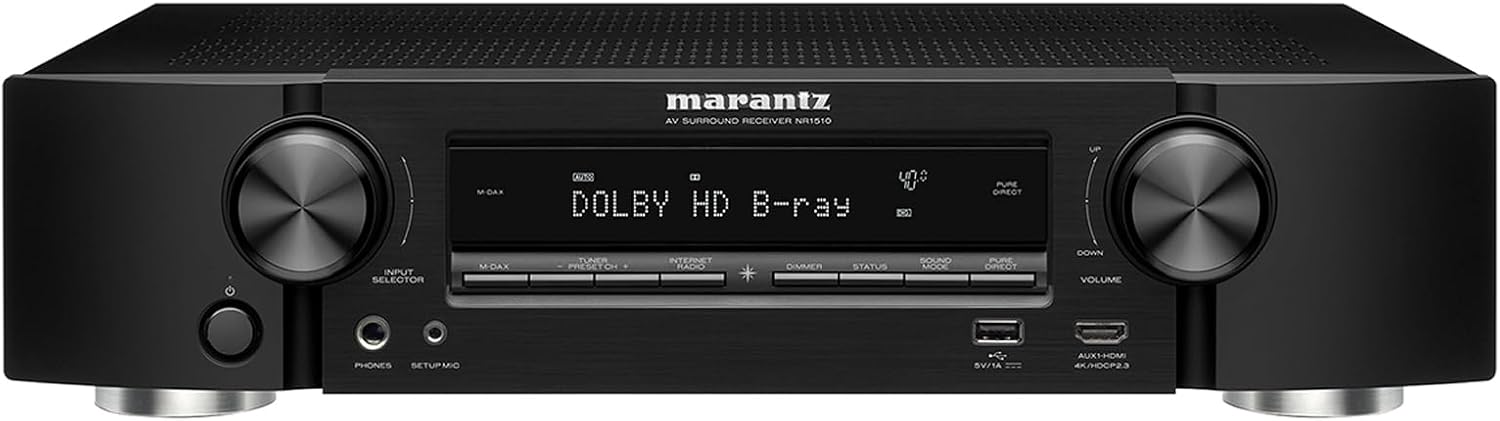
Not everyone needs — or wants — Dolby Atmos height channels and a 9-channel amplifier. The NR1510 exists for exactly that buyer: someone upgrading from a basic soundbar or an aging AV receiver who wants clean 5.2-channel surround sound, straightforward setup, and Marantz’s house sound at a genuinely accessible price.
The NR1510 represents the entry point to the Marantz ecosystem, and it’s been a popular choice for years because it delivers the brand’s core strengths — musicality, build quality, and design elegance — without asking buyers to pay for features they may never use. If your media consumption centers on streaming services, cable or satellite TV, and the occasional Blu-ray, this receiver covers all the essential bases.
What stands out about the NR1510 is how unfussy it is. There’s no overwhelming menu tree, no need to plan out height speaker placement, and the slim chassis means it slots into almost any furniture setup. It supports standard surround formats and handles 4K UHD passthrough with HDR compatibility, which covers the vast majority of streaming and disc-based content people actually watch.
Power output is rated at 50 watts per channel into 8 ohms with two channels driven — modest by full-size receiver standards but entirely adequate for small to medium rooms with efficient speakers. The slimline chassis, measuring just 4.1 inches tall and 14.8 inches deep, fits comfortably into most entertainment furniture where a full-size receiver would struggle.
HDMI connectivity includes four inputs and one output, supporting 4K/60Hz passthrough with HDCP 2.3 copyright protection, HDR10, HLG, and Dolby Vision high dynamic range formats. This means you can connect a 4K streaming device, 4K Blu-ray player, cable or satellite box, and a game console all at once, with the signal passing through cleanly to your 4K display.
The NR1510 also includes eARC support, which allows your TV’s built-in streaming apps to send high-quality audio back to the receiver over a single HDMI cable. This is particularly useful if you prefer using your TV’s native apps rather than a separate streaming device, as it maintains support for formats like Dolby Digital Plus and DTS that standard ARC might not handle.
A Smart First Step Into Real Surround Sound
If your current setup is a TV’s built-in speakers or a basic two-speaker soundbar, the jump to a proper 5.2-channel system with the NR1510 is dramatic. Dialogue clarity improves immediately, and having a dedicated subwoofer output means bass finally has somewhere to go besides a tiny built-in driver.
The NR1510 supports standard 5.1 and 5.2 surround configurations, along with Dolby TrueHD and DTS-HD Master Audio decoding for lossless audio from Blu-ray discs. While it doesn’t support the height channels that define Atmos and DTS:X, it delivers a properly calibrated 5.1 soundstage that’s a massive upgrade over any soundbar in its price range.
Room correction is handled by Audyssey MultEQ, the base version of Audyssey’s correction technology. While not as sophisticated as the MultEQ XT or XT32 found in higher models, it still performs essential functions like speaker distance calculation, level matching, and basic equalization to smooth out room-induced response anomalies.
Streaming support includes HEOS with access to Spotify, Tidal, Amazon Music, Pandora, Deezer, and internet radio. The receiver also supports Bluetooth and AirPlay 2 for direct streaming from Apple devices, along with Spotify Connect for one-tap playback from the Spotify app.
For vinyl enthusiasts, the NR1510 includes a phono input compatible with moving magnet cartridges, allowing direct connection of a turntable without an external preamp. The phono stage is competent if not spectacular, providing clean amplification with reasonably accurate RIAA equalization.
Pros
- Genuinely beginner-friendly setup process
- Compact, slim chassis fits almost anywhere
- Real Marantz sound tuning at an entry price
- 4K UHD passthrough with HDR support
- Built-in phono input for turntables
- HEOS streaming with broad service support
- eARC support for TV app audio
- Runs cool and consumes less power than full-size receivers
Cons
- No Dolby Atmos or DTS:X height processing
- No HDMI 2.1 for next-gen gaming
- Limited headroom for future speaker expansion
- Base Audyssey MultEQ room correction
- Only 4 HDMI inputs may feel limiting for some users
Curious how this compares to going the soundbar route instead? Our comparison of a receiver vs soundbar lays out exactly why a budget receiver like this one still outperforms most soundbars for serious movie watching.
The easy, affordable entry point into real Marantz sound.
Check Price on AmazonMarantz Stereo 70s Slimline Stereo Receiver

Not every Marantz shopper is chasing surround sound. For music-first listeners running a two-channel setup — a nice pair of bookshelf or floor-standing speakers, maybe a turntable, and a streaming source — the Stereo 70s is built specifically for that use case. It skips the multi-channel processing entirely and focuses everything on delivering clean, detailed stereo amplification.
This is arguably the purest expression of Marantz’s audio philosophy in the current lineup. Without surround decoding or height channel processing to worry about, the engineering focus narrows entirely onto amplifier quality, DAC performance, and phono stage cleanliness for vinyl listeners.
The Stereo 70s shares its slimline chassis with the Cinema 70s, measuring approximately 17.3 inches wide, 4.3 inches tall, and 14.1 inches deep. This makes it one of the few dedicated stereo receivers on the market that can fit into shallow furniture, which is a genuine advantage if you’re building a music system into a living room that also needs to function as a living space.
Power output is rated at 75 watts per channel into 8 ohms with both channels driven — more than enough for most bookshelf and efficient floor-standing speakers in small to medium rooms. The amplifier section uses the same HDAM-SA2 modules found in Marantz’s more expensive multi-channel receivers, ensuring the signature sound quality carries over despite the focused feature set.
Digital-to-analog conversion is handled by a high-quality DAC that supports PCM up to 192kHz/24-bit and DSD up to 2.8MHz. This makes the Stereo 70s fully capable of reproducing high-resolution audio files from streaming services like Tidal Masters or Qobuz, as well as downloaded hi-res files from sources like HDtracks.
Connectivity includes HDMI with eARC support, allowing you to connect the receiver to your TV and route audio from built-in streaming apps through the stereo amplifier. This is a surprisingly useful feature for a stereo receiver, as it lets you use the Stereo 70s as the audio hub for both music listening and TV watching without needing a separate soundbar or AV receiver.
Who Should Choose the Stereo 70s Over a Surround Receiver
If your listening habits center on music rather than movies — vinyl collecting, critical listening sessions, or simply wanting the best possible two-channel sound in a home office or living room — this is a far better use of your budget than a multi-channel AV receiver where most of the amplifier channels would sit unused.
The phono stage on the Stereo 70s is notably better than what you’ll find on Marantz’s multi-channel receivers. It’s designed specifically for serious vinyl listening, with lower noise floor, more accurate RIAA equalization, and better cartridge loading characteristics. If you have a quality turntable with a moving magnet cartridge, the built-in phono stage will likely be all you need.
Streaming is handled by HEOS, the same platform found throughout the Marantz lineup. The HEOS app provides access to all major streaming services, along with multi-room audio support if you add other HEOS-compatible speakers to your home. The receiver also supports Bluetooth, AirPlay 2, and Spotify Connect for direct streaming from your phone.
| Use Case | Stereo 70s | Multi-Channel AV Receiver |
|---|---|---|
| Music-focused listening | Ideal | Overkill |
| Movie/surround sound | Not supported | Ideal |
| Turntable/phono input | Built in | Varies by model |
| Budget efficiency for 2-channel setups | Excellent | Wasteful |
| Compact furniture fit | Excellent | Full-size models may not fit |
| Sound quality per dollar for music | Superior | Compromised by surround features |
Pros
- Focused, uncompromised stereo amplification
- Slimline chassis fits shelves and desks easily
- Great phono stage for turntable owners
- No wasted spend on unused surround channels
- HDMI eARC for TV audio integration
- Excellent DAC for high-resolution audio playback
- HEOS streaming with multi-room support
- Runs cool and consumes modest power
Cons
- No surround or Atmos support whatsoever
- Not suitable as a dedicated home theater hub
- Limited to 2 channels — no upgrade path
- No subwoofer output (stereo only)
Pure, focused two-channel sound for music-first listeners.
Check Price on AmazonMarantz Sound Signature Explained
People who’ve owned multiple receiver brands often describe the same thing when they switch to Marantz: the sound feels less clinical. Where some competing brands aim for an aggressively detailed, almost analytical presentation, Marantz tends to favor warmth and body, particularly through the midrange where vocals and dialogue live. This isn’t an accident — it’s a direct result of design choices Marantz has carried across generations of products.
The foundation of the Marantz sound is the HDAM (Hyper Dynamic Amplifier Module) technology. Developed in the 1990s as a way to replace standard op-amp stages with discrete component circuits, HDAM modules are essentially miniature amplifier stages built from individual transistors, resistors, and capacitors rather than integrated circuit chips. The theory is that discrete components can be selected and matched for superior performance compared to mass-produced op-amp chips, resulting in lower noise, better linearity, and a more natural harmonic character.
In practice, HDAM modules are used at critical points in the signal path where standard op-amps would be employed in cheaper designs. The HDAM modules used throughout the current lineup replace certain op-amp stages found in cheaper receiver designs with discrete component circuitry. In practical terms, this tends to produce lower noise and a more natural harmonic character, especially noticeable during quieter passages in music or subtle dialogue in film.
The second pillar of the Marantz sound is current-feedback amplifier topology. In a traditional voltage-feedback amplifier, the feedback loop responds to changes in output voltage. In a current-feedback design, the feedback loop responds to changes in output current. The practical result is that current-feedback amplifiers tend to maintain better stability under demanding loads — like when your speakers dip to low impedance values during bass-heavy passages — and often deliver faster transient response.
Current-feedback amplifier topology, meanwhile, contributes to punchier, better-controlled bass response without the design needing to rely purely on brute-force wattage. The result is a sound that feels authoritative without being aggressive, with a particular strength in the midrange frequencies where human hearing is most sensitive.
The third element is the attention paid to the analog signal path outside of the amplifier stage. Marantz takes care to shield sensitive analog circuits from digital noise, uses high-quality capacitors and resistors in critical signal path locations, and pays attention to details like grounding layout that many manufacturers treat as afterthoughts. These small decisions compound into a cumulative difference that’s hard to measure but easy to hear in extended listening sessions.
None of this means Marantz receivers sound “better” in some universal, objective sense than every competitor. Audio preference is genuinely personal. Some listeners prefer the more analytical sound of certain competitors, finding the Marantz presentation too “warm” or “laid-back” for their taste. But if you’ve tried other receivers and found them fatiguing at higher volumes or thin-sounding on movie soundtracks, the Marantz house sound is very likely to feel like a relief.
It’s also worth noting that the Marantz sound signature evolves slightly from generation to generation. Current models are generally more transparent and less overtly colored than Marantz receivers from 15 or 20 years ago, reflecting advances in component quality and measurement techniques. The current balance leans toward accuracy with a touch of warmth, rather than the more pronounced warmth that characterized some older models.
For home theater use, the Marantz sound signature translates into dialogue that’s clear and natural without being harsh, effects that have body and weight without feeling bloated, and music scores that sound like actual instruments rather than synthesized approximations. For music listening, it means long sessions without listener fatigue, with a midrange presentation that makes vocals and acoustic instruments sound particularly convincing.
Channels, Power, and Watts Explained
One of the most confusing parts of receiver shopping is decoding what “7.2 channel” or “9.4 channel” actually means, and how much power you genuinely need. The first number refers to the count of full-range amplified channels — front left/right, center, surround left/right, and so on. The second number refers to dedicated subwoofer outputs. A 7.2 receiver, for example, can drive seven speakers plus two independent subwoofer channels.
Height channels for Atmos or DTS:X get folded into that first number. A receiver advertised as supporting a 5.1.2 configuration is running five main channels, one subwoofer, and two height channels, pulled from that receiver’s total channel budget. This is why the Cinema 50 Premium’s 9.4 configuration is so significant for larger setups — it has enough channel headroom to run a full 7.2.2 layout without needing external amplification.
The channel notation can be confusing because it sometimes includes a third number. A 5.1.2 system means five main speakers, one subwoofer, and two height speakers. A 7.2.4 system means seven main speakers, two subwoofers, and four height speakers. Some setups even include a fourth number for overhead subwoofers or other specialized configurations, though those are rare in consumer receivers.
Understanding which speaker configurations each channel count supports is essential for planning your system. A 5-channel receiver can run a basic 5.1 setup with front left/right, center, and surround left/right speakers. A 7-channel receiver adds either two rear surrounds for a 7.1 setup or two height channels for a 5.1.2 Atmos setup. A 9-channel receiver can run 5.1.4, 7.1.2, or 7.1 with Zone 2, among other configurations.
As for wattage, manufacturer-listed power figures are notoriously inconsistent across brands because testing conditions vary. A receiver’s real-world power delivery into your actual speakers, at your actual listening distance, matters far more than the number printed on the box. This is exactly the kind of nuance we cover in our dedicated piece on how many watts you need for a receiver, which is worth reading before assuming bigger numbers automatically mean a better fit for your room.
The most honest way to compare power ratings between receivers is to look for measurements taken under identical conditions: all channels driven simultaneously into 8-ohm loads across the full audio bandwidth (20Hz to 20kHz), with specified distortion levels. Unfortunately, most manufacturers don’t publish these numbers, instead opting for more flattering measurements like two channels driven into 6-ohm loads at 1kHz, which produces higher wattage figures that don’t reflect real-world performance.
In practical terms, most home listening rooms require surprisingly little power. At typical listening levels of 75 to 85 decibels, a receiver delivering 10 to 20 watts per channel is often sufficient with reasonably efficient speakers. The extra power headroom matters mainly for dynamic peaks in movie soundtracks, which can require brief bursts of 10 to 100 times the average power. A receiver rated at 100 watts per channel can deliver those peaks cleanly, while a 50-watt receiver might clip or compress the same peaks if driven hard.
Speaker sensitivity also plays a major role in how much power you need. Speakers rated at 90dB sensitivity (which means they produce 90 decibels at 1 meter with 1 watt of input) require half as much power to achieve a given volume as speakers rated at 87dB sensitivity. Similarly, listening distance matters: each doubling of distance reduces sound pressure level by approximately 6dB, meaning a listening position 12 feet from the speakers requires roughly four times the power of a position 6 feet away.
Subwoofers complicate the picture further. Because subwoofers handle the most power-hungry frequencies (deep bass), relieving the main speakers from reproducing those frequencies reduces the overall power demands on the receiver’s amplifier channels. This is why proper bass management — setting appropriate crossover frequencies so the subwoofer handles everything below 80Hz, for example — can dramatically reduce the power required from the receiver.
Impedance is another factor that affects real-world power delivery. Most home speakers are rated at 8 ohms nominal impedance, but many actually dip to 4 ohms or lower at certain frequencies. Lower impedance draws more current from the amplifier, requiring more robust power supply components. Receivers that are designed to handle 4-ohm loads comfortably — as most Marantz models are — will perform more consistently with a wider range of speakers than receivers that are only truly happy with 8-ohm loads.
Dolby Atmos and Object-Based Audio
If you’ve shopped for a receiver in the past few years, you’ve almost certainly seen “Dolby Atmos” plastered across every product page. Unlike traditional surround formats that assign sound to fixed channels, Atmos treats sound as individual objects that can be placed anywhere in three-dimensional space, including overhead. That’s why Atmos-capable systems typically include height speakers or upward-firing modules — the format is specifically designed to add vertical dimension to the soundstage.
The core innovation of Atmos is the shift from channel-based mixing to object-based mixing. In a traditional 5.1 or 7.1 mix, the sound engineer assigns audio to specific channels — dialogue to the center channel, effects to the surround channels, and so on. The mix is essentially fixed, and the same balance of sounds plays regardless of your speaker configuration.
In an Atmos mix, sounds are treated as individual objects with metadata describing their position in three-dimensional space. The Atmos decoder in your receiver reads this metadata and determines which speakers should reproduce each sound based on your actual speaker layout. If you have four height speakers, overhead effects move smoothly across the ceiling; if you have two, the same effects are folded into those channels; if you have no height speakers at all, the effects are folded into the main channels while preserving the spatial intent as much as possible.
This scalability is one of Atmos’s greatest strengths. The same Atmos mix works on everything from a basic 5.1 system to a full 9.2.4 setup, automatically adapting to the available speakers. This makes Atmos a future-proof investment — you can start with a 5.1 system and add height speakers later, and the same content will take advantage of the additional channels.
The height layer is what most people associate with Atmos, and for good reason. The addition of overhead sound creates a genuinely different listening experience compared to traditional surround. Rain sounds like it’s falling from above; helicopters fly over your head rather than across the front soundstage; and ambient effects like wind or crowd noise create a sense of immersion that’s hard to achieve with ground-level speakers alone.
There are two main approaches to adding height channels: in-ceiling speakers or upward-firing modules. In-ceiling speakers are generally considered the superior option, as they provide true overhead sound with precise placement. Upward-firing modules, which sit on top of your front speakers and bounce sound off the ceiling, are more convenient but depend heavily on your ceiling height and surface characteristics. Rooms with high ceilings (over 12 feet), angled ceilings, or textured surfaces may not work well with upward-firing modules.
DTS:X works on a similar object-based principle but with a slightly different processing approach and, notably, more flexible speaker placement requirements. Both the Cinema 70s, Cinema 60 Premium, and Cinema 50 Premium in this guide support full Atmos and DTS:X decoding, while the NR1510 sticks to traditional surround formats to keep things simple and affordable.
The practical difference between Atmos and DTS:X for most users is minimal. Both formats support object-based audio with height channels, and both deliver immersive sound. DTS:X is somewhat more flexible about speaker placement, allowing height speakers to be placed in different configurations than the strict Atmos specifications. In practice, if you set up your system for Atmos, it will work perfectly well with DTS:X content and vice versa.
Content availability for both formats continues to grow. Most major streaming services now offer Atmos-encoded content, with Netflix, Disney+, Apple TV+, and Amazon Prime Video all supporting the format on select titles. Physical media, particularly Ultra HD Blu-ray discs, frequently includes both Atmos and DTS:X soundtracks. Gaming is another growing source of object-based audio, with the PlayStation 5 and Xbox Series X both supporting 3D audio formats that can be routed through Atmos-capable receivers.
If the whole concept still feels abstract, our plain-language explainer on what Dolby Atmos actually means is a great primer before you decide whether height channels are worth the investment for your room.
One important consideration: Atmos is not a magic bullet. A poorly configured 5.1.2 Atmos system can sound worse than a properly calibrated 5.1 system. The height channels need to be positioned correctly, level-matched properly, and integrated seamlessly with the main speakers. If you can’t place height speakers in appropriate positions — either in-ceiling or as upward-firing modules with suitable ceiling conditions — you might be better off saving the money and investing in better main speakers instead.
HDMI 2.1 and 8K Explained
The transition from HDMI 2.0 to HDMI 2.1 has been one of the most confusing changes in recent receiver history. HDMI 2.1 dramatically increases bandwidth from 18Gbps to 48Gbps, enabling new features like 4K at 120 frames per second, 8K at 60 frames per second, Variable Refresh Rate (VRR), Auto Low Latency Mode (ALLM), and Quick Frame Transport (QFT). But navigating which receivers actually support these features — and which HDMI ports on those receivers support them — requires careful attention.
HDMI 2.1 is not a simple upgrade; it’s a fundamental reworking of the HDMI specification. The increased bandwidth requires new cable types (Ultra High Speed HDMI cables, capable of 48Gbps) and new transmitter/receiver chips in both sources and displays. This is why the rollout of HDMI 2.1 has been gradual and somewhat messy, with some early “HDMI 2.1” products only supporting select features.
For Marantz receivers, HDMI 2.1 support varies by model. The Cinema 60 Premium and Cinema 50 Premium feature full 48Gbps HDMI 2.1 ports on all HDMI inputs, supporting 8K/60Hz, 4K/120Hz, VRR, ALLM, and QFT. The Cinema 70s Slimline includes some HDMI 2.1 ports — typically three of its six inputs — while the remaining inputs support HDMI 2.0 speeds. The NR1510 is a full HDMI 2.0 device with no 2.1 capabilities.
The practical implications of HDMI 2.1 depend heavily on your sources and display. If you’re connecting a current-generation gaming console (PlayStation 5 or Xbox Series X) and want 4K/120Hz gaming, you need HDMI 2.1 throughout the signal chain — from console to receiver to display. If your gaming is limited to 4K/60Hz, HDMI 2.0 bandwidth is sufficient, and you can save money by choosing a receiver without 2.1 support.
8K content is still extremely scarce, and 8K displays remain expensive niche products. The main reason to care about 8K capability today is future-proofing — ensuring your receiver won’t need to be replaced when 8K content becomes more common, likely several years from now. If you upgrade receivers every three to five years, 8K support may not be a critical consideration. If you plan to keep your receiver for a decade or more, HDMI 2.1 becomes more important.
Variable Refresh Rate (VRR) deserves special attention for gamers. VRR synchronizes the display’s refresh rate with the source’s frame rate, eliminating screen tearing and reducing stutter during gameplay. This feature is supported by both current-generation consoles and recent PC graphics cards. ALLM automatically switches the display to a low-latency mode when gaming content is detected, while QFT reduces latency by transmitting frames more efficiently.
One workaround for receivers without HDMI 2.1 support is to connect your gaming console directly to your TV’s HDMI 2.1 port and route audio back to the receiver via eARC. This approach preserves the gaming benefits of HDMI 2.1 while allowing an older receiver to handle audio processing. The eARC protocol supports high-bandwidth audio formats like Dolby Atmos and DTS:X over a single HDMI connection from the TV to the receiver.
This eARC workaround is particularly relevant for owners of the Cinema 70s, which has limited HDMI 2.1 ports. If you have more 2.1-capable sources than the receiver can accommodate, connecting one or more directly to the TV and using eARC for audio is a viable solution that maintains most of the HDMI 2.1 benefits.
HDCP 2.3 is another protocol worth understanding. High-bandwidth Digital Content Protection is the copy protection scheme used on HDMI connections. HDCP 2.3 is the current version, and it’s required for 4K content from most sources. All current Marantz receivers support HDCP 2.3, but older sources or displays with older HDCP versions may cause handshake issues that result in blank screens or audio dropouts.
Cable quality matters more with HDMI 2.1 than with previous versions. The increased bandwidth demands cleaner signal transmission, and cables that worked fine for 4K/60Hz may fail at 4K/120Hz or 8K. For HDMI 2.1 connections, look for cables certified as “Ultra High Speed HDMI” with the official certification label. These cables have been tested to ensure they can handle the full 48Gbps bandwidth.
HEOS Multi-Room Streaming
HEOS is Marantz’s multi-room streaming platform, built into every current receiver in the company’s lineup. It’s essentially Marantz’s answer to Sonos — a way to stream music to any HEOS-compatible device in your home, controlled from a single app on your phone or tablet. If you’ve used Sonos, you’ll find HEOS familiar; if you haven’t, the concept is straightforward: each HEOS device is a zone, and the app lets you play different music in different zones or group zones together for synchronized playback.
The HEOS ecosystem includes not just receivers but also standalone wireless speakers, soundbars, and even subwoofers. This means you can start with a Marantz receiver in your living room and expand to HEOS wireless speakers in other rooms over time, all controlled through the same app. For anyone building a whole-home audio system gradually, this is a compelling advantage over proprietary ecosystems that lock you into a single brand’s speakers.
Streaming service support in HEOS is comprehensive, covering all the major platforms: Spotify, Tidal, Amazon Music HD, Pandora, Deezer, iHeartRadio, SiriusXM, and TuneIn internet radio. The app also supports playback from network-attached storage (NAS) devices, USB drives connected to the receiver, and local files stored on your phone or tablet.
Audio quality on HEOS depends on the service and your subscription tier. Tidal HiFi subscribers can stream lossless CD-quality audio and, with Tidal Masters, high-resolution MQA-encoded files. Amazon Music HD offers lossless and high-resolution streaming. Spotify’s highest quality tier streams at 320kbps Ogg Vorbis, which is good but not lossless. The receiver’s DAC handles the conversion, and all current Marantz models support at least 192kHz/24-bit PCM, with some supporting DSD as well.
One limitation of HEOS compared to some competitors is the lack of native support for certain services. Apple Music, for example, is not directly integrated into HEOS, though AirPlay 2 provides a workaround — you can stream Apple Music from your iPhone or iPad to the receiver using AirPlay, though this ties up your phone during playback. Similarly, YouTube Music requires Bluetooth or Chromecast (if supported by the specific model) rather than native HEOS integration.
The HEOS app itself is functional but not the most polished streaming app on the market. The interface is clean and straightforward, with basic browsing, search, and queue management, but it lacks some of the refinement and discoverability features found in dedicated streaming service apps. Most users will probably use HEOS for multi-room coordination while using individual streaming apps for daily listening.
Multi-room synchronization works well once configured, with tight sync between zones and support for grouping and ungrouping zones on the fly. You can play the same music throughout the house, different music in different rooms, or focus all zones on a single source. Latency between zones is minimal, and the system handles network variations gracefully.
For network setup, HEOS works over standard Wi-Fi or Ethernet connections. Wired connections are generally more reliable for multi-room use, particularly if you’re streaming high-resolution audio to multiple zones simultaneously. If your network is congested or your Wi-Fi coverage is spotty, consider connecting your receiver directly to your router via Ethernet.
Audyssey Room Correction Explained
Every Marantz receiver in this guide includes some form of Audyssey room correction, a technology that measures your room’s acoustic characteristics and automatically adjusts the receiver’s output to compensate for issues caused by the room itself. Understanding how Audyssey works — and its limitations — is key to getting the best performance from your receiver.
Audyssey works by playing a series of test tones through your speakers and measuring the response with a included microphone placed at your listening position. By taking measurements at multiple positions throughout the listening area, the system builds a model of how your room affects sound reproduction and applies corrections to produce a more balanced, accurate response.
The corrections Audyssey applies address several room-induced problems. First, it calculates the distance from each speaker to the listening position and applies appropriate delays so that sound from all speakers arrives simultaneously. Second, it level-matches all speakers so that no single channel dominates. Third, it applies equalization to smooth out frequency response anomalies caused by room reflections, standing waves, and boundary interactions. Finally, it sets crossover frequencies for bass management, directing low frequencies to your subwoofer rather than your main speakers.
There are three versions of Audyssey in the current Marantz lineup: MultEQ (found in the NR1510 and Cinema 70s), MultEQ XT (found in the Cinema 60 Premium), and MultEQ XT32 (found in the Cinema 50 Premium). The differences between versions are substantial.
MultEQ, the base version, applies equalization at up to 6 measurement positions and uses a relatively coarse filter resolution, particularly in the bass region. It’s functional but offers limited correction for problematic rooms.
MultEQ XT increases the number of measurement positions to 8 and uses higher-resolution filters, providing better correction in the bass region and more accurate overall response shaping. It’s a meaningful step up from the base version and handles most rooms well.
MultEQ XT32 is the flagship version, using the highest-resolution filters and applying the most sophisticated correction algorithms. It’s particularly effective in the bass region, where room modes cause the most audible problems. XT32 can correct frequency response anomalies with precision that approaches dedicated room correction systems costing hundreds or thousands of dollars.
The Audyssey calibration process itself is straightforward. Place the included microphone at your primary listening position, plug it into the receiver, and follow the on-screen prompts. The system plays test tones through each speaker in sequence, then prompts you to move the microphone to additional positions. For best results, take measurements at positions that reflect your actual listening habits — the primary seat, adjacent seats, and positions slightly forward and behind the primary seat.
After calibration, Audyssey stores its corrections in the receiver’s memory, and you can toggle the correction on or off to compare. Many listeners find that Audyssey produces a clearer, more balanced sound, particularly in the bass region, while others prefer the uncorrected sound for certain types of music. The ability to toggle is useful for comparing and finding your preference.
One common complaint about Audyssey is that the default settings can sound overly bass-heavy or thin depending on the room. This is often because Audyssey sets the crossover frequency based on its measurements, and the default setting may not match your preferences. Most Audyssey-equipped receivers allow you to manually adjust the crossover frequency after calibration, and many listeners find that setting the crossover to 80Hz (a common starting point) produces more consistent results than leaving it at the Audyssey-determined value.
Dynamic EQ is another Audyssey feature worth understanding. When enabled, Dynamic EQ adjusts the frequency response based on listening volume to compensate for the way human hearing perceives different frequencies at different loudness levels. This is based on equal-loudness contours (Fletcher-Munson curves) and can improve perceived balance at lower listening volumes. Some listeners love it; others find it artificially boosts bass and treble. It’s a matter of personal preference, and the feature can be toggled on or off.
For more detailed guidance on the calibration process, our guide on how to calibrate receiver speakers provides step-by-step instructions and troubleshooting advice.
Matching a Receiver to Your Room
The single biggest mistake receiver shoppers make is buying based on features alone without considering their actual room. A 9.4-channel flagship receiver is wasted in a small apartment bedroom where there’s no physical space for height speakers or rear surrounds. Conversely, underbuying for a large open living room means you’ll be constantly pushing a smaller amplifier toward its limits, which tends to produce compressed, strained sound at higher volumes.
Room dimensions are the first factor to consider. Small rooms (under 150 square feet) generally don’t need high power output — efficient speakers at moderate volumes require surprisingly little wattage, and the room’s small volume means sound pressure builds quickly. A 7-channel receiver like the Cinema 70s or even the NR1510 is more than adequate for spaces this size.
Medium rooms (150 to 300 square feet) are the sweet spot for most home theater setups. These spaces can accommodate a full 7-channel system with Atmos height channels, and they benefit from the additional power headroom of a full-size receiver like the Cinema 60 Premium. Speaker placement is generally easier in rooms this size, with sufficient distance from walls and seating positions to create a proper soundstage.
Large rooms (over 300 square feet) present different challenges. Distance from speakers to listening positions increases, requiring more power to achieve the same volume levels. Room modes become more problematic, potentially creating uneven bass response. Open-plan spaces that flow into kitchens or hallways complicate acoustics further. For these environments, the Cinema 50 Premium’s additional power and advanced room correction are genuinely beneficial.
Ceiling height matters for Atmos installations. In-ceiling speakers require sufficient cavity space above the ceiling, which may not be available in apartments or homes with concrete ceilings. Upward-firing Atmos modules work best with flat, reflective ceilings between 8 and 12 feet high. If your ceiling is vaulted, angled, or unusually high, Atmos height effects may be compromised.
Furniture layout also affects your speaker configuration options. A room with the primary seating against the back wall limits rear surround placement, potentially making a 5.1 system more practical than a 7.1 or 7.1.2 system. Similarly, a room with the TV in a corner rather than centered on a wall creates challenges for front speaker placement that may favor fewer channels.
As a rough guide: small to medium rooms under roughly 200 square feet tend to do very well with the Cinema 70s or NR1510, depending on whether Atmos matters to you. Medium to large living rooms in the 200–350 square foot range are the sweet spot for the Cinema 60 Premium. Dedicated theater rooms, finished basements, or larger open-plan spaces are where the Cinema 50 Premium’s extra channels and power headroom actually get used properly.
It’s also worth thinking honestly about whether you need a full surround system at all. If your space and habits lean more toward music listening than movie watching, comparing options like the best home stereo system under $500 or going all-in on a dedicated setup like the best home theater system under $10,000 might reshape your priorities before you settle on a specific receiver.
Finally, consider future plans. If you’re renting and likely to move within a few years, investing in a system tailored to your current space makes sense — you can always adjust when you move. If you’re in a long-term home and gradually building toward a dedicated theater, choosing a receiver with room to grow, like the Cinema 50 Premium with its pre-outs for external amplification, might save you money in the long run.
Speaker Matching and Impedance
Choosing the right speakers for your Marantz receiver is just as important as choosing the right receiver for your room. Speaker impedance, sensitivity, and power handling all interact with the receiver’s amplifier design to determine overall system performance. Understanding these interactions helps you avoid mismatches that can lead to poor sound quality or even equipment damage.
Impedance is the electrical resistance a speaker presents to the amplifier, measured in ohms. Most home theater speakers are rated at 8 ohms nominal impedance, but many actually dip to 4 ohms or lower at certain frequencies. The nominal rating is an average; the actual impedance varies with frequency depending on the speaker’s design.
Lower impedance speakers draw more current from the amplifier for a given voltage, requiring more robust amplifier power supplies. All current Marantz receivers are designed to handle 4-ohm loads, but some handle them more gracefully than others. The full-size models (Cinema 60 Premium and Cinema 50 Premium) have larger power supplies and more robust output stages, making them better suited to demanding 4-ohm speakers than the slimline models.
If your speakers are rated at 6 ohms or lower nominal impedance and you plan to drive them at high volumes, a full-size receiver is likely the safer choice. The additional power supply capacitance and better thermal management in these models reduces the risk of overheating or protection mode shutdown during demanding passages.
Sensitivity is another critical specification, expressed in decibels (dB). A speaker with 90dB sensitivity produces 90 decibels of sound pressure level at 1 meter distance with 1 watt of input. A speaker with 87dB sensitivity requires approximately double the power to achieve the same volume. In practice, speakers with sensitivity ratings above 89dB are considered efficient and work well with any receiver in this guide, while speakers below 86dB are relatively inefficient and benefit from more powerful amplification.
Power handling is the maximum amount of power a speaker can accept without damage, expressed in watts. This rating matters less than most people assume. Underpowered amplifiers are more likely to damage speakers than overpowered ones, because clipping (when the amplifier runs out of headroom and flattens the waveform) produces high-frequency distortion that can overheat tweeters. A receiver rated at 100 watts per channel is generally safe with speakers rated for 50 watts or 200 watts, as long as you don’t push the system into audible distortion.
Matching speaker brands and models across the front soundstage is important for tonal consistency. The front left, center, and right speakers should ideally be from the same manufacturer and product line, ensuring the timbre of voices and effects remains consistent as sounds pan across the front of the room. Surround and height speakers are less critical to match precisely, though using similar-quality speakers throughout the system produces the most cohesive result.
Subwoofer integration is another key consideration. Most home theater receivers, including all Marantz models in this guide, use an active crossover to route bass frequencies to the subwoofer, relieving the main speakers and amplifier from the burden of reproducing deep bass. The crossover frequency — typically 80Hz as a starting point — determines where this handoff occurs. Setting the crossover too high can make the subwoofer’s location audible; setting it too low can leave a gap in the frequency response if the main speakers can’t reproduce the frequencies below the crossover point effectively.
The number of subwoofers also affects performance. A single subwoofer can produce uneven bass response due to room modes, with some listening positions experiencing excessive bass and others experiencing bass nulls. Adding a second subwoofer, placed in a different location, smooths out these variations and produces more consistent bass throughout the listening area. All Marantz receivers in this guide support at least two subwoofer outputs, with the Cinema 50 Premium supporting four.
For detailed guidance on speaker connection, including proper wiring techniques and polarity, our guide on how to connect speakers to a receiver provides comprehensive instructions.
Setup and Calibration Tips
Buying the right receiver is only half the job — proper setup is what actually unlocks its performance. Every model in this guide includes automated room correction, which measures your room’s acoustic characteristics through an included microphone and adjusts speaker levels, distances, and equalization accordingly. Skipping this step, or rushing through it, is one of the most common reasons people feel underwhelmed by a receiver that should sound excellent.
Before you even get to calibration, though, speaker placement and wiring need to be right. Our guide on how to connect speakers to a receiver covers proper polarity, gauge selection, and terminal connections, all of which affect sound quality more than people expect. Once your speakers are wired correctly, our full walkthrough on how to set up a home theater receiver takes you through the complete process from unboxing to a fully calibrated system.
Here are some additional setup tips that often get overlooked:
Speaker placement matters more than receiver quality. Even the best receiver can’t fix speakers placed in bad positions. Front speakers should be placed at ear height, roughly equidistant from the primary listening position, and angled inward toward the listener. Surround speakers should be slightly above ear height and to the sides or slightly behind the listening position. Height speakers for Atmos should be either in the ceiling directly above the listening area or placed as upward-firing modules on top of the front speakers.
Use proper speaker wire gauge. For runs under 50 feet, 16-gauge speaker wire is generally adequate for most systems. For longer runs or lower-impedance speakers, step up to 14-gauge or even 12-gauge wire. Thicker wire reduces resistance, which matters more for longer runs and higher current demands.
Pay attention to polarity. Every speaker connection has a positive (+) and negative (–) terminal, and maintaining consistent polarity throughout the system is essential for proper bass response and imaging. If one speaker is wired out of phase, the sound waves from that speaker will partially cancel with other speakers, resulting in thin, weak bass and a diffuse soundstage.
Run the full calibration routine. Audyssey calibration typically takes 10 to 15 minutes and requires you to move the microphone to multiple positions. Don’t skip positions or rush through the process — the additional measurements provide the system with valuable data about your room’s acoustic characteristics.
Check the calibration results. After calibration, review the speaker settings the receiver detected. Check that speaker distances are approximately correct, levels are balanced, and crossover settings make sense for your speakers. If something looks obviously wrong — like a speaker reported as being 30 feet away when it’s actually 8 feet — there may have been an issue with the measurement process.
Experiment with crossover settings. The default crossover settings determined by Audyssey are a good starting point, but you may prefer different settings. A common approach is to set all speakers to “Small” with an 80Hz crossover, which routes all bass below 80Hz to the subwoofer. This reduces the power demands on the receiver and can improve clarity in the main speakers. If you have large floor-standing speakers capable of reproducing deep bass, you might experiment with lower crossover settings, but 80Hz is a safe default for most systems.
Enable Dynamic EQ if you listen at moderate volumes. Dynamic EQ adjusts frequency response based on listening volume to compensate for human hearing characteristics. At lower volumes, our ears are less sensitive to bass and treble, and Dynamic EQ boosts these frequencies to maintain perceived balance. If you do most of your listening at lower volumes, enabling Dynamic EQ can improve perceived fullness and detail.
Consider acoustic treatment. Room acoustics play a major role in sound quality, and no receiver can fully compensate for a room with excessive reverb or problematic reflections. Adding area rugs, curtains, bookshelves, and acoustic panels can significantly improve sound quality without changing any equipment. Even modest acoustic treatment can produce bigger improvements than upgrading from a mid-range to a high-end receiver.
Finally, if you’re moving from a simpler two-speaker setup, we’d recommend reading through how to set up a home audio system as well, since a lot of foundational setup principles apply regardless of channel count.
Gaming with Marantz Receivers
Gaming has become a major consideration in receiver selection, thanks to the current generation of consoles supporting 4K at 120Hz, Variable Refresh Rate, and other features that require HDMI 2.1 bandwidth. If gaming is a significant part of your entertainment habits, understanding how Marantz receivers handle gaming sources is essential.
The PlayStation 5 and Xbox Series X both support 4K at 120Hz output for compatible games, which requires HDMI 2.1 throughout the signal chain. If your receiver only supports HDMI 2.0, you’ll be limited to 4K at 60Hz or lower resolutions at higher refresh rates. While 4K/60Hz is still very good, the smoother motion at 120Hz is a meaningful upgrade for fast-paced games like first-person shooters or racing titles.
Among the receivers in this guide, the Cinema 60 Premium and Cinema 50 Premium offer full HDMI 2.1 support on all HDMI inputs, making them the best choices for serious gamers. The Cinema 70s offers HDMI 2.1 on some inputs (typically three of six), which is sufficient for a single current-generation console plus a couple of other 2.1-capable sources. The NR1510 is limited to HDMI 2.0, capping gaming at 4K/60Hz.
Variable Refresh Rate (VRR) is one of the most impactful gaming features enabled by HDMI 2.1. VRR synchronizes the display’s refresh rate with the game’s frame rate, eliminating screen tearing and reducing stutter when frame rates fluctuate. Both current-generation consoles support VRR, and it requires HDMI 2.1 support throughout the signal chain. If you’re sensitive to screen tearing or stutter, VRR is a meaningful upgrade.
Auto Low Latency Mode (ALLM) is another gaming-focused feature. ALLM automatically switches the display to its low-latency mode when gaming content is detected, reducing input lag. While many displays offer a manual “Game Mode” setting, ALLM automates the process, switching the display to game mode when you start playing and back to normal mode when you stop. This convenience feature is particularly useful if you use your display for both gaming and movie watching and dislike manually toggling modes.
Audio quality for gaming is another consideration. Modern games increasingly support object-based audio formats, with the PlayStation 5’s 3D Audio and the Xbox Series X’s spatial audio support both capable of routing through Atmos-capable receivers. If you’ve invested in an Atmos speaker setup, gaming is another content type that benefits from the height channels, with overhead effects and positional audio enhancing immersion in supported titles.
For competitive gaming, latency matters. Receivers add a small amount of processing delay, typically a few milliseconds, which is generally negligible for casual gaming. However, if you’re a competitive player who reacts to split-second timing, you might prefer connecting your console directly to the display and routing audio to the receiver via eARC. This bypasses the receiver’s video processing and minimizes latency.
One often-overlooked gaming feature is the receiver’s ability to handle multiple game consoles. If you have both a PlayStation and an Xbox, along with other sources like a cable box and streaming device, the number of HDMI inputs matters. All Marantz receivers in this guide include enough HDMI inputs for a multi-console setup, but if you have many HDMI sources, the additional inputs on the full-size models may be valuable.
Vinyl and Turntable Integration
The vinyl revival shows no signs of slowing, and Marantz has responded by including phono inputs on all current receivers. If you own a turntable or are considering getting into vinyl, understanding how Marantz receivers handle phono integration is important.
A turntable’s output signal is fundamentally different from other audio sources. The cartridge produces a very low-level signal (typically a few millivolts for moving magnet cartridges, less for moving coil) with a non-standard frequency response (the RIAA equalization curve). This signal requires a phono preamplifier (also called a phono stage) to boost the signal to line level and apply the correct equalization. Without a phono preamp, a turntable connected to a standard line input will produce very quiet, tinny sound.
All Marantz receivers in this guide include a built-in phono stage compatible with moving magnet cartridges. This is convenient, eliminating the need for a separate phono preamp for most turntables. The quality of the built-in phono stages varies by model — the Stereo 70s has the best phono stage in the lineup, followed by the Cinema 60 and 50, with the NR1510 and Cinema 70s offering more basic implementations.
Moving coil cartridges are a different story. These cartridges produce even lower output levels than moving magnet types and require either a phono stage with moving coil support or a step-up transformer. None of the Marantz receivers in this guide support moving coil cartridges directly, so owners of turntables with moving coil cartridges will need a separate phono preamp or step-up transformer.
The quality of your turntable and cartridge has a significant impact on the performance of the built-in phono stage. A budget turntable with a basic moving magnet cartridge will sound fine through the built-in phono stage, but if you’ve invested in a high-quality turntable with a premium cartridge, you may hear benefits from a dedicated external phono preamp. As with most audio upgrades, the law of diminishing returns applies — a $200 external phono preamp may sound noticeably better than the built-in stage, while a $2,000 unit may offer only marginal improvements unless the rest of your system is equally high-end.
Grounding is a common source of problems in turntable setups. Turntables typically include a separate ground wire that needs to be connected to the ground terminal on the receiver or phono preamp. Without proper grounding, you’ll hear a characteristic hum from the phono input. All Marantz receivers with phono inputs include a ground terminal, and connecting your turntable’s ground wire to this terminal usually eliminates hum.
Placement is another consideration for turntable integration. Turntables are sensitive to vibration, and placing one on the same surface as a receiver with a large power transformer can introduce noise or cause the stylus to pick up mechanical vibrations. If possible, place the turntable on a separate, stable surface from the receiver and any speakers. Wall-mounted shelves are particularly effective for isolating turntables from floor-borne vibrations.
For vinyl enthusiasts building a music-focused system, the Stereo 70s is the obvious choice among the receivers in this guide. Its dedicated stereo design, superior phono stage, and focused feature set make it the best match for a turntable-based music system. If you need both vinyl playback and surround sound for movies, the Cinema 60 Premium offers the best balance of features, with a good phono stage and full 7.2-channel Atmos support.
Troubleshooting Common Issues
Even well-designed receivers occasionally encounter issues. Here are some common problems and their likely solutions:
No Sound
The most common cause of no sound is an incorrect input selection or muted output. Check that the receiver is set to the correct input and that mute is not engaged. If the receiver is connected via HDMI, try power-cycling both the source and the display — HDMI handshake issues can cause audio to drop out. For eARC setups, ensure eARC is enabled on both the TV and receiver, and try a different HDMI cable if problems persist.
No Video
HDMI handshake problems are the usual culprit when video fails to appear. Try connecting the source directly to the display to isolate whether the issue is with the receiver or the source/display combination. Check that your HDMI cables are rated for the resolution and bandwidth you’re trying to pass — 4K/120Hz and 8K require Ultra High Speed HDMI cables. Power-cycling all components in the chain often resolves handshake issues.
Receiver Shuts Down or Enters Protection Mode
Protection mode engages when the receiver detects a short circuit, overheating, or excessive current draw. Check speaker connections for stray wire strands that could be touching adjacent terminals. Ensure the receiver has adequate ventilation — at least 4 inches above and 2 inches on each side. If the problem persists, the issue may be with speaker impedance dipping too low for the amplifier, and you may need to adjust the receiver’s impedance setting or use speakers with higher impedance.
Poor Sound Quality
If the sound seems thin, harsh, or unbalanced, first check that speaker polarity is consistent throughout the system. Next, verify that the room correction is engaged and that its settings match your speaker configuration. If the bass seems weak, check the subwoofer crossover settings and ensure the subwoofer is powered on and its volume is set appropriately. Experiment with different sound modes — some modes apply processing that can degrade sound quality, and “Pure Direct” or “Direct” modes bypass processing for the cleanest signal path.
Network or Streaming Problems
HEOS streaming issues are often network-related. Ensure the receiver is connected to your network (wired Ethernet is more reliable than Wi-Fi for streaming). Restart the HEOS app and the receiver if connections fail. Check that your streaming service subscription is active and that you’re logged in to the correct account in the HEOS app. If problems persist, check for firmware updates on both the receiver and the app.
Remote Control Not Working
Replace the batteries first — this solves the vast majority of remote control issues. If the remote still doesn’t work, check for obstructions between the remote and the receiver’s IR sensor. Some models support a smartphone app that can serve as a backup remote, which is useful if the physical remote is lost or damaged.
For persistent issues, consult the receiver’s manual or contact Marantz support. Many problems can be resolved with a firmware update or factory reset, though a factory reset should be a last resort since it erases all settings and requires re-running room calibration.
Long-Term Maintenance and Care
A Marantz receiver is a substantial investment, and with proper care, it should provide reliable service for many years. Here are some maintenance tips to maximize the lifespan of your receiver:
Dust management is the most important long-term maintenance consideration. Dust accumulates inside electronic equipment over time, acting as an insulator that traps heat and potentially causing component failure. Wipe the exterior of the receiver regularly with a soft, dry cloth, and consider using compressed air to blow dust out of ventilation slots. If your receiver lives in a particularly dusty environment, a cover when the receiver is not in use can help, though make sure the receiver is fully cooled before covering it.
Ventilation is critical for receiver longevity. Heat is the enemy of electronic components, shortening capacitor lifespan and increasing the risk of solder joint failure. Ensure your receiver has adequate clearance for airflow — Marantz recommends at least 4 inches above and 2 inches on each side. If your receiver is in an enclosed cabinet, consider adding ventilation fans or leaving the cabinet door open during use.
Power management also affects longevity. Leaving the receiver on 24/7 shortens component lifespan and wastes electricity. Use the receiver’s standby mode rather than leaving it fully powered, and consider using the auto-off feature if your model includes it. Power surges can damage receiver components, so use a quality surge protector or, ideally, a power conditioner with surge suppression.
Firmware updates are important for both performance and security. Marantz periodically releases firmware updates that fix bugs, improve stability, and occasionally add new features. Check for updates periodically through the receiver’s network settings or the HEOS app. While firmware updates rarely go wrong, it’s a good practice to avoid updating during thunderstorms or when power outages are possible.
Cable management matters more than most people realize. Cables should be routed to avoid strain on connectors, and HDMI cables in particular should be handled carefully — the connectors are relatively delicate and can be damaged by repeated bending or tension. Label cables at both ends to simplify future troubleshooting or equipment changes.
Speaker connections should be checked periodically. Binding posts can loosen over time, and loose connections can cause intermittent sound or damage to the amplifier. Every few months, give the binding posts a gentle twist to ensure they’re secure.
With proper care, a quality Marantz receiver should provide 7 to 10 years of reliable service, and many continue working well beyond that. If you eventually upgrade, well-maintained used receivers retain reasonable resale value, particularly for reputable brands like Marantz.
Buying Checklist Before You Purchase
Use this quick checklist to sanity-check your decision before you buy any Marantz receiver:
- Do you know how many speaker channels your room can realistically support?
- Have you measured your cabinet depth if considering a slimline model?
- Do you need HDMI 2.1 for current or upcoming gaming consoles?
- Is Dolby Atmos height sound actually a priority for your viewing habits?
- Have you budgeted for speaker wire, an HDMI cable rated for your resolution, and possibly a subwoofer?
- Would your money be better spent on a two-channel stereo receiver if movies aren’t your main use case?
- Have you checked that your speakers’ impedance and sensitivity are compatible with the receiver?
- Do you have adequate ventilation space for the receiver?
- Is your network capable of supporting HEOS streaming reliably?
- Have you considered future expansion plans and whether the receiver supports them?
Going through each of these questions honestly will save you from either overspending on channels you’ll never use, or underbuying and needing to upgrade again within a year or two.
Technical Glossary
- ALLM (Auto Low Latency Mode)
- A feature that automatically switches a display to its lowest-latency mode when gaming content is detected, reducing input lag.
- Atmos (Dolby Atmos)
- An object-based audio format that allows sound to be placed in three-dimensional space, including overhead, creating a more immersive listening experience.
- Audyssey
- A room correction technology that measures room acoustics and automatically adjusts speaker levels, distances, and equalization for improved sound quality.
- Current Feedback
- An amplifier topology that responds to changes in output current rather than voltage, often providing better stability and faster transient response.
- DAC (Digital-to-Analog Converter)
- Converts digital audio signals to analog signals that can be amplified and played through speakers.
- DSD (Direct Stream Digital)
- A high-resolution audio format used in SACD (Super Audio CD) and some high-resolution downloads.
- DTS:X
- DTS’s object-based audio format, similar to Dolby Atmos, supporting height channels and flexible speaker placement.
- eARC (Enhanced Audio Return Channel)
- An HDMI feature that allows audio to be sent from a TV back to a receiver, supporting high-bandwidth formats like Dolby Atmos.
- HDCP (High-bandwidth Digital Content Protection)
- Copy protection technology used on HDMI connections to prevent unauthorized copying of digital content.
- HDMI 2.1
- The latest HDMI specification, supporting higher bandwidth (48Gbps), 8K resolution, 4K at 120Hz, VRR, ALLM, and other features.
- HDAM (Hyper Dynamic Amplifier Module)
- Marantz’s proprietary discrete amplifier module design, used in place of standard op-amp chips for improved performance.
- HEOS
- Marantz’s multi-room streaming platform, supporting streaming services and multi-zone audio throughout the home.
- HDR (High Dynamic Range)
- Video technology that expands the range of brightness and color compared to standard dynamic range, including formats like HDR10, HDR10+, Dolby Vision, and HLG.
- Impedance
- Electrical resistance measured in ohms; speakers typically have nominal impedances of 4, 6, or 8 ohms.
- MQA (Master Quality Authenticated)
- A high-resolution audio format used by Tidal Masters, encoding high-resolution audio in a compact file size.
- Op-Amp (Operational Amplifier)
- An integrated circuit amplifier used in many audio designs; Marantz’s HDAM modules replace standard op-amps with discrete components.
- Phono Stage (Phono Preamp)
- Amplifies the low-level signal from a turntable cartridge and applies RIAA equalization to produce line-level audio.
- QFT (Quick Frame Transport)
- An HDMI feature that reduces latency by transmitting frames more quickly, beneficial for gaming.
- RIAA Equalization
- The standard frequency response curve applied to vinyl records during mastering, which must be reversed during playback.
- Room Correction
- Technology that measures and compensates for room acoustics, including Audyssey, Dirac, and other systems.
- Sensitivity
- A measure of speaker efficiency, expressed in decibels; higher sensitivity speakers require less power to achieve a given volume.
- VRR (Variable Refresh Rate)
- An HDMI feature that synchronizes the display refresh rate with the source frame rate, eliminating screen tearing in gaming.
Frequently Asked Questions
What makes Marantz receivers sound different from other brands?
Marantz uses discrete HDAM circuitry and current-feedback amplifier topology that generally produces a warmer, fuller midrange and more controlled bass compared to receivers built around simpler, cheaper amplifier designs.
Is a slimline Marantz receiver less powerful than a full-size one?
Slimline models trade some thermal headroom and port count for a shallower chassis, but they still deliver genuinely strong performance for small to medium rooms. Full-size models simply have more room for larger power supplies and additional connectivity.
Do I need Dolby Atmos if I mainly watch regular TV shows?
Not really. Atmos shines most with movies and Atmos-mixed streaming content. If your viewing is mostly cable news, sitcoms, or older content, a standard surround receiver like the NR1510 will serve you just as well.
Can I use a Marantz AV receiver for music only, without any surround speakers?
Yes, most AV receivers can run in stereo-only mode. That said, if music is genuinely your primary use case, a dedicated stereo receiver like the Stereo 70s will usually deliver better two-channel performance for the same money.
How many watts per channel do I actually need for a mid-size living room?
Most mid-size living rooms are well served by 50–100 watts per channel into an 8-ohm load, assuming reasonably efficient speakers. Larger rooms or less efficient speakers may benefit from more headroom.
What’s the difference between the Cinema 60 Premium and Cinema 70s Slimline?
Both are 7.2-channel receivers with Atmos support, but the 60 Premium has a full-size chassis with more robust power delivery and additional HDMI 2.1 ports, while the 70s prioritizes a shallow, space-saving design.
Is the Cinema 50 Premium overkill for a normal living room?
For most standard living rooms, yes. Its 9.4-channel design and quad subwoofer outputs are really built for dedicated theater rooms or larger open-plan spaces where the extra channels can actually be used.
Does the NR1510 support 4K content?
Yes, the NR1510 supports 4K UHD passthrough with HDR compatibility, covering the vast majority of current streaming and disc content, though it lacks HDMI 2.1 for next-generation gaming features.
How difficult is it to calibrate a Marantz receiver?
Not difficult at all. Every model in this guide includes automated room correction with a bundled calibration microphone that walks you through the process step by step in around 10–15 minutes.
Should I buy a soundbar instead of a Marantz receiver?
If you want genuine surround separation, stronger power headroom, and long-term expandability, a receiver like the NR1510 will outperform most soundbars in the same price range, though soundbars remain simpler to install.
Can Marantz receivers stream music directly without a separate device?
Yes, current Marantz receivers include built-in HEOS streaming, supporting popular music services directly along with multi-room audio to other HEOS-enabled speakers in your home.
What’s the safest first Marantz receiver for a beginner?
The NR1510 UHD is the most beginner-friendly option in this lineup, offering straightforward setup, a compact design, and genuine Marantz sound quality without the complexity of Atmos height channel planning.
Can I connect a turntable directly to a Marantz receiver?
Yes, all current Marantz receivers include a phono input compatible with moving magnet cartridges, allowing direct connection of most turntables without an external phono preamp. Moving coil cartridges require a separate phono preamp or step-up transformer.
Do Marantz receivers support wireless surround speakers?
No, Marantz receivers require wired connections for main, surround, and height speakers. The HEOS ecosystem includes wireless speakers, but these function as separate zones rather than as wireless surround channels for the receiver.
What’s the difference between HDMI ARC and eARC?
ARC (Audio Return Channel) supports compressed audio formats like Dolby Digital, while eARC (Enhanced Audio Return Channel) supports high-bandwidth formats like Dolby Atmos, DTS:X, and lossless audio. eARC requires HDMI 2.1 or HDMI 2.0 with eARC support on both the TV and receiver.
Can I use the receiver without a subwoofer?
Yes, all Marantz receivers can be configured to run without a subwoofer by setting the front speakers to “Large” and disabling the subwoofer output. However, adding a subwoofer dramatically improves bass performance for movies and many types of music.
How long do Marantz receivers typically last?
With proper care and ventilation, Marantz receivers typically provide 7 to 10 years of reliable service, and many continue working longer. Heat is the primary factor affecting longevity, so adequate ventilation is essential.
Are Marantz receivers worth the price premium over Denon?
For listeners who value the Marantz sound signature — warmer midrange, more controlled bass, and a more refined overall presentation — the premium is justified. If you prioritize maximum features per dollar, Denon offers excellent value, and the two brands share parentage and some underlying technology.
Can I connect wireless headphones to a Marantz receiver?
Most Marantz receivers support Bluetooth transmission, allowing connection to Bluetooth headphones for private listening. The specific implementation varies by model, so check the receiver’s specifications before purchasing if this is an important feature.
What’s the best speaker configuration for a small apartment?
For a small apartment, a 5.1 setup (front left/right, center, surround left/right, and subwoofer) is usually the sweet spot. If you can add height speakers, a 5.1.2 Atmos setup with upward-firing modules or small ceiling speakers adds immersion without requiring rear surround speakers.
Final Verdict: Which Marantz Receiver Should You Buy?
There isn’t a single “best” Marantz receiver — there’s a best Marantz receiver for your specific room, budget, and listening habits. If you’re working with a shallow cabinet and want full Atmos support, the Cinema 70s Slimline is the obvious pick. If you have the space and want more power headroom plus extra HDMI 2.1 ports for gaming, step up to the Cinema 60 Premium. For a genuine dedicated theater room where you want every channel filled, the Cinema 50 Premium is the flagship-tier choice. Budget-conscious buyers upgrading from a soundbar will be extremely well served by the NR1510, and dedicated music listeners should strongly consider the Stereo 70s over any multi-channel option.
Think about how you’ll actually use the receiver day to day. If you watch movies a few times a week and listen to music occasionally, a 7-channel receiver like the Cinema 60 Premium or Cinema 70s covers all your needs without overspending. If you’re building a dedicated theater room over time, the Cinema 50 Premium’s expandability makes sense. If music is your passion, the Stereo 70s delivers the best sound per dollar for two-channel listening.
Also consider the long-term picture. A receiver is a component that should last the better part of a decade, and buying the right one the first time saves money and frustration compared to upgrading every few years. The additional channels and features you don’t need today might become valuable in a few years if your living situation changes or your interests expand.
Whichever model you land on, you’re buying into a sound signature that’s earned its reputation over decades, not just a spec sheet. Take the time to match the receiver to your actual room and habits, and you’ll get years of genuinely satisfying performance out of it.
Ready to upgrade your home theater with a Marantz receiver?
Shop Marantz Receivers on Amazon