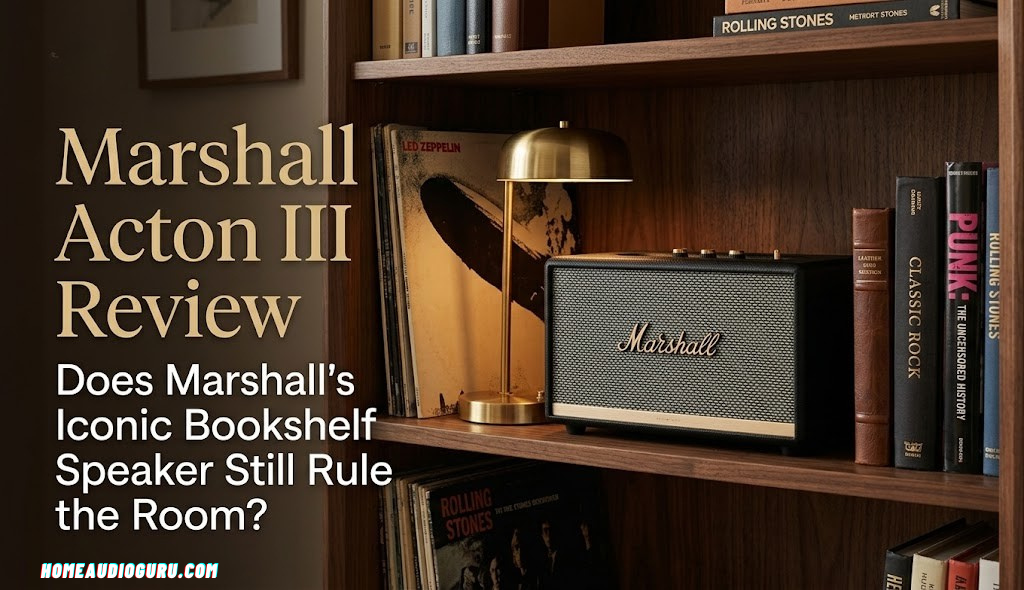
Marshall Acton III Review: Does Marshall’s Iconic Bookshelf Speaker Still Rule the Room?
A deep, honest look at sound quality, connectivity, design, and whether it deserves a spot on your shelf
First Impressions: Unboxing the Marshall Acton III
There’s a specific feeling that comes from lifting a Marshall speaker out of its box for the first time, and the Acton III doesn’t dilute that feeling one bit. Before you even power it on, the weight in your hands tells you this isn’t a plastic toy destined for a junk drawer in six months. The vinyl-textured shell, the brass-toned control knobs catching the light, the fold-back leather-look strap on top — every design cue borrows directly from Marshall’s guitar amplifier heritage, and it’s clearly intentional rather than nostalgic dressing on a generic Bluetooth speaker.
Inside the box, you’ll find the speaker itself, a two-prong (or region-appropriate) power cable, a quick start guide, and not much else. Marshall doesn’t bundle a 3.5mm aux cable in most regions anymore, which is a small omission if you were hoping to wire in a turntable or CD player on day one. Still, the unboxing experience feels premium, deliberately unhurried, like the company wants you to actually look at the thing before you plug it in.
Setting it up is refreshingly low-friction. Plug in power, hold the Bluetooth button until the indicator pulses, and pair from your phone’s Bluetooth menu. Within ninety seconds of opening the box, most people will have music playing. That kind of frictionless first-run experience matters more than spec sheets suggest, because it sets the tone for how much you’ll actually use the speaker versus how much it becomes a shelf ornament that occasionally gets dusted.
If you’ve shopped this category before, you’ve probably also looked at something like the Amazon Echo Studio or a compact soundbar such as the Samsung B-Series soundbar. The Acton III occupies a different lane entirely — it isn’t trying to be a smart speaker hub or a home theater centerpiece. It’s a single-box music speaker built for people who care about how their audio gear looks as much as how it sounds.
Check Current Price and Availability
See real-time pricing, colorways, and shipping options for the Marshall Acton III on Amazon.
View on AmazonDesign and Build Quality
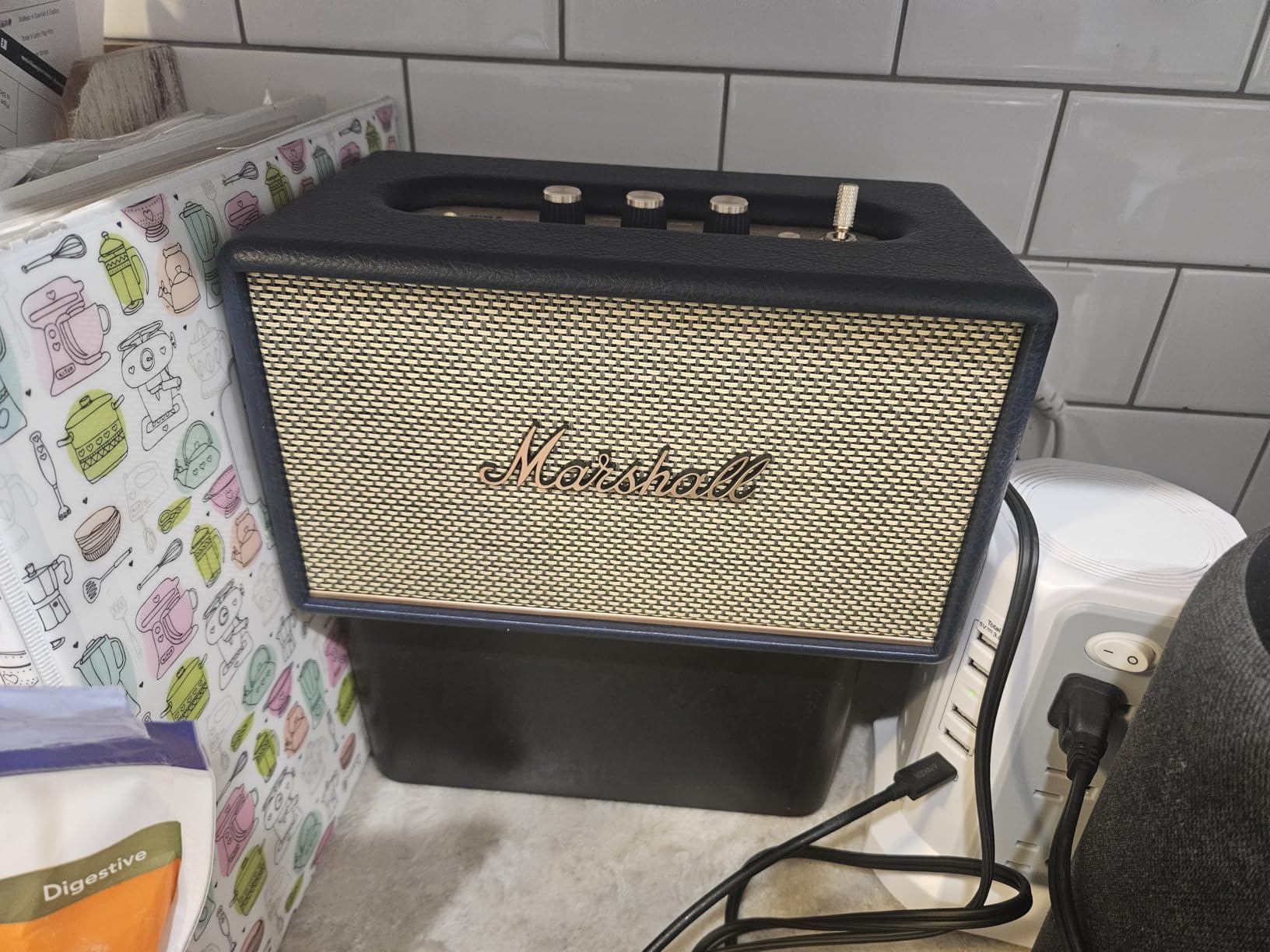
Marshall’s design language is, at this point, basically a genre of its own in the audio world. The Acton III sticks closely to the formula established by its predecessors: a rounded-rectangle cabinet wrapped in textured black vinyl, a woven grille protecting the drivers, and a top panel dominated by three brass-finished knobs and a directional joystick control. It’s unmistakably a Marshall product from ten feet away, and that visual consistency is part of the appeal for people building a cohesive aesthetic across multiple rooms.

The top-mounted controls are more than decoration. The bass and treble knobs give you real, functional EQ adjustment without needing to open an app, which is something a lot of “smart” speakers have quietly abandoned in favor of software-only tone controls buried three menus deep. The volume knob doubles as a source selector button, and the small joystick handles playback, track skipping, and Bluetooth pairing. For anyone who prefers physical controls over swiping through a phone screen every time they want to nudge the treble down, this is a genuinely welcome throwback.
Build quality feels dense and substantial. The cabinet doesn’t flex or creak under light pressure, and the internal bracing is stiff enough that even at higher volumes you won’t feel the enclosure buzzing sympathetically with the bass driver, a common failure point in cheaper speakers. The fabric grille is removable for cleaning, though Marshall doesn’t officially recommend running it through a washing machine, so a light vacuum or damp cloth is the safer approach for dust buildup.
One practical design change from the Acton II generation is the switch to USB-C for auxiliary functions and firmware updates, replacing older micro-USB connections. It’s a small thing, but it matters for future-proofing, since USB-C has become the near-universal standard across phones, laptops, and accessories.
| Design Element | Details |
|---|---|
| Cabinet Material | Vinyl-wrapped MDF-style enclosure |
| Grille | Woven fabric, removable for cleaning |
| Control Layout | Bass, treble, and volume knobs, plus multidirectional joystick |
| Connector Type | USB-C (auxiliary/firmware), 3.5mm aux input |
| Available Finish | Black with brass hardware (primary market color) |
| Approximate Weight | Just over 3 kg, giving it a stable, grounded feel |
Sound Quality Breakdown
This is where the Acton III earns most of its reputation. Marshall built this speaker around a dual-driver configuration: a woofer handling low and midrange frequencies, paired with a tweeter dedicated to the highs. The crossover tuning favors a warm, slightly bass-forward signature rather than a clinical, flat response, which fits the brand’s rock-and-roll heritage but also happens to suit most modern pop, hip-hop, and rock recordings extremely well.
Bass response is the standout trait. For a single-box speaker in this size class, the low end has real weight and texture rather than the boomy, one-note thump you get from cheaper Bluetooth speakers trying to compensate for a small driver with aggressive DSP boosting. You can physically feel kick drums and bass guitar lines rather than just hearing an approximation of them.
Midrange is where vocals and guitars live, and the Acton III handles this band with clarity rather than letting it get swallowed by the bass. Acoustic recordings, in particular, sound natural and present, avoiding the muddy quality that afflicts speakers with poorly tuned crossovers.
Treble is present but never harsh, even at higher volumes, which suggests careful tuning to avoid the sibilance problems that plague many compact speakers when pushed past 70 percent volume. That said, this isn’t an audiophile reference monitor — extreme detail retrieval in the upper frequencies isn’t the goal here, and listeners coming from high-end bookshelf speakers with separate amplification will notice the difference in resolution.

Stereo separation from a single-box speaker is inherently limited by physics, and the Acton III is no exception when used alone. The left and right channels are positioned close together inside one cabinet, so the soundstage is narrower than what you’d get from two separated bookshelf speakers or a proper stereo pair. Marshall addresses this directly by supporting true stereo pairing between two Acton III units through their app, which we cover in more detail further down.
Compared to something like the Bose Smart Soundbar, the tonal philosophy is different. Soundbars are engineered primarily for dialogue clarity and front-stage width for TV content, while the Acton III is tuned specifically as a music speaker first. If your primary use case is movies and TV, that’s an important distinction to weigh.

Hear the Difference Yourself
Sound quality like this is best judged in your own room. Check today’s price and read verified buyer feedback.
Check Price on AmazonBluetooth and Wi-Fi Connectivity
The Acton III moves up to Bluetooth 5.2, a meaningful jump over the Bluetooth 5.0 found in the Acton II. In real-world use, this translates to a noticeably more stable connection with fewer dropouts, especially in apartments or offices crowded with competing 2.4GHz signals from routers, smart home devices, and neighboring Bluetooth gear.
Effective Bluetooth range sits around the typical 10-meter (33-foot) benchmark in open space, though walls, furniture, and interference will shrink that in practice, as with any Bluetooth device. What stands out more than raw range is connection stability at the edges of that range — the Acton III tends to degrade gracefully with minor audio compression rather than cutting out entirely, which is a subtle but appreciated engineering choice.
Beyond Bluetooth, the Acton III also connects to home Wi-Fi networks, unlocking a separate tier of functionality entirely. Once connected to Wi-Fi through the Marshall app, the speaker can stream directly from services like Spotify Connect without routing audio through your phone’s Bluetooth radio, which both improves audio quality slightly (higher potential bitrate) and stops your phone’s battery from draining during long listening sessions.
For anyone weighing this against Wi-Fi-first smart speakers like the Amazon Echo Dot or the larger Echo Dot Max, it’s worth noting the Acton III does not include a built-in voice assistant like Alexa. It’s a hi-fi-focused speaker with smart connectivity features layered on top, not a voice-first smart home device.
Marshall App and Controls
The Marshall app (available for iOS and Android) is where the Wi-Fi features come to life. Inside the app, you can rename the speaker, adjust EQ digitally (in addition to the physical knobs), set up multi-room groups, initiate firmware updates, and link streaming service accounts for direct Spotify Connect playback.
The app’s interface leans minimal and dark-themed, matching the product’s aesthetic rather than feeling like a generic afterthought bolted onto the hardware. Setup walks you through connecting the speaker to your 2.4GHz Wi-Fi network (5GHz-only networks will need a temporary 2.4GHz band enabled on most routers), and the whole process typically takes under five minutes assuming your Wi-Fi credentials are close at hand.
One nice touch: firmware updates are pushed through the app rather than requiring a computer or USB connection, so the speaker has actually gained new features over time — including expanded multi-room compatibility — through software updates alone, without buying new hardware.
| App Feature | Available? |
|---|---|
| Digital EQ Adjustment | Yes |
| Spotify Connect | Yes |
| Multi-Room Grouping | Yes |
| Stereo Pairing Setup | Yes |
| Firmware Updates Over Wi-Fi | Yes |
| Built-In Voice Assistant | No |
Multi-Room and Stereo Pairing
If you already own or plan to own more than one Marshall Wi-Fi speaker, the multi-room feature is a genuine differentiator. Through the app, you can group multiple compatible Marshall speakers across different rooms and play synchronized audio throughout the house, or send different music to different rooms independently.
Stereo pairing deserves special mention because it directly addresses the single-box soundstage limitation discussed earlier. Pairing two Acton III units as dedicated left and right channels transforms the listening experience, particularly for stereo-mixed music where instrument separation and width matter. If budget allows, this is the single upgrade path most likely to make a serious difference in perceived audio quality.
For readers comparing whole-home audio strategies, our guide on the best home audio systems and our walkthrough on how to set up a home audio system both cover how a speaker like the Acton III fits into a broader multi-room strategy, rather than existing as an isolated purchase.
Acton III vs Competitors
The Acton III doesn’t exist in a vacuum. Depending on your budget and priorities, there are several credible alternatives worth cross-shopping before committing.
| Speaker | Best For | Key Tradeoff |
|---|---|---|
| Marshall Acton III | Style-conscious music listeners wanting real physical EQ controls | No built-in voice assistant or battery |
| Polk MagniFi Mini | Compact home theater sound for smaller TVs | Less refined for pure music listening — see our Polk MagniFi Mini review |
| Sony HT-S2000 | Movie-focused households wanting a soundbar setup | Weaker standalone music tonality — see our Sony HT-S2000 review |
| Vizio 5.1 Soundbar SE | Budget-conscious surround sound for TV | Bass reliant on separate subwoofer unit — see our Vizio 5.1 review |
| Amazon Echo Studio | Voice-assistant-first smart speaker households | Less premium physical design — see our Echo Studio review |
If your household is torn between prioritizing music fidelity versus TV dialogue clarity, it’s worth reading our broader breakdown of the best home theater systems under $1000 alongside this review before deciding, since the right answer often depends more on primary use case than on any single spec sheet.
Placement and Room Fit
Because the Acton III relies on a single cabinet for both channels, placement matters more than it would with a true stereo pair. Positioning it away from corners reduces unwanted bass buildup, and keeping it at roughly ear height when seated — on a shelf, credenza, or dedicated stand — gives the most balanced listening experience.
In smaller rooms (bedrooms, home offices, dorm-style spaces), a single Acton III comfortably fills the space with room to spare on the volume dial. In larger open-plan living rooms, the speaker still performs admirably but you may notice bass thinning out at the far edges of the room, which is the point where either a stereo pair or a dedicated system becomes worth considering. For those specifically shopping in the sub-$500 range for larger spaces, our guide to the best home stereo systems under $500 is a useful parallel reference.
Because it’s mains-powered rather than battery-operated, the Acton III is best thought of as a fixed-position speaker rather than something you’ll be carrying between rooms daily — a meaningful distinction from Marshall’s portable Bluetooth speaker lineup.

Ready to Add This to Your Setup?
Compare colors, bundle options, and current Amazon pricing before you decide.
See Latest PriceWho This Speaker Is Really For
The Acton III makes the most sense for people who want one excellent-sounding, great-looking speaker to anchor a room, without needing a receiver, separate amplifier, or a tangle of speaker wire. It suits home offices, bedrooms, living rooms, and studio apartments equally well, and it particularly appeals to anyone who already appreciates Marshall’s design language from their guitar amp heritage.
It’s a less natural fit for anyone whose primary use case is TV and movie dialogue, since a purpose-built soundbar will generally handle center-channel speech more clearly. It’s also not the right choice for outdoor parties or portable use, given the lack of a battery and the absence of a formal water-resistance rating — for that, a ruggedized portable speaker remains the better tool.
Readers curious whether wireless speakers in general sacrifice audio quality compared to wired setups may also want to read our deep dive on whether wireless speakers lose sound quality, as well as our broader piece asking are wireless speakers any good, both of which provide useful context for setting realistic expectations before buying any Bluetooth speaker, including this one.
Pros and Cons Summary
Pros
- Rich, warm sound with genuinely satisfying bass for its size
- Real physical bass/treble knobs, not just app-only EQ
- Premium build quality and unmistakable Marshall design
- Bluetooth 5.2 plus Wi-Fi for stable connectivity and multi-room use
- True stereo pairing option with a second unit
- Spotify Connect support through the Marshall app
Cons
- No internal battery — it’s a stationary, mains-powered speaker
- No built-in voice assistant like Alexa or Google Assistant
- No official water or splash resistance rating
- Single-unit soundstage is narrower than a proper stereo pair
- Premium price point compared to generic Bluetooth speakers
Video Walkthrough
For a hands-on look at the Acton III in action, including how it sounds across different genres and how the physical controls feel in daily use, this video walkthrough is a helpful companion to the written review above.
Frequently Asked Questions
Is the Marshall Acton III worth the money?
For most listeners who want a stationary bookshelf-style Bluetooth speaker with genuine bass response, iconic styling, and multi-room capability, the Acton III earns its price tag. It isn’t the cheapest option in its class, but the build quality and sound signature justify the cost for anyone treating it as a long-term piece of furniture-grade audio gear.
Does the Marshall Acton III have Wi-Fi or just Bluetooth?
The Acton III supports both Bluetooth 5.2 and Wi-Fi connectivity, which means it can join a multi-room system alongside other Marshall Wi-Fi speakers using the Marshall app, in addition to standard Bluetooth pairing from a phone or laptop.
Can the Marshall Acton III be used outdoors?
The Acton III is designed primarily as an indoor speaker. It does not carry a formal IP water-resistance rating, so it should be kept away from rain, pool splashes, or humid outdoor environments. For outdoor use, a ruggedized portable speaker is a better fit.
How long does the battery last on the Marshall Acton III?
The Acton III does not include an internal battery. It is a mains-powered speaker meant to stay plugged in as a stationary unit, which is a key difference from Marshall’s portable lineup like the Emberton or Kilburn series.
What is the difference between the Marshall Acton II and Acton III?
The Acton III upgrades the wireless chipset to Bluetooth 5.2 for a more stable connection, adds Wi-Fi and multi-room support through the Marshall app, refines the internal amplifier tuning, and includes USB-C for auxiliary and firmware needs, while keeping the same recognizable analog-style control layout as its predecessor.
Does the Marshall Acton III support stereo pairing?
Yes. Two Acton III units can be paired together through the Marshall app to create a true left-right stereo pair, which noticeably widens the soundstage compared to running a single speaker in mono.
Is the Marshall Acton III loud enough for a large room?
The Acton III comfortably fills small to medium rooms such as bedrooms, home offices, and living rooms up to roughly 300 square feet. In larger open-plan spaces, volume remains adequate but bass presence thins out, so a second unit or a dedicated home theater system is a better match for bigger areas.
Does the Marshall Acton III work with Spotify Connect?
Yes, the Acton III supports Spotify Connect directly through the Marshall app once it’s connected to Wi-Fi, allowing playback control without keeping Bluetooth active or draining a phone’s battery.
What colors does the Marshall Acton III come in?
The Acton III is most commonly available in the classic black vinyl finish with brass detailing, which matches the aesthetic of the rest of Marshall’s home speaker lineup, though cream and other limited finishes have appeared in some markets.
Can I use the Marshall Acton III with a turntable?
The Acton III does not have a dedicated phono input, so a turntable would need a built-in preamp or an external phono preamp connected through the auxiliary input to work properly with this speaker.
Is the Marshall Acton III better than a soundbar?
For music listening, the Acton III generally produces richer, more balanced sound than a budget soundbar. For TV and movie dialogue clarity, a purpose-built soundbar with center-channel tuning still tends to have the edge, so the right choice depends on whether music or TV audio is the priority.
Does the Marshall Acton III have Bluetooth multipoint?
The Acton III can remember multiple previously paired devices, but true simultaneous multipoint connection to two active devices at once is limited, so most users will still need to manually switch sources when moving between a phone and a laptop.
Inside the Amplifier: Power, Class D Efficiency, and Heat Management
Underneath the vinyl shell, the Acton III runs a Class D amplifier design paired with dedicated channels for the woofer and tweeter, a configuration often described as bi-amping. Instead of a single amp pushing a passive crossover network, each driver receives power tuned specifically to its frequency range. This matters more than it sounds on paper, because it means the woofer isn’t wasting amplifier headroom trying to reproduce frequencies it was never designed to handle cleanly, and the tweeter isn’t starved of power during bass-heavy passages.
Class D amplification also brings efficiency benefits that show up in two practical ways: the speaker doesn’t get uncomfortably hot during long listening sessions, and it can push meaningful volume without an external power brick the size of a laptop charger. Older analog amplifier designs of similar output would run considerably hotter and less efficiently, which is part of why compact, mains-powered speakers of the Acton III’s size were rare a decade ago.
In everyday use, you’ll notice the cabinet stays only mildly warm to the touch even after hours of continuous playback at moderate-to-loud volumes, a good sign that the internal thermal design and driver protection circuitry are doing their job. Marshall doesn’t publish exhaustive continuous-power figures in most consumer-facing materials, but the practical experience is one of confident headroom — you can turn the volume knob most of the way up in a small-to-medium room without the sound falling apart into distortion or the amplifier audibly straining.
This headroom is part of why the Acton III holds up so well against speakers that look similar on a spec sheet but sound thin or strained once pushed past conversational volume. A lot of budget Bluetooth speakers can hit a stated maximum decibel number, but the difference between “loud” and “loud and still sounding good” is where the amplifier design and driver matching really separate serious audio gear from novelty electronics.
A Closer Look at Materials and Long-Term Durability
Longevity is a fair question to ask before spending this much on a single speaker, and it’s worth examining the materials choices that go into the Acton III beyond the surface-level vinyl wrap. The cabinet itself uses a dense composite material designed to resist resonance, which is the enemy of clean bass reproduction. A flimsy enclosure will vibrate along with the woofer, smearing bass notes together and adding an unwanted buzzing quality at higher volumes. The Acton III’s cabinet, by contrast, stays inert even when the woofer is working hard, which you can verify yourself by resting a hand flat against the side panel during a bass-heavy track.

The fabric grille uses a tightly woven weave that resists sagging over time, a detail that matters because cheaper speakers often see their grille cloth stretch and droop within a year or two of regular handling. The brass-finished knobs, meanwhile, use a metal-and-composite hybrid construction rather than pure plastic, which explains why they feel more substantial to turn than the loose, wobbly knobs found on many competing products in this price bracket.
Feet on the underside are rubberized, which serves two purposes: they prevent the speaker from sliding on smooth shelf surfaces during bass-heavy playback, and they decouple the cabinet slightly from the surface it’s resting on, reducing unwanted resonance transfer into wooden shelves or cabinets. This is a small detail, but it’s the kind of engineering thoughtfulness that shows up in the listening experience even if most buyers never consciously notice it.
Marshall’s home speaker lineup, including the Acton III, tends to hold resale value reasonably well precisely because of this reputation for durability. Owners of older Acton and Kilburn models frequently report years of daily use without any degradation in either the physical control feel or the underlying audio performance, which is a meaningful data point when comparing against speakers that are functionally disposable after eighteen months.
Real-World Setup Walkthrough
Because setup experience varies so much between smart speakers, it’s worth walking through exactly what happens from the moment you plug in the Acton III to the moment it’s fully integrated into a home network, rather than relying on marketing claims about “easy setup.”
After connecting power, the speaker illuminates a small indicator light near the control cluster. Holding the Bluetooth button for a few seconds puts it into pairing mode, at which point it appears in your phone’s Bluetooth device list under its default product name. Standard Bluetooth pairing at this stage takes seconds and requires no app at all — this is worth highlighting because some competing “smart” speakers require app-based account creation before they’ll even play audio over Bluetooth, which is a frustrating experience if you just want to quickly play a podcast.
Moving to Wi-Fi and the full Marshall app experience takes a few extra minutes. After downloading the app and creating an account, the app scans for nearby Marshall speakers on the same network segment (or guides you through a temporary Bluetooth-assisted setup handshake if the speaker isn’t yet on Wi-Fi). You’ll select your home Wi-Fi network, enter your password, and the speaker reboots briefly before appearing as a controllable device inside the app’s device list.
From there, linking a Spotify account, adjusting digital EQ, naming the speaker for multi-room purposes (“Living Room,” “Office,” etc.), and checking for firmware updates are all just a few taps away. The entire process, start to finish including account creation, typically takes under ten minutes for anyone with their Wi-Fi password readily available — which stacks up favorably against the more convoluted setup flows that some competing ecosystem-locked smart speakers require.
For households already running other connected audio gear, our step-by-step guide on how to set up a home audio system covers broader network considerations — like keeping IoT devices on a separate Wi-Fi band or guest network — that can make multi-speaker setups like this one run more smoothly across an entire household.
Genre-by-Genre Listening Notes
Spec sheets and driver descriptions only tell part of the story. To really understand how the Acton III performs, it helps to walk through how it handles different genres of music, since tonal balance preferences vary so much depending on what you actually listen to.
Rock and Classic Rock
Unsurprisingly, given Marshall’s amplifier heritage, this is where the Acton III feels most at home. Distorted guitars have bite without becoming harsh, and the low end gives kick drums and bass guitar real physical presence. Live recordings in particular benefit from the speaker’s slightly forward midrange, which brings vocal presence and crowd ambience closer to the listener.
Hip-Hop and Bass-Heavy Electronic Music
The bass response here is a genuine strength. Sub-bass elements that would disappear entirely on smaller Bluetooth speakers retain real weight and rhythm on the Acton III, though listeners chasing true sub-40Hz extension for the deepest electronic bass will still want a dedicated subwoofer. For casual and moderately serious listening, though, the low end holds up impressively for a single-cabinet design.
Acoustic and Singer-Songwriter Material
This is arguably the most surprising strength of the speaker. Stripped-back acoustic guitar and vocal recordings sound remarkably natural, with none of the boxy coloration that plagues bass-forward speakers when handling sparse arrangements. Vocal sibilance is well controlled, and string instrument texture comes through with more nuance than the speaker’s rock-oriented reputation might suggest.
Classical and Orchestral
This is the one genre where the Acton III’s limitations show up most clearly. Orchestral recordings demand wide dynamic range and a broad soundstage that a single-cabinet speaker simply can’t replicate, regardless of internal engineering quality. Listeners who primarily enjoy classical music will get more accurate results from a true stereo pair (using two Acton III units) or a dedicated hi-fi system.
Podcasts and Spoken Word
Voice clarity is excellent, helped by the well-controlled midrange, making this a strong choice for podcast listening in a home office or kitchen. The physical volume knob is particularly handy here, letting you make quick on-the-fly adjustments during a call or while cooking without fumbling for a phone.
Where the Acton III Sits in Marshall’s Broader Lineup
Understanding the Acton III’s positioning within Marshall’s full catalog helps clarify who it’s actually built for. Marshall’s speaker lineup spans truly portable, battery-powered models designed for outdoor use and travel, all the way up to larger stationary speakers intended as serious home hi-fi replacements. The Acton III sits closer to the middle of that spectrum — bigger and more capable than the compact portables, but smaller and more affordable than Marshall’s flagship stationary speakers.
This middle positioning is precisely why it works so well as a single “do it all” speaker for a bedroom, office, or apartment living room, without asking buyers to commit to either a compact, bass-light portable speaker or a large, expensive floor-standing hi-fi unit. It’s the practical middle ground, and for a large percentage of shoppers, that middle ground is exactly the right fit.
It’s also worth noting how the Acton III fits into a hub-and-spoke buying strategy for readers building out a full home audio setup room by room. Pairing an Acton III in a living room with a soundbar-driven setup in a media room, or a portable speaker for the patio, is a common and sensible way to avoid over-committing to a single form factor across an entire home.
Common Issues and How to Resolve Them
No speaker is entirely free of quirks, and prospective buyers benefit from knowing what issues actually come up in real-world use rather than just marketing copy. The most commonly reported issue with the Acton III, as with most Wi-Fi-enabled speakers, involves initial network connection hiccups — typically resolved by ensuring the speaker connects to a 2.4GHz band rather than a 5GHz-only network, since many Wi-Fi speaker chipsets (this one included) don’t support 5GHz connections.
Bluetooth pairing conflicts can occasionally occur if the speaker has too many previously paired devices remembered simultaneously; clearing the pairing list through a factory reset (typically a button combination held for several seconds, detailed in the manual) resolves this in the rare cases it comes up.
Firmware update failures, while uncommon, are usually resolved by ensuring a stable Wi-Fi connection during the update process and avoiding power interruption mid-update. Marshall’s app typically flags update status clearly and won’t leave the speaker in a non-functional state if an update is interrupted, though patience during the process is advisable.
Users switching between Bluetooth and Wi-Fi/Spotify Connect modes occasionally report a few seconds of audio lag during the handoff, which is a minor, expected behavior rather than a defect, as the speaker’s internal audio pathway briefly reconfigures between input sources.
Marshall’s Journey From Guitar Amps to Home Speakers
To fully appreciate why the Acton III looks and sounds the way it does, it helps to understand where Marshall came from as a company. Marshall built its reputation over decades as a maker of guitar amplifiers used on some of the most famous stages in rock history. The stack of Marshall amps behind a guitarist became almost as iconic as the music itself, and that visual identity — black vinyl, gold piping, a certain rugged confidence — is baked directly into every consumer speaker the brand has released since expanding into lifestyle audio.
When Marshall entered the Bluetooth speaker and headphone market, it faced an interesting challenge: translate an identity built around stage volume and raw guitar tone into consumer products meant for bedrooms, offices, and living rooms. The Acton line, now in its third generation, represents one of the more successful examples of that translation. Rather than simply slapping a Marshall logo on a generic speaker shell, the engineering teams behind the Acton speakers clearly worked to carry over some of that amplifier-driven warmth into the tuning itself, not just the aesthetic.
This lineage matters for buyers because it explains a specific tonal personality that shows up across the whole Marshall speaker range, the Acton III included. It’s not a neutral, reference-flat sound signature the way some studio monitor manufacturers pursue. It’s a deliberately colored, warm, slightly bass-forward sound that flatters rock, pop, and hip-hop first, while still handling other genres respectably. Buyers who understand this going in tend to be far happier with their purchase than those expecting a clinical, audiophile-neutral tuning.
Each generation of the Acton has iterated primarily on connectivity and internal electronics rather than reinventing the exterior design, and that’s arguably the right call. The physical design already resonates strongly with the target audience; the smart money goes into making the Bluetooth chipset more stable, the Wi-Fi features more capable, and the amplifier tuning more refined, rather than chasing a design refresh for its own sake.
What a Week of Daily Use Actually Looks Like
Specs and first impressions only tell part of the story — the real test of any speaker is what happens after the novelty wears off and it becomes part of your daily routine. Over a week of regular use spanning morning news podcasts, background music during work, and evening listening sessions, a few patterns emerge with the Acton III that are worth calling out specifically.
Mornings tend to be podcast and news territory for most people working from a home office, and this is where the physical volume knob earns its keep. Being able to reach over and nudge volume up or down without unlocking a phone, opening an app, or asking a voice assistant to repeat a command it misheard is a small but constant quality-of-life improvement that’s easy to underestimate until you’ve lived with it for a week.
Midday work sessions with background music reveal how well the Acton III handles lower listening volumes without losing tonal balance. A lot of bass-forward speakers sound impressively punchy at party volume but become thin and hollow when turned down for background listening. The Acton III’s internal tuning holds up reasonably well at lower volumes, retaining a sense of body in the low end even when it’s not being pushed hard, which speaks to thoughtful loudness-compensation tuning in the amplifier stage rather than a simple one-size-fits-all EQ curve.
Evenings are where the speaker gets to show off. Whether it’s a dinner playlist, a movie’s soundtrack playing in the background, or a proper focused listening session, this is when the Acton III’s bass depth and overall dynamic range feel most rewarding. It’s also when the stereo pairing option (if you own two units) becomes most noticeable, since a wider soundstage matters more during focused listening than during passive background use.
By the end of a week, the pattern that emerges is one of consistent reliability: Bluetooth reconnects promptly every time a paired phone comes back into range, Wi-Fi streaming through Spotify Connect rarely drops out, and the physical controls never feel like an afterthought bolted onto a software-first product. For a speaker meant to become part of daily infrastructure rather than a novelty, that consistency matters more than any single standout spec.
Building Out a Multi-Room Ecosystem Around the Acton III
For readers thinking beyond a single speaker purchase, it’s worth mapping out how the Acton III can serve as a starting point for a broader whole-home audio ecosystem rather than a one-off purchase. Because Marshall’s Wi-Fi speaker lineup shares the same multi-room platform, an Acton III bought today can be joined later by additional Marshall speakers in other rooms, all controllable from the same app, all capable of playing synchronized audio or independent streams depending on the moment.
A sensible expansion strategy might start with a single Acton III in the most-used room of the home — typically a living room or open-plan kitchen/living space — before adding a second unit either as a true stereo pair in that same room, or as an independent speaker in a bedroom or office. This staged approach lets you spread cost over time while still ending up with a cohesive, single-app-controlled system rather than a mismatched pile of competing speaker brands and apps.
For homes that already have a mix of existing audio gear — a soundbar in the media room, smart speakers in the kitchen — the Acton III can still slot in cleanly as a Bluetooth-only addition without needing to fully commit to the Wi-Fi ecosystem, which offers useful flexibility for anyone not ready to standardize their entire home around one platform. This flexibility is one of the underappreciated strengths of a well-designed dual-mode (Bluetooth plus Wi-Fi) speaker: it works equally well as a standalone impulse purchase or as the seed of a much larger system.
Readers actively planning a full-home rollout may find it useful to cross-reference this review against our broader guide on the best home audio systems, which discusses budget allocation strategies across multiple rooms rather than focusing on a single product in isolation.
Price-to-Value Analysis
No review is complete without an honest conversation about value, and value is a more nuanced question than simply comparing sticker prices across a spec sheet. The Acton III sits in a premium-but-not-flagship price bracket within Marshall’s own lineup, above their smallest and most affordable options but below their largest stationary speakers designed to compete more directly with true hi-fi bookshelf systems.
When judged purely on a dollar-per-decibel or dollar-per-watt basis, generic Bluetooth speakers from lesser-known brands will always appear cheaper. What that comparison misses is everything that doesn’t show up on a spec sheet: build quality that holds up over years rather than months, a control scheme that remains genuinely pleasant to use daily, firmware support that continues adding features rather than abandoning the product after launch, and a design that ages gracefully rather than looking dated within a single product cycle.
Viewed through that lens, the Acton III’s price makes considerably more sense. It’s priced as a long-term piece of home audio furniture rather than a disposable gadget, and buyers who intend to keep it for five-plus years will find the cost-per-year of ownership quite reasonable compared to buying and replacing two or three cheaper speakers over that same period.
That said, value is always contextual. Buyers on a tight budget who mainly need background music for a dorm room or a single season of apartment living may reasonably conclude that a cheaper speaker meets their needs adequately, and that’s a perfectly valid conclusion. The Acton III’s value proposition is strongest for buyers who see this as a long-term investment in their living space rather than a short-term convenience purchase.
Buyer Personas: Four Real Scenarios
Rather than speaking to buyers in the abstract, it helps to walk through a handful of realistic scenarios and how the Acton III fits, or doesn’t fit, into each one.
The Apartment Dweller Building Their First Real Sound System
For someone moving into their first apartment and wanting one good speaker rather than a phone propped against a water glass, the Acton III is close to an ideal entry point. It requires no separate amplifier, no speaker wire, and no technical setup knowledge beyond plugging it in and pairing a phone. The compact footprint also suits smaller living spaces where a full component stereo system simply isn’t practical.
The Home Office Professional
Someone spending eight-plus hours a day at a desk benefits enormously from a speaker that handles both background music and video call audio well, without needing dedicated desktop computer speakers cluttering the workspace further. The Acton III’s balanced midrange makes spoken audio from video calls and podcasts clear, while its bass response keeps focus-friendly instrumental music from sounding thin during long stretches of low-volume background listening.
The Multi-Room Household Planner
For a family or household planning to eventually cover multiple rooms with synchronized audio, starting with a single Acton III and expanding over time through Marshall’s multi-room platform offers a lower-risk entry point than committing to an expensive whole-home system all at once. Each additional speaker adds coverage without requiring new infrastructure or rewiring.
The Design-Conscious Buyer
Some buyers genuinely care as much about how a speaker looks sitting on a shelf as how it sounds playing music. For this buyer, generic black-box Bluetooth speakers from unfamiliar brands simply aren’t in consideration regardless of specs, because they don’t want to look at them. The Acton III’s stage-inspired design solves that problem directly, functioning as much as a piece of intentional home decor as a piece of audio equipment.
Accessories and Optional Add-Ons Worth Considering
While the Acton III works perfectly well as a standalone purchase, a few optional accessories can meaningfully improve the experience depending on your specific setup. A dedicated speaker stand or shelf riser, for instance, can help position the speaker at proper ear height in rooms where existing furniture doesn’t naturally place it there, improving both perceived sound quality and visual presentation.
For anyone planning to run a wired auxiliary connection — from a turntable with a built-in preamp, an older CD player, or a laptop without reliable Bluetooth — a good quality 3.5mm auxiliary cable is worth having on hand, since Marshall doesn’t always bundle one in the box depending on region and retailer.
A second Acton III unit is, as discussed earlier, the single accessory purchase most likely to meaningfully transform the listening experience through true stereo pairing. For buyers on the fence about whether to buy one unit now and a second later, or two units at once, buying both simultaneously (where budget allows) avoids potential firmware version mismatches between an older and newer production batch, which can occasionally complicate initial pairing setup.
Surge protection is also worth a mention for any mains-powered audio equipment kept plugged in long-term. A basic surge-protected power strip is inexpensive insurance against power fluctuations that could otherwise affect the internal electronics over years of continuous use.
Longevity, Repairability, and Long-Term Ownership
An often-overlooked part of any purchase decision in this price range is how well a product is supported years down the line, both in terms of continued firmware updates and physical repairability if something eventually goes wrong. Marshall has a track record of supporting its Wi-Fi speaker lineup with firmware updates well beyond the initial launch window, which matters because software-connected speakers can otherwise become functionally obsolete if a manufacturer stops maintaining the backend services and companion app.
On the physical repair side, the modular nature of the internal components — separate driver units, a distinct amplifier board, and a separate Wi-Fi/Bluetooth module — means that, in principle, individual failures don’t necessarily require replacing the entire unit, though official consumer repair programs and parts availability vary by region and should be checked directly with Marshall support if longevity and repairability are a top priority for your purchase decision.
From a pure durability standpoint, previous generations of the Acton line have developed a reasonably strong reputation for lasting many years of daily use without significant performance degradation, which is a meaningful data point for buyers weighing this against cheaper alternatives that may need replacing far sooner.
Living With the Acton III Long-Term: What Changes After the Honeymoon Phase
Initial impressions of any product are inevitably colored by the novelty of unboxing something new. What’s more useful for a buying decision is understanding how a product feels after that initial excitement fades and it simply becomes part of the furniture, literally and figuratively.
With the Acton III, the qualities that stand out in month one are largely the same qualities that hold up in month six and beyond: the physical controls remain satisfying to use rather than becoming an annoyance, the build quality shows no signs of the wobble or looseness that cheaper speakers develop over time, and the sound signature continues to flatter the kind of music it was tuned for without becoming fatiguing during long listening sessions.
The one place where long-term ownership reveals something not obvious from a first impression is how much the multi-room and Wi-Fi features get used in practice versus how much they seemed appealing on a spec sheet. Many buyers report using straightforward Bluetooth pairing far more often day-to-day than the full Wi-Fi/Spotify Connect feature set, simply because Bluetooth requires zero extra setup once paired. The Wi-Fi features become genuinely valuable specifically for households that expand into multi-room setups, while single-speaker households may find themselves leaning on Bluetooth as their default connection method most of the time regardless of what the app offers.
This is a useful, honest data point for prospective buyers: the Wi-Fi and multi-room capabilities are real, functional, and well-implemented, but they’re a bonus layer on top of a speaker that already succeeds purely as a well-built, great-sounding Bluetooth speaker, rather than being the sole reason to justify the purchase.
A Deeper Technical Look: How the Wireless Chipset Handles Real-World Interference
Bluetooth 5.2 brings improvements that go beyond a simple version number bump. The updated chipset generation improves how the speaker negotiates and maintains connections in environments crowded with other wireless devices, which matters enormously in real apartment and office settings where dozens of Bluetooth accessories, Wi-Fi routers, smart home hubs, and other 2.4GHz devices are all competing for the same frequency spectrum.
In practical terms, this shows up as fewer momentary dropouts when walking between rooms with a phone in your pocket, more reliable reconnection after the source device goes to sleep or briefly disconnects, and generally lower audible latency between phone and speaker, which matters more than people expect when watching video content over Bluetooth, since noticeable lip-sync drift is one of the more common complaints with older Bluetooth speaker generations.
The improved chipset also enables more efficient coexistence between the Bluetooth radio and the separate Wi-Fi radio inside the same enclosure, which is a genuinely difficult engineering problem — two radios operating on overlapping frequency bands inside one small chassis can interfere with each other if not carefully managed, leading to degraded performance on both connections simultaneously. Marshall’s implementation in the Acton III handles this coexistence competently, with users rarely reporting simultaneous Bluetooth and Wi-Fi performance issues when both are technically active (though as noted earlier, true simultaneous dual-source audio isn’t a supported use case).
For technically inclined buyers who care about these details, it’s worth noting that wireless performance in speakers like this is rarely just about the advertised Bluetooth version number. Antenna placement, shielding from the metal driver components, and firmware-level connection management all play equally important roles, and Marshall’s iterative refinement across three generations of the Acton line shows in how dependable the wireless performance feels in day-to-day use compared to earlier models in the same product family.
Availability, Warranty, and What to Check Before Buying
Before finalizing a purchase, it’s worth confirming a few practical details that can vary by retailer and region. Warranty coverage on Marshall’s home speaker lineup typically follows standard consumer electronics terms, but buyers should confirm current warranty length and terms directly through the listing or Marshall’s official documentation at time of purchase, since policies can be updated.
Power cable and plug configuration will vary depending on the region you’re purchasing for, so double-check that the listing matches your local electrical standard rather than assuming a universal cable is included. Buyers importing the speaker from a different region than where they’ll use it should specifically verify voltage compatibility and plug type before ordering.
Because this is a popular, frequently reviewed product, it’s also worth checking recent buyer feedback on the listing itself for any region-specific or batch-specific quality control notes that may not be reflected in a general review, since manufacturing consistency can occasionally vary between production runs of any high-volume consumer electronics product.
Expert Tips for Getting the Most Out of Your Acton III
A handful of practical adjustments can meaningfully improve the listening experience beyond simply plugging the speaker in and pressing play, and it’s worth walking through them since most buyers never discover these on their own.
Tip One: Start With Flat EQ, Then Adjust by Ear Over Several Days
It’s tempting to immediately crank the bass knob upon first listen, since the low end is the Acton III’s most immediately gratifying trait. A better approach is to leave both bass and treble knobs at their neutral center position for the first few listening sessions across different genres, then make small adjustments based on what you notice is missing rather than what feels exciting in the moment. Ears adapt quickly to a boosted bass response, and what sounds thrilling on day one can start to feel muddy and fatiguing by day five if pushed too far initially.
Tip Two: Position Away From Hard Corners
Room corners naturally reinforce bass frequencies through boundary reinforcement, a basic principle of room acoustics. Placing the Acton III directly in a corner will often result in bass that sounds boomy and undefined compared to the same speaker positioned a foot or two away from adjacent walls. If corner placement is unavoidable due to room layout, compensating by nudging the bass knob slightly toward the lower end can help restore balance.
Tip Three: Use the Physical Knobs for Genre-Specific Adjustments
Rather than settling on one permanent EQ setting, take advantage of the physical knobs to make small adjustments when switching between fundamentally different genres. A slight treble boost helps acoustic and vocal-forward material breathe a little more, while a slight bass boost benefits hip-hop and electronic music without needing to dig through app menus to make the change.
Tip Four: Keep Firmware Current
Because Marshall periodically pushes firmware improvements through the app, it’s worth checking for updates every month or two rather than assuming the speaker is done receiving improvements after initial setup. Past updates to speakers in this product line have included meaningful additions like expanded multi-room compatibility and connection stability improvements, delivered entirely through software rather than requiring new hardware.
Tip Five: Consider Cable Management for a Cleaner Look
Because the Acton III is mains-powered, there’s a permanent power cable to route. A simple cable clip or channel along the back of a shelf keeps the cord from becoming a visible eyesore that undercuts the otherwise clean, considered aesthetic the speaker brings to a room. This is a minor detail, but for design-conscious buyers, it’s the kind of finishing touch that makes the difference between a speaker that looks intentionally placed versus one that looks like it was set down in a hurry.
The Broader Bookshelf Bluetooth Speaker Landscape
It’s worth stepping back and looking at where products like the Acton III sit within the broader evolution of home Bluetooth speakers over the past several years. A decade ago, the category was dominated by simple mono or basic-stereo pucks with limited EQ control, minimal build quality ambition, and connectivity limited strictly to Bluetooth with no companion app ecosystem at all. Buyers had few options that combined genuine audio fidelity with design that could double as home decor rather than obviously looking like a gadget.
The market has matured considerably since then, driven partly by consumer expectations shifting toward wanting fewer, better devices rather than a growing pile of single-purpose gadgets scattered around the home. Speakers like the Acton III represent that maturation directly: a single product expected to handle Bluetooth streaming from a phone, Wi-Fi streaming from a fixed home network, multi-room grouping with other speakers, and physical control for users who don’t want to touch an app for every minor adjustment.
This convergence of features into fewer devices is likely to continue, and buyers evaluating the Acton III today are effectively looking at a snapshot of where premium lifestyle audio has landed for this particular form factor: single-cabinet stationary speakers with real EQ control, dual connectivity, and design language strong enough to stand as a piece of furniture in its own right. Whether the next generation pushes further into voice assistant integration, expanded wireless protocols, or entirely new form factors remains to be seen, but the current formula the Acton III represents has clearly resonated enough with buyers to justify three full product generations and counting.
For shoppers trying to decide whether to buy now or wait for a hypothetical future revision, the practical answer is usually to buy based on today’s needs rather than speculating on unannounced future products. The Acton III, as it exists right now, already represents a mature, well-refined execution of everything this speaker category is currently capable of delivering at this size and price point.
Final Verdict: Should You Buy the Marshall Acton III?
The Marshall Acton III succeeds at exactly what it sets out to do: deliver warm, room-filling sound in a genuinely handsome package, backed by real physical controls and modern Wi-Fi convenience features. It’s not trying to be a smart home hub, a portable party speaker, or a home theater surround system, and judging it against those categories misses the point. As a dedicated music speaker for a bedroom, office, or living room, it’s one of the more compelling single-box options in its price range, especially for anyone who values tactile controls and a design that looks as good turned off as it does playing music.
If your priorities lean toward TV dialogue clarity or true portability, this isn’t the right tool for the job — but if you want one speaker that sounds great and looks like a piece of intentional decor rather than tech clutter, the Acton III is very much worth your consideration.
Check Current Price on Amazon