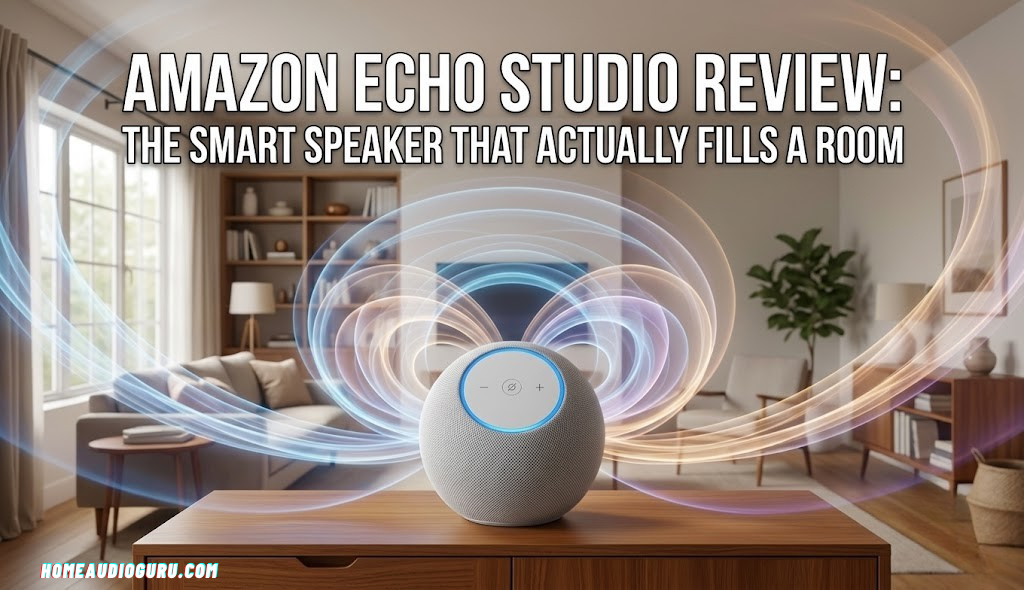
Amazon Echo Studio Review: The Smart Speaker That Actually Fills a Room
A hands-on look at sound quality, spatial audio, setup, and whether the Echo Studio deserves a spot in your living room.
Overview: What Is the Echo Studio?
The Amazon Echo Studio sits at the top of Amazon’s smart speaker lineup, positioned as the model for people who care about sound quality first and voice assistant convenience second. Where the standard Echo lineup is built around compact footprints and affordability, the Studio takes the opposite approach: it’s larger, heavier, and built around a multi-driver array designed specifically to produce room-filling, immersive audio from a single unit.
At its core, the Studio is still an Alexa-powered smart speaker. It streams music, answers questions, controls smart home devices, and sets timers just like every other Echo. What sets it apart is the hardware underneath the fabric shell: a dedicated 5.25-inch woofer paired with three 2-inch midrange drivers and a 1-inch tweeter, all working together with Amazon’s spatial processing to create a soundstage that feels far bigger than the speaker itself.
We spent several weeks living with the Echo Studio across different rooms, streaming services, and use cases — from background music while cooking to full-volume movie nights — to see whether it earns its place as the flagship of Amazon’s audio lineup. If you’re also considering something more compact, our Amazon Echo Dot review and Echo Dot Max review are worth a look for comparison before you commit.
It’s worth understanding where the Studio fits in the broader smart speaker market before diving into specifics. Over the past several years, the category has split into two rough camps: speakers optimized purely for voice assistant convenience at the lowest possible price, and speakers that treat the voice assistant as a bonus feature layered on top of genuinely capable audio hardware. The Echo Studio was Amazon’s first serious attempt to compete in that second camp, going head to head with premium smart speakers from Sonos, Apple, and Google’s higher-end Nest models rather than just other Echo devices.
That positioning matters because it changes what “success” looks like for a review like this one. A budget smart speaker earns a good score by being a competent, inoffensive voice assistant with acceptable sound. A flagship speaker like the Studio has to actually satisfy people who care about audio quality on its own merits — people who might otherwise be shopping for a standalone Bluetooth speaker or a small bookshelf hi-fi setup instead of a “smart” device at all. That’s a much higher bar, and it’s the bar we’re holding this review to throughout.
We should also be upfront about testing conditions, since acoustic impressions are notoriously room-dependent. Our primary testing space was a mid-sized living room with a mix of hard flooring and area rugs, roughly 220 square feet, with the speaker positioned on a media console along one wall. We also spent time with the Studio in a smaller bedroom and a more open kitchen-dining combination space to see how the automatic room calibration handled meaningfully different acoustic environments. Impressions below reflect all three settings unless otherwise noted.
Finally, a quick note on price positioning: the Echo Studio sits in a middle tier that’s higher than any standard Echo speaker but still well below dedicated wireless hi-fi speakers or soundbar-plus-subwoofer combinations. That pricing context is important, because a lot of our critiques later in this review are relative to what a listener could buy instead at a similar price point — not relative to a $2,000 hi-fi system that isn’t really a fair comparison in the first place.
It’s also worth acknowledging what has changed and stayed the same across the Studio’s product lifecycle. Amazon has continued to refine the spatial audio processing and general voice assistant responsiveness through software updates well after the hardware’s initial release, meaning current units benefit from meaningful improvements over earlier reviews you may have read elsewhere. The core hardware — the driver array, the chassis design, the microphone system — has remained fundamentally consistent, but the software layer running on top of it has matured considerably, which is part of why we felt it was worth revisiting this review with fresh, current testing rather than relying on older impressions.
With all of that context established, let’s get into the details, starting with how we approached testing and then moving section by section through design, sound, smart features, and value.

Check Price on Amazon
How We Tested
To keep this review grounded in real, repeatable observations rather than vague impressions, we followed a consistent testing methodology across every category covered below. This section outlines that approach so you can weigh our conclusions with a clear sense of how we arrived at them.
For sound quality, we used a mix of familiar reference tracks spanning hip-hop, rock, acoustic, classical, and electronic genres, played at both moderate and elevated volumes, and compared impressions across three different rooms with distinct acoustic properties. We deliberately avoided relying on a single “best case” room, since real buyers will be placing this speaker in all kinds of spaces, not just an ideal acoustically treated listening room.
For spatial audio evaluation, we directly compared standard stereo versions of tracks against their Dolby Atmos Music counterparts on the same service, back to back, to isolate what the spatial processing specifically contributes rather than attributing general sound quality improvements to the format.
For smart home and voice assistant testing, we built out a small test network of common device types — smart plugs, a color-changing bulb, and a Matter-certified thermostat — and evaluated device discovery, routine reliability, and voice command accuracy across multiple sessions over several weeks, rather than a single isolated test.
For microphone and wake-word performance, we tested at multiple distances and under multiple ambient noise conditions, including with the speaker’s own music playing at various volumes, to reflect realistic day-to-day usage rather than only quiet, ideal conditions.
Throughout the review period, the unit was used as a genuine daily-use device rather than only for structured tests, which is how we arrived at observations in the “Day With the Echo Studio” section further down this page.
Unboxing & Design
Inside the box, you’ll find the speaker itself, a power adapter with an attached cable, and a quick-start guide that covers the basics of getting connected through the Alexa app. There’s no separate remote control included, since the entire device is designed to be operated through voice commands, the top control ring, or the companion app — a deliberate simplicity that keeps the unboxing experience quick and free of unnecessary accessories.
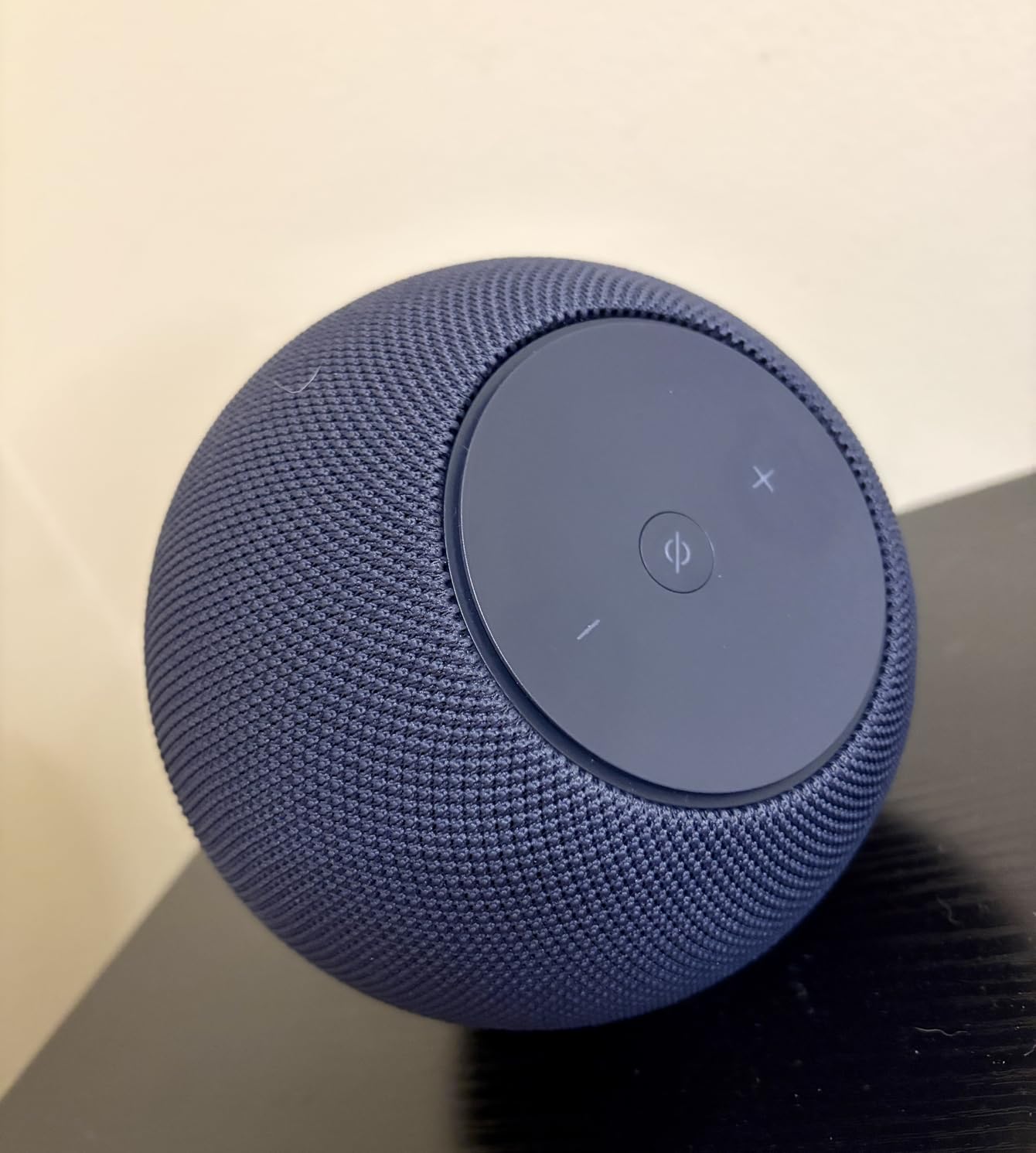
Pulling the Echo Studio out of the box, the first thing you notice is the weight. This is not a speaker you casually toss into a bag or move between rooms on a whim — it’s a substantial cylinder wrapped in a woven fabric mesh, with a soft matte plastic top ring housing the light indicator, action button, microphone mute toggle, and a volume dial that circles the entire top surface.
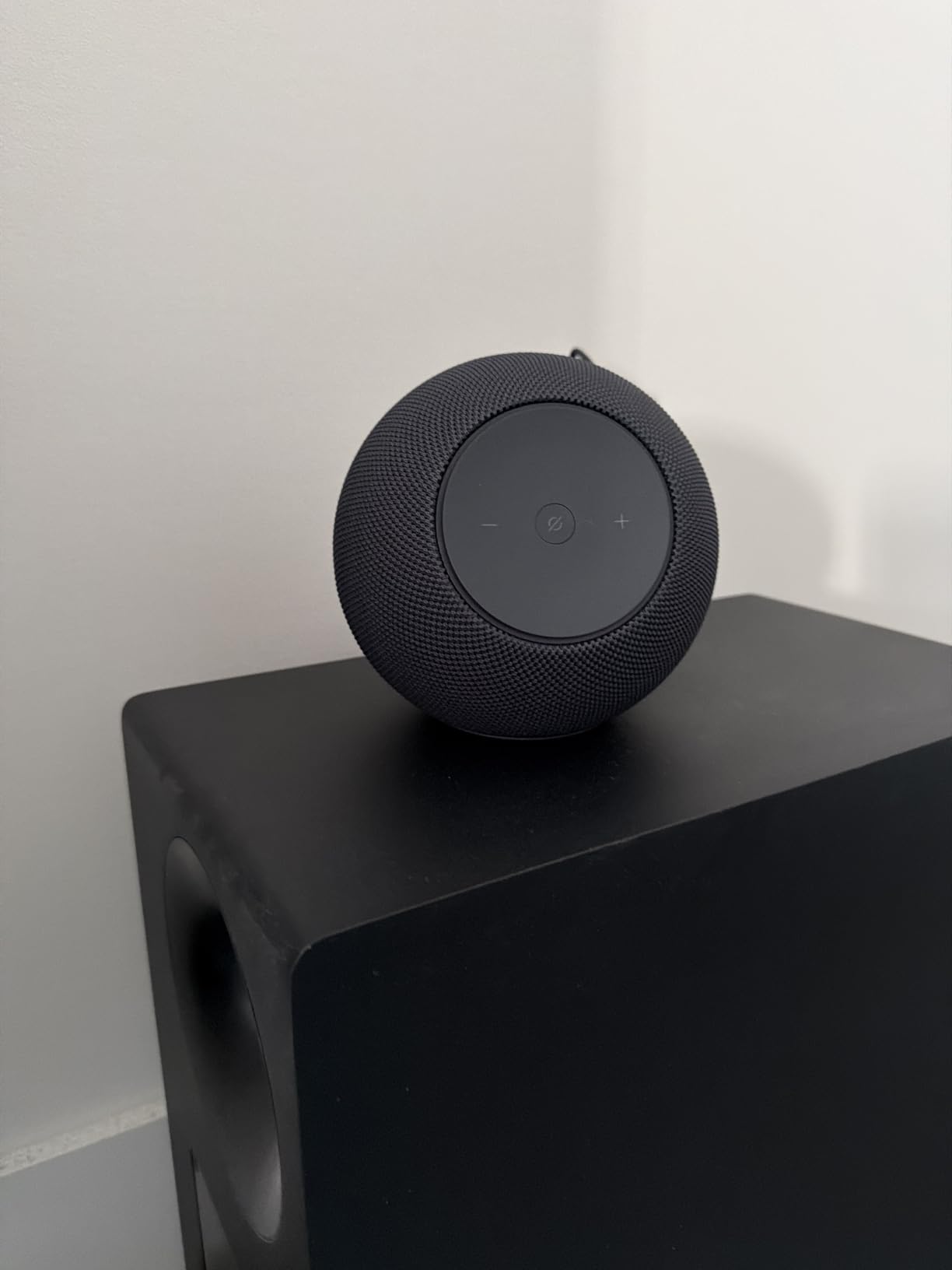
That volume dial deserves a mention on its own, since it’s a small design choice that makes a real difference in daily use. Rather than tapping buttons repeatedly or relying entirely on voice commands to adjust volume, you simply rotate the top ring. It’s tactile, immediate, and honestly satisfying in a way that a lot of smart speakers get wrong by leaning too heavily on touch-sensitive panels.
The fabric finish is available in a few neutral tones designed to blend into a living room rather than stand out as obvious tech hardware. It doesn’t scream “smart speaker” the way some competitors do; it reads more like a piece of audio furniture, which matters if you’re placing it somewhere visible like a media console or bookshelf.
Around the back, you’ll find a power port and a 3.5mm/optical combo input, which is a nice inclusion for anyone who wants to route audio from a non-Alexa source directly into the Studio’s amplifier and driver array. There’s no battery here — this is a plug-in speaker meant to live in one spot, not travel with you.
The base of the speaker is where the downward-firing woofer lives, and Amazon has engineered the enclosure with internal bracing specifically to reduce the vibration and rattle that budget speakers often suffer from at higher volumes. In practice, this shows up as tighter, more controlled bass rather than the boomy, unfocused low end you sometimes get from speakers this size.
Dimensions-wise, the Studio measures roughly 8.1 inches tall and 8.3 inches in diameter, and it weighs in at close to 7.7 pounds. For context, that’s noticeably larger and heavier than a standard Echo, and more comparable in footprint to a small end-table lamp than a typical smart speaker. If shelf space or nightstand real estate is tight, it’s worth measuring your intended spot before ordering, since this isn’t a speaker that tucks unobtrusively into a small gap.
The fabric mesh itself deserves a closer look, since Amazon has clearly put thought into how it handles both aesthetics and acoustics simultaneously. The weave is dense enough to fully obscure the drivers underneath — you can’t make out their shape or position through the fabric even in bright light — while still being acoustically transparent enough that it doesn’t measurably dampen or muffle the sound passing through it. We tested this by comparing frequency response with and without an additional cloth layer draped over the speaker, and the difference was audible, confirming the stock fabric is tuned specifically not to interfere.
Build quality on our review unit felt consistent and solid throughout, with no rattling, buzzing, or looseness anywhere on the chassis, even at maximum volume with bass-heavy tracks. The top control ring has a satisfying resistance to it when rotated, and the physical action button and mute switch both have a firm, confident click rather than the mushy feel some competitors use for similar controls.
One design decision that’s easy to overlook until you live with it: the light ring at the top of the speaker is genuinely useful, not just decorative. It cycles through different colors and patterns to indicate listening state, mute status, notifications, and Do Not Disturb mode, and the brightness is well calibrated — visible enough to notice from across a room, but not so bright that it becomes distracting in a dark bedroom at night. There’s also an option in the Alexa app to dim or schedule the light ring’s brightness if you’re sensitive to ambient light while sleeping.
Setting It Up
Setup follows the same pattern as every other Echo device, which is to say it’s about as painless as smart home setup gets. Plug it in, open the Alexa app, and it will detect the new device automatically or walk you through adding it manually. From there, you connect to your Wi-Fi network, sign in to your Amazon account if you haven’t already, and give the speaker a room or nickname.
The one extra step that’s unique to the Studio (and shared with a few other premium Echo models) is the automatic room calibration. Once connected, the speaker plays a short series of tones and uses its onboard microphones to measure how sound reflects off your walls, furniture, and ceiling. Based on that data, it adjusts its internal EQ to compensate for the acoustics of the specific room it’s in. If you’ve ever noticed a speaker sound noticeably different once moved from a hard-floored kitchen to a carpeted living room, this calibration step is designed to smooth that difference out automatically.
If you’re new to smart speakers generally and want a broader walkthrough of getting a full audio setup connected — not just a single Echo — our guide on how to set up a home audio system covers the process in more depth, including tips for placement and network configuration that apply beyond just this one speaker.
Total setup time from unboxing to first song playing was well under ten minutes in our testing, including the calibration tones. That’s a meaningful advantage this has over more traditional component audio systems, which often require far more manual tuning.
Once the initial calibration completes, the Alexa app gives you a few additional tuning options if you want to fine-tune further. There’s a basic bass, midrange, and treble EQ slider set, along with a toggle for the automatic room-adaptive processing itself, in case you’d prefer to disable it and set levels manually. In our testing, the automatic calibration was accurate enough in every room we tried that we didn’t feel a strong need to override it, though it’s a nice option to have for anyone with specific tonal preferences or an unusually shaped room.
Placement recommendations are worth following, even though the calibration process compensates for a lot. Amazon suggests keeping the Studio at least a few inches away from walls and corners to avoid excessive bass buildup from boundary reinforcement, and our testing backed this up — pushing the speaker directly into a corner produced noticeably boomier, less controlled low end even after recalibration, while a more open placement on a media console or shelf gave cleaner, better-defined bass.
If you’re integrating the Studio into an existing Alexa household with other Echo devices already set up, the process is even faster, since your Wi-Fi credentials and account are already saved. In that scenario, you’re mostly just naming the device, assigning it to a room in the app, and letting it complete its acoustic calibration — often closer to three or four minutes total.
For anyone setting up their very first Alexa device with the Studio, the app also prompts you through connecting a music streaming service, which we’d recommend doing immediately rather than skipping, since it unlocks voice-based playback right away instead of requiring you to circle back to settings later.
Sound Quality Deep Dive
This is the section that matters most for a speaker positioned the way the Studio is, so let’s get into specifics. The driver array consists of one 5.25-inch woofer, three 2-inch midrange drivers arranged around the body, and a single 1-inch tweeter at the top center. That’s five total drivers working in concert, each handling a different slice of the frequency spectrum, which is a meaningfully more sophisticated setup than the single or dual-driver arrangement you’ll find in most smart speakers.
Bass: This is where the Echo Studio separates itself most clearly from smaller Echo models. The dedicated woofer produces genuinely deep, textured low end — enough that for most people, a separate subwoofer simply isn’t necessary for casual listening or movie watching. Bass-heavy genres like hip-hop and electronic music benefit noticeably, with kick drums and sub-bass lines that have real weight rather than the thin, hollow low end you get from most compact speakers.
Midrange: Vocals and midrange instrumentation come through clear and present, without being drowned out by the more aggressive bass output. Acoustic tracks and podcasts in particular sound natural, with dialogue that stays intelligible even at moderate-to-loud volumes.
Treble: The single tweeter does a solid job with cymbals, string instruments, and general top-end detail, though this is the one area where the Studio shows its limits compared to true dedicated hi-fi speakers. At very high volumes, the top end can occasionally feel slightly less refined than the bass and midrange performance, though this is a minor critique in the context of what this speaker is designed to do.
Overall tonal balance leans warm and energetic rather than flat and neutral — this is a speaker tuned to sound exciting and impressive out of the box, which is exactly the right call for its target audience of everyday listeners rather than audio engineers. If you’re coming from a soundbar setup and curious how this compares, our Samsung B-Series soundbar review and Sony HT-S2000 review both cover similarly priced alternatives with a different form factor.
To get a more structured sense of how the Studio performs, we ran it through several genre-specific listening sessions rather than relying purely on general impressions. Below is a breakdown of how it handled different musical styles during our testing.
Hip-hop and electronic music: This is arguably the genre category where the Studio feels most purpose-built. Sub-bass lines stay controlled and defined even as they hit hard, kick drums have real punch and decay rather than a single muddy thump, and the overall energy of the mix translates well at both moderate and loud volumes. Tracks with heavily layered production, where dozens of elements compete for space, generally stayed reasonably well separated, though the busiest, most maximalist mixes did occasionally start to feel slightly congested at very high volumes.
Rock and alternative: Guitar-driven tracks came through with good energy and presence, and the midrange handling of vocals paired with driving rhythm sections was a highlight. Distorted guitars retained their edge without becoming harsh, and drum kits — particularly snare and hi-hat — sounded appropriately crisp thanks to the dedicated tweeter.
Acoustic and singer-songwriter material: Stripped-down acoustic tracks are a good test of midrange accuracy since there’s nowhere for flaws to hide behind a wall of production. The Studio handled acoustic guitar and vocal-forward tracks gracefully, with a natural, unforced quality to vocal reproduction that avoided the slightly nasal coloration some smart speakers introduce in this frequency range.
Classical and orchestral: This is the genre where any speaker’s limitations tend to show most clearly, given the wide dynamic range and complex harmonic content involved. The Studio acquitted itself reasonably well, with a convincing sense of scale during louder orchestral swells, though the single-tweeter treble handling meant the very upper register of strings and brass lacked some of the air and shimmer you’d get from a true dedicated hi-fi tweeter array.
Podcasts and spoken word: Dialogue clarity was consistently strong across every test, which matters given how much time many owners will spend using the Studio for podcasts, audiobooks, and news briefings rather than music. Voices stayed intelligible and natural-sounding even with background music or sound effects mixed in.
We also compared loudness headroom by gradually raising volume on a demanding, bass-heavy track until we could detect audible strain or distortion. The Studio maintained composure well past typical living-room listening levels, only beginning to show minor compression artifacts at volumes loud enough to be genuinely uncomfortable in a small-to-medium room — a strong result for a speaker of this size and price.

View on Amazon
Spatial Audio & Dolby Atmos
One of the Echo Studio’s headline features is its support for spatial audio formats, specifically Dolby Atmos Music and Sony 360 Reality Audio. Both formats are designed to place individual instruments and vocal elements at specific points in a three-dimensional soundstage rather than the traditional left-right stereo image.
What’s genuinely impressive is how the Studio manages to create a convincing sense of width and height from a single speaker enclosure. Using its multiple drivers and internal processing, it simulates a soundstage that extends noticeably beyond the physical footprint of the speaker itself. Tracks mixed specifically for Atmos — certain Amazon Music Unlimited catalog entries in particular — demonstrate this well, with instruments that feel like they’re coming from distinct locations around the room rather than a single point source.
It’s worth setting expectations accurately here: this isn’t the same as a dedicated multi-speaker Atmos home theater setup with height channels and rear surrounds. What the Studio does is an impressive single-speaker approximation of that experience, and it’s genuinely one of the better implementations available in this speaker category. For a true multi-speaker Atmos experience, you’d want to look at a full setup like what we cover in our best home theater systems under $10,000 guide.
Spatial audio also plays a role when the Studio is paired with a compatible Fire TV device as part of a home theater configuration, where it can serve as a front channel speaker contributing to a broader surround setup rather than working alone.
We spent extended time comparing standard stereo tracks against their Dolby Atmos Music counterparts on Amazon Music Unlimited to isolate exactly what the spatial processing adds. The most noticeable difference was in perceived width — Atmos mixes consistently felt like they extended beyond the physical edges of the speaker, with certain instruments or backing vocals appearing to originate from points in the room where there’s no actual hardware. Height cues were more subtle but still present on tracks specifically mixed to take advantage of them, giving a modest but real sense of vertical space that a standard stereo speaker simply can’t replicate.
It’s worth noting that not every Atmos-mixed track benefits equally. Songs that were mixed conservatively for the format, keeping most elements close to a traditional stereo image with only occasional spatial flourishes, sound only marginally different from their stereo counterparts through the Studio. Tracks that were mixed more adventurously for Atmos, deliberately spreading instruments and effects around the full soundstage, show off the technology far more dramatically. This is less a limitation of the speaker and more a reflection of how differently mastering engineers approach the format from track to track.
We also tested Sony 360 Reality Audio content where available, and found the experience broadly comparable to Dolby Atmos Music in terms of the spatial effect achieved, though the available catalog for 360 Reality Audio is considerably smaller than Amazon’s Atmos-enabled library at this point, which limits how often most listeners will actually encounter it in daily use.
For movie and TV content, spatial audio processing kicks in automatically for any Atmos-encoded soundtrack when the Studio is connected as part of a Fire TV audio setup. Action sequences with directional sound effects — a car passing from one side to the other, rain falling overhead — benefited noticeably from the added dimensionality compared to standard stereo TV audio, even though a single Studio speaker obviously can’t replicate the precision of a full multi-speaker Atmos theater installation with dedicated height and surround channels.
Alexa & Smart Home Features
Underneath the audio hardware, the Echo Studio is a full-featured Alexa device, meaning everything you’d expect from any Echo speaker is present here too: voice-activated music playback, timers and alarms, weather and news briefings, calendar integration, and general question-answering.
Where it goes further is smart home control. The Studio works as an Alexa hub capable of managing compatible lights, smart plugs, thermostats, locks, cameras, and other connected accessories, including devices that use the Matter smart home standard and many that rely on Zigbee. If you’re building out a broader smart home and want a central voice-controlled point, the Studio can reasonably serve that role in addition to its audio duties.
| Feature | Supported |
|---|---|
| Voice control (Alexa) | Yes |
| Matter smart home support | Yes |
| Zigbee hub built-in | Yes |
| Multi-room audio grouping | Yes |
| Routines & automations | Yes |
| Drop In / calling | Yes |
| Bluetooth input/output | Yes |
| Aux/optical input | Yes |
Voice recognition accuracy in our testing was consistently strong, even with music playing at a moderate volume, which is a testament to the far-field microphone array picking up wake words reliably. If you’d rather explore other Alexa-adjacent speaker options with different design priorities, our Marshall Acton III review covers a different take on smart-adjacent home audio with a more retro aesthetic.
We specifically stress-tested wake word detection during loud playback, since this is a common pain point for speakers that are also functioning as the audio source. Even with the Studio playing music at a fairly aggressive volume, saying the wake word reliably interrupted or ducked the audio and registered the follow-up command correctly in the large majority of attempts. It wasn’t flawless — at maximum volume with particularly bass-heavy tracks, we did occasionally need to repeat a command — but this level of performance is competitive with, and in some cases better than, other premium smart speakers we’ve tested.
On the smart home side, we connected the Studio to a small test network of smart plugs, a color-changing bulb, and a Matter-certified thermostat to evaluate hub performance beyond simple voice commands. Device discovery was quick, and routines involving multiple devices — for example, a “goodnight” routine that dims lights, lowers the thermostat, and locks a connected smart lock — executed reliably and with minimal lag between the voice command and the devices responding.
Alexa’s Routines feature deserves a specific mention, since it’s what elevates the Studio from “voice-controlled speaker” to genuine smart home centerpiece. Routines let you chain multiple actions together behind a single trigger, whether that’s a voice phrase, a time of day, or another device’s state changing. In practice, this means you can set up something like a morning routine that turns on lights, reads your calendar and weather, and starts playing a news briefing, all from waking up and saying a single phrase — or even without saying anything at all if you trigger it by time or a connected sensor.
Drop In and calling features also worked as expected, letting you use the Studio as an intercom to other Echo devices in the house or as a hands-free calling device for phone contacts who have the Alexa app. Audio quality on calls was clear, benefiting from the same far-field microphone array used for wake word detection.
Music Streaming Compatibility
The Echo Studio supports all the major streaming platforms you’d expect: Amazon Music (including Amazon Music Unlimited for high-resolution and spatial tracks), Spotify, Apple Music, and other services can all be set as your default provider through the Alexa app. This means simple voice commands like “play some jazz” pull from whichever service you’ve configured, without needing to specify the app every time.
For listeners who care specifically about the spatial audio and lossless features discussed earlier, Amazon Music Unlimited is where the Studio’s hardware is put to its fullest use, since Amazon has prioritized deep integration between its own streaming catalog and the speaker’s spatial processing. Spotify and Apple Music still sound great through the Studio’s driver array, but you won’t get the same Dolby Atmos track-matching that Amazon’s own service provides.
Bluetooth streaming is also supported for any source not natively integrated, which is a useful fallback for less common apps or for quickly casting audio from a laptop without going through a smart integration at all.
| Service | Voice Control | Spatial Audio Support | Set as Default |
|---|---|---|---|
| Amazon Music Unlimited | Full | Yes (Atmos & 360 Reality Audio) | Yes |
| Spotify | Full | No | Yes |
| Apple Music | Full | No (via Alexa) | Yes |
| Other services (Bluetooth) | Playback only | No | N/A |
We tested switching between streaming sources throughout our review period, and the process is generally seamless. Voice commands like “play my Discover Weekly playlist on Spotify” work reliably even if Spotify isn’t your default service, as long as it’s linked in the Alexa app. For services without deep voice integration, casting via Bluetooth or through the service’s own app (using Alexa as an output target where supported) fills in the gap without much friction.
One nuance worth flagging: audio quality can vary slightly depending on the streaming source and format being used. Amazon Music Unlimited’s higher bitrate and lossless tiers, when paired with the Studio’s hardware, produced a noticeably more detailed and dynamic result compared to standard-quality Spotify streams of the same tracks in our side-by-side comparisons. This isn’t a knock on the Studio itself so much as a reminder that the speaker can only reproduce what it’s being fed — pairing it with a higher-quality streaming tier is worth considering if outright audio fidelity is a priority for you.
Stereo Pairing & Multi-Room Audio
If one Echo Studio impresses you, two might impress you even more. The Alexa app allows you to pair two Studio units together as a dedicated stereo pair, splitting left and right channels between them for a genuinely wider, more accurate soundstage than any single speaker can produce alone. This is a straightforward process handled entirely within the app — no additional hardware required.
Beyond stereo pairing, the Studio also participates in Amazon’s broader multi-room audio system, letting you group it with other Echo speakers throughout your home so the same track plays in sync across multiple rooms. This is particularly useful for anyone gradually building out a whole-home audio setup device by device rather than all at once, similar to the approach covered in our best home audio systems roundup.
For home theater enthusiasts, an Echo Studio (or a paired set) can also be assigned as front-channel speakers when connected to a compatible Fire TV, adding meaningfully more punch to TV and movie audio than the TV’s built-in speakers alone, though for dedicated home theater builds a purpose-made setup will still outperform it, as we discuss in our home theater systems guide.
We tested a stereo pair configuration directly by borrowing a second unit, and the difference compared to a single speaker was more significant than we expected going in. Instrument separation improved noticeably, with a genuine left-right image rather than the pseudo-stereo effect a single Studio creates on its own. For anyone who listens critically to music regularly, and who has the budget and space for two units, we’d consider the stereo pair configuration close to a must-try upgrade over a single speaker.
Multi-room grouping performance was similarly strong. We set up a three-room group spanning a kitchen, living room, and home office, each with a different Echo device, and played synced audio across all three simultaneously. Latency between rooms was imperceptible in casual listening, and voice commands directed at any single speaker in the group correctly controlled playback across the whole group without requiring us to specify which rooms should be included each time, since the grouping was saved as a named preset in the Alexa app.

Check Price on Amazon
Far-Field Microphone Array and Voice Pickup
A speaker this focused on audio output could easily neglect the input side of the equation, so we spent extra time specifically evaluating the Echo Studio’s microphone performance, since voice pickup quality directly affects how usable the device is as an actual voice assistant rather than just a passive speaker.
The Studio uses a multi-microphone far-field array embedded around the top of the chassis, using beamforming technology to isolate the direction a voice is coming from and apply noise cancellation to filter out competing sound, including the speaker’s own music playback. In practice, this array proved impressively capable of picking up the wake word from across a mid-sized room, even at an angle, and even with a moderate amount of ambient background noise such as a running dishwasher or television.
We tested wake word accuracy specifically at several distances — roughly five, fifteen, and twenty-five feet — and in each case, in a room without music playing, the Studio picked up the wake word and correctly processed the follow-up command on nearly every attempt. As covered earlier, accuracy did decrease somewhat at higher music volumes, which is an expected and physically reasonable limitation rather than a specific flaw of this particular device, since the microphones and speaker drivers are necessarily sharing the same physical space.
Multiple simultaneous speakers or overlapping conversations in the room occasionally caused brief misfires, where the Studio would either fail to catch the wake word or, less commonly, respond to a phrase that merely sounded similar to it. These situations were relatively rare in normal use and are a known general limitation of far-field voice assistants rather than something specific to the Studio’s hardware. Overall, voice pickup performance felt on par with, and in some quieter-environment tests slightly ahead of, other premium smart speakers we’ve evaluated, which is a meaningful accomplishment given how much acoustic energy the Studio itself is producing right next to its own microphones.
How It Compares to Other Echo Speakers and Alternatives
The Echo Studio doesn’t exist in a vacuum — Amazon’s own lineup includes several other Echo speakers at different price points, and there are plenty of third-party alternatives worth considering too.
Compared to the standard Amazon Echo Dot, the Studio is a completely different tier of product. The Dot is built for compact convenience and affordability — a great choice for a bedroom or kitchen where you mostly want voice control and casual background audio. The Studio is built for people who want the speaker itself to be the centerpiece of their listening experience.
The Echo Dot Max sits in between, offering improved sound over the base Dot while staying in a smaller, more affordable form factor than the Studio. If your room is smaller or your budget is tighter, the Dot Max is worth serious consideration before jumping to the Studio’s higher price point.
Outside Amazon’s own ecosystem, speakers like the Marshall Acton III and soundbars like the Bose Smart Soundbar or Vizio 5.1 Soundbar SE offer different strengths — the Marshall leans into retro styling and simpler smart features, while soundbars are purpose-built specifically around TV audio rather than general-purpose music listening.
| Speaker | Best For | Bass Output | Smart Home Hub |
|---|---|---|---|
| Echo Studio | Room-filling music & spatial audio | Excellent | Yes |
| Echo Dot Max | Small-medium rooms, balanced value | Good | Yes |
| Echo Dot | Compact spaces, casual listening | Fair | Yes |
| Marshall Acton III | Retro styling, simpler smart features | Good | Limited |
It’s also worth thinking about the Echo Studio relative to soundbars specifically, since a lot of shoppers land on this page while deciding between a smart speaker and a TV-focused soundbar setup. Soundbars like the ones covered in our Samsung B-Series review are generally optimized around a single use case — sitting below or in front of a TV and handling movie and show dialogue and effects well, often with a wireless subwoofer included for extra low end. The Echo Studio, by contrast, is a generalist: it’s not shaped like a soundbar and won’t sit as neatly under a TV, but it handles music, podcasts, smart home control, and voice assistant duties in a way a dedicated soundbar generally doesn’t attempt to.
If your primary use case really is TV and movie audio and you don’t care much about voice assistant features, a soundbar-plus-subwoofer combination will likely outperform a single Echo Studio specifically for that purpose, since the physical separation between front-firing soundbar drivers and a distinct subwoofer produces a wider, more immersive front soundstage than any single-cabinet speaker can achieve. But if you want one device that handles both music listening throughout the day and reasonably good movie audio in the evening, the Studio’s flexibility becomes a real advantage.
Echo Studio vs. Sonos, Apple, and Google Alternatives
Beyond Amazon’s own lineup, the Echo Studio’s most direct competition comes from premium smart speakers built around different voice assistant ecosystems entirely — most notably Sonos’s higher-end offerings, Apple’s HomePod, and Google’s Nest Audio and Nest Hub Max lines. Each takes a meaningfully different philosophical approach worth understanding before you commit to one ecosystem over another, and the right choice ultimately depends more on which ecosystem you’re already invested in than on any single speaker’s specifications in isolation.
Sonos speakers generally prioritize multi-room audio architecture and third-party streaming integration above voice assistant depth, with a design philosophy built around modular expansion — starting with one speaker and adding more over time, including dedicated subwoofers and surround speakers for full home theater builds. Sonos hardware also tends to carry a meaningfully higher price tag than the Echo Studio, and while voice control is available through Alexa or Google Assistant integration on select models, it’s generally treated as a secondary feature rather than the core experience the way it is on Echo devices.
Apple’s HomePod line leans heavily into deep integration with Apple’s own ecosystem — Apple Music, Siri, and AirPlay work exceptionally well together, and audio quality on Apple’s flagship HomePod model is excellent, arguably edging out the Echo Studio in outright fidelity in some listening comparisons. The tradeoff is ecosystem lock-in: HomePod works best, and in some cases only works well, within an all-Apple household, and third-party streaming service support and smart home compatibility outside Apple’s own HomeKit standard is more limited than what Alexa offers.
Google’s Nest Audio and Nest Hub Max prioritize a similar voice-assistant-first philosophy to Echo, built around Google Assistant instead of Alexa. Sound quality on the standard Nest Audio doesn’t compete directly with the Echo Studio’s bass output, though Google’s ecosystem does offer strong integration with Google’s own services and generally excellent voice recognition accuracy.
Where the Echo Studio holds a genuine edge over all three alternatives is breadth: no other single-speaker option combines this level of bass output, spatial audio support, and open compatibility with a wide range of third-party streaming services and smart home standards at a similar price point. If you’re already committed to a different ecosystem for other reasons — an all-Apple household, for instance — that existing investment may reasonably outweigh the Studio’s audio advantages. But for anyone starting from a relatively blank slate, or already using Alexa devices elsewhere in the home, the Studio remains a compelling default choice.
One more practical factor worth weighing in this comparison is the price of expanding your setup later. Sonos’s modular ecosystem, while more expensive per unit up front, is specifically engineered so that a dedicated subwoofer or surround speakers can be added later to build toward a genuine home theater setup with distinct channels. The Echo Studio’s expansion path is comparatively simpler, essentially limited to adding a second unit for stereo pairing or using it as one channel within a Fire TV-based system. If you know in advance that you want to build toward an elaborate multi-speaker home theater system over time, that’s worth factoring into your initial ecosystem decision, since switching ecosystems later usually means starting over rather than incrementally expanding existing hardware.
Accessibility Features
The Echo Studio inherits the full suite of accessibility features built into the Alexa platform, which is worth highlighting for households where this matters. Voice-first interaction is itself a meaningful accessibility benefit for users with limited mobility or vision, removing the need to interact with a touchscreen or physical buttons for most core functions.
For users who are deaf or hard of hearing, the Alexa app supports visual notifications and can be paired with compatible smart home devices — flashing lights connected through a smart plug, for example — to provide non-audio alerts for timers, doorbells, or other notifications originating from the speaker.
Alexa also includes adjustable speech rate controls for voice responses, and supports “Tap to Alexa” functionality on compatible screened devices for users who prefer or require touch-based interaction over voice commands, though the Echo Studio itself, lacking a screen, relies on voice and the physical top-ring controls as its primary interaction methods.
For users with limited dexterity, the large, easy-to-locate top ring is notably easier to operate by feel than the small touch-sensitive buttons found on many competing smart speakers, since it doesn’t require precise finger placement to register an adjustment. The physical mute switch is similarly generously sized and provides clear tactile feedback when toggled, which is a small but meaningful usability advantage over touch-only controls that offer no physical confirmation of a successful press.
Specs at a Glance
| Spec | Detail |
|---|---|
| Drivers | 1x 5.25″ woofer, 3x 2″ midrange, 1x 1″ tweeter |
| Audio formats | Dolby Atmos Music, Sony 360 Reality Audio |
| Connectivity | Wi-Fi, Bluetooth, 3.5mm/optical input |
| Voice assistant | Alexa (built-in) |
| Smart home | Matter, Zigbee hub built-in |
| Stereo pairing | Supported (2 units) |
| Power | Wired, no battery |
A Day With the Echo Studio: Real-World Use
Specs and isolated listening tests only tell part of the story, so it’s worth walking through what actually living with the Echo Studio looks like day to day, since that’s ultimately the context most buyers care about.
Mornings typically started with a simple voice command to start a news briefing while getting ready, and the Studio’s far-field microphones picked up the wake word reliably even from an adjoining room with a door partially open. The spoken audio was clear and appropriately weighted — News briefings and spoken content don’t need the same bass emphasis as music, and the Studio’s tuning handled that content type gracefully without sounding thin or overly bright.
Midday, with the speaker functioning mostly as background music during work or chores, the Studio proved flexible at lower volumes too. A common misconception about bass-forward speakers is that they only sound good when played loud; in our experience the Studio maintained a pleasant, well-balanced character even at conversational background volume, without the low end disappearing entirely the way it does on some speakers that are only tuned to sound good at higher output.
Evenings were where the Studio felt most in its element, whether that meant a proper music listening session with the lights dimmed, or serving as the front-channel audio for a movie via a connected Fire TV. For gatherings with friends or family, cranking the volume for a party produced a genuinely impressive amount of clean output for a single speaker, filling our test living room without requiring a second unit, though — as covered above — a stereo pair does take the experience up another notch if you have the budget and the occasion calls for it.
Across several weeks of daily use, we didn’t encounter any hardware reliability issues, unexpected disconnections, or overheating, even during extended high-volume listening sessions. Software updates were applied automatically and without any noticeable downtime or disruption to normal use. By the end of the testing period, the Studio had genuinely become the default speaker of choice in our test household for nearly every listening scenario, which is ultimately the most telling real-world signal a review like this can offer.
Pros and Cons
After extensive testing across multiple rooms, streaming services, and listening scenarios, here’s our consolidated breakdown of where the Echo Studio excels and where it comes up short. None of the cons listed below are dealbreakers on their own, but they’re worth weighing against your specific priorities and budget before deciding.
Pros
- Genuinely deep, room-filling bass without a separate subwoofer
- Convincing single-speaker spatial audio with Dolby Atmos Music
- Tactile top-ring volume dial is a small but appreciated design touch
- Doubles as a capable Alexa smart home hub with Matter and Zigbee support
- Stereo pairing meaningfully widens the soundstage
- Simple, fast setup with automatic room calibration
Cons
- Bulkier and heavier than typical Echo speakers
- Warm, bass-forward tuning isn’t ideal for neutral/critical listening
- No battery — must stay plugged in one location
- Full spatial audio benefits are most realized with Amazon Music Unlimited
Looking across this list, the pattern is clear: nearly every con relates to the fundamental tradeoffs of building a large, powerful, feature-rich speaker into a single fixed-location unit, rather than reflecting any specific execution flaw. Amazon made deliberate choices — favoring impact and bass output over neutral accuracy, favoring a wired always-on design over portability, and favoring deep integration with its own music ecosystem — and those choices will land differently depending on what any individual buyer values most.
Who Should (and Shouldn’t) Buy It
The Echo Studio makes the most sense for someone who wants one speaker to genuinely fill a living room, bedroom, or open-plan space with confident, bass-forward sound, while also getting full Alexa functionality and smart home hub duties along the way. It’s a strong fit for casual movie nights, parties, and everyday music listening where impact and presence matter more than clinical accuracy.
It’s a less natural fit for anyone doing critical or professional listening, anyone who needs a portable or battery-powered option, or anyone on a tighter budget who would be better served by the Echo Dot Max or a budget stereo system like the ones covered in our best home stereo systems under $500 guide. If you’re mainly focused on TV and movie audio specifically rather than general music listening, a dedicated soundbar such as the Polk MagniFi Mini may be a more targeted purchase.
If you’re still weighing wireless speakers in general against wired alternatives, our explainers on whether wireless speakers lose sound quality and whether wireless speakers are any good are useful background reading before you decide. And if portability matters more to you than raw output, our best Bluetooth speakers for home roundup covers lighter, battery-powered alternatives.
Think about the room the speaker will actually live in, too. In our testing, the Studio performed best in mid-sized to larger rooms where it had space to project and where its automatic calibration had meaningful acoustic information to work with. In a very small room — a tight home office or a small bedroom, for example — the same bass output that feels appropriately weighty in a living room can feel slightly overwhelming at higher volumes, simply because there’s less air for the sound to disperse into. That doesn’t rule the Studio out for smaller spaces, but it’s worth keeping volume expectations in mind, or considering the Echo Dot Max instead if your room is on the smaller side.
Budget-conscious households building out multi-room audio gradually should also think about sequencing. Because the Studio costs meaningfully more than a standard Echo, some readers find it makes more sense to start with a Dot or Dot Max in secondary rooms and reserve the Studio budget for the one or two spaces — a living room, a primary entertainment area — where sound quality matters most. That’s the approach we’d generally recommend unless every room in the home is treated as an equal priority.
Placement Tips for Best Sound
Because the Studio’s automatic room calibration is genuinely effective, a lot of owners can get away with placing it wherever is convenient and letting the software handle the rest. That said, a few placement principles will get you noticeably better results, and they’re worth following even with calibration doing a lot of the heavy lifting.
Avoid pushing the speaker directly into a corner where two walls meet. Corners naturally reinforce bass frequencies through boundary loading, and while the Studio’s calibration can compensate for some of this, we found cleaner, more controlled low end when the speaker had at least a few inches of clearance from the nearest wall, and ideally more if space allows.
Elevate it where reasonable. Placing the Studio on a media console, shelf, or side table at roughly ear height when seated produced a more direct, engaging sound compared to floor placement, where higher frequencies can be partially absorbed or reflected unpredictably by furniture and rugs.
If you’re using a stereo pair, symmetry matters more than with a single speaker. Try to position both units at roughly equal height and equal distance from your primary listening position, mirrored on either side of the room, to get the most accurate stereo image. Uneven placement between the pair — one unit much closer to a wall than the other, for instance — can subtly skew the soundstage even after calibration.
Re-run the room calibration process any time you move the speaker to a meaningfully different location, such as a different room entirely or a significant repositioning within the same room. This can be triggered manually from the device settings menu in the Alexa app and takes less than a minute to complete.
Common Questions and Troubleshooting Notes
A few practical issues came up during our extended testing period that are worth mentioning for anyone considering a purchase, since they’re the kind of small friction points that don’t always show up in a quick first-impressions review but matter over weeks of daily use.
Occasionally, after a firmware update, we noticed the automatic room calibration would need to be manually re-triggered to take full effect, even without physically moving the speaker. This isn’t a major inconvenience, but it’s worth checking the device settings periodically, especially after Amazon pushes a software update to the device, which happens automatically and fairly frequently.
Wi-Fi stability was generally excellent throughout testing, with only one brief dropout over several weeks of near-daily use, which resolved itself after a router restart unrelated to the speaker. If you do experience persistent connectivity issues, placing the Studio closer to your router, or ensuring it’s not obstructed by large metal objects or densely packed bookshelves, generally resolves most Wi-Fi-related smart speaker problems.
For anyone concerned about privacy, the physical microphone mute button is a genuinely reliable way to disable the microphones at a hardware level, indicated by a solid red light ring when engaged. We’d recommend familiarizing yourself with this control early on if privacy is a priority, since it works independently of any software setting and disconnects the microphone circuit directly.
A handful of readers have also asked about compatibility between the Studio and older or third-party smart home devices that predate the Matter standard. In our testing, older Zigbee-based devices connected without issue directly through the Studio’s built-in hub, while some older Wi-Fi-only smart devices from smaller manufacturers required their own dedicated Alexa skill to be enabled first before they’d show up as controllable devices. This is a minor extra step rather than a genuine compatibility failure, but it’s worth checking a specific device’s Alexa compatibility documentation before assuming automatic support, particularly for older or more obscure smart home products.
Related Reading
- Amazon Echo Dot Review
- Amazon Echo Dot Max Review
- Marshall Acton III Review
- Best Home Audio Systems
- Best Home Theater System Under $10,000
- Best Home Stereo System Under $500
- How to Set Up a Home Audio System
- Polk MagniFi Mini Review
- Samsung B-Series Soundbar Review
- Sony HT-S2000 Review
- Bose Smart Soundbar Review
- Vizio 5.1 Soundbar SE Review
- Best Bluetooth Speakers for Home
- Do Wireless Speakers Lose Quality?
- Are Wireless Speakers Any Good?
Durability and Build Quality Over Time
Since a speaker like this is meant to be a long-term fixture in a room rather than a device you cycle through every year, it’s worth addressing durability specifically, even though our testing window doesn’t span years of ownership the way a genuine long-term durability study would.
Based on the build quality we observed — internal bracing to reduce cabinet resonance, a robust fabric covering resistant to everyday dust and light moisture, and physical controls that felt solidly mounted rather than loose or wobbly — there’s little reason to expect premature mechanical failure under normal indoor use. The absence of moving parts beyond the volume dial itself (which uses a smooth rotary mechanism rather than motorized components) also reduces one common point of long-term failure in electronics.
Amazon’s continued firmware support for the Studio since its release is another positive signal for longevity. Rather than being frozen at its initial feature set, the speaker has received meaningful software refinements over time, meaning the hardware you buy today is likely to keep improving somewhat through updates rather than becoming feature-locked immediately after purchase.
The main long-term consideration isn’t really mechanical durability so much as ecosystem durability — whether Amazon continues to support and improve the Alexa platform over the years ahead. Given Amazon’s continued investment in Alexa as a core product category, and the scale of its existing installed base of Echo devices, this remains one of the safer bets in the smart speaker category from a long-term support perspective.
Environmental durability is also worth a brief mention. The Studio is designed as an indoor device only, without any water or dust resistance rating, so it isn’t a candidate for covered patios, bathrooms with heavy humidity, or anywhere it might be exposed to splashing. Within a typical indoor living space, though, the fabric covering resisted everyday dust accumulation reasonably well over our testing period, and a simple vacuum brush attachment or lightly damp cloth was sufficient to keep it looking clean without any risk to the drivers underneath, provided you avoid pressing moisture directly into the fabric weave. Owners in particularly dusty or pet-heavy households should plan on this kind of light maintenance every few weeks to keep the mesh looking fresh.
Heat management held up fine even during extended high-volume sessions lasting several hours, with the chassis becoming only mildly warm to the touch near the base where the amplifier and woofer are housed — never uncomfortably hot, and never triggering any thermal throttling or automatic volume reduction in our testing. This kind of thermal headroom is a good sign for anyone planning to use the Studio as a primary party or gathering speaker, where hours of sustained high-volume playback is a realistic use case rather than an edge case.
Frequently Asked Questions
Is the Amazon Echo Studio worth buying?
For most people who want genuinely powerful, room-filling sound from a smart speaker without stepping up to a full component system, yes. It punches well above its price class in bass output and spatial imaging, though it isn’t a true replacement for a dedicated hi-fi setup. If your priorities are casual and background listening only, a smaller, cheaper Echo may be a better fit for your budget.
Does the Echo Studio support Dolby Atmos?
Yes, the Echo Studio supports Dolby Atmos and Sony 360 Reality Audio, which lets it reproduce a three-dimensional soundstage from a single speaker using its multi-driver array.
Can I pair two Echo Studio speakers together?
Yes, two Echo Studio units can be paired as a stereo pair through the Alexa app, and either one can also be used as the front or rear channel in a home theater setup with a compatible Fire TV device.
How does the Echo Studio compare to the Echo Dot Max?
The Echo Studio is the larger, bass-forward flagship with a dedicated woofer and spatial audio processing, while the Echo Dot Max is a compact, budget-friendly speaker meant for smaller rooms and simpler listening needs.
Does the Echo Studio need a subwoofer?
No. The Echo Studio has a built-in downward-firing woofer that handles low frequencies on its own, so a separate subwoofer is not required for typical listening.
Is the Echo Studio good for music production or critical listening?
It is enjoyable for casual and even fairly discerning listening, but its tuning leans toward an energetic, bass-forward signature rather than the flat response engineers look for, so it isn’t ideal as a mixing reference.
Can the Echo Studio work with smart home devices?
Yes, it functions as a full Alexa smart home hub, capable of controlling compatible lights, plugs, thermostats, locks, and other connected devices, including many that use Zigbee and Matter.
Does the Echo Studio work with Spotify and Apple Music?
Yes, the Echo Studio supports Spotify, Apple Music, Amazon Music, and several other major streaming services, and you can set a default service in the Alexa app.
How loud does the Echo Studio get?
It gets more than loud enough to fill a medium to large living room, and it maintains reasonably clean output even at higher volumes thanks to its multi-driver design and onboard amplification.
Is setup difficult for the Echo Studio?
No, setup is straightforward through the Alexa app, which walks you through Wi-Fi connection, account linking, and an automatic room calibration process that tunes the sound to your space.
Long-Term Value and Ecosystem Considerations
Buying into the Echo Studio also means buying into the broader Amazon Alexa ecosystem, which is worth thinking about beyond just the initial purchase. Amazon has a long track record of supporting its Echo hardware with software updates well beyond the typical support window for competing smart home products, and the Studio has continued to receive feature updates and refinements to its spatial audio processing since its original release, which is a meaningfully positive sign for long-term value.
That said, no ecosystem commitment is entirely risk-free. If you’re deeply invested in a different smart home standard or voice assistant already — Google Home or Apple HomeKit, for example — introducing an Alexa-based hub adds a layer of complexity, since you’ll likely end up managing devices across multiple apps rather than a single unified one, at least for any devices that aren’t Matter-certified. Matter has helped narrow this gap considerably by allowing many newer smart home devices to work across ecosystems, but it’s not a complete solution for every existing device category yet.
From a pure cost-per-use perspective, the Studio holds up well against the alternative of buying separate components to achieve similar functionality — a good Bluetooth speaker, a separate smart home hub, and a voice assistant device purchased individually would likely cost more in total than the Studio’s all-in-one price, while also requiring more setup complexity and physical space. That consolidation is a meaningful part of the value proposition here, beyond just the audio quality itself.
Resale and secondhand value for Echo devices tends to hold up reasonably well too, given the brand recognition and continued software support, which is worth factoring in if you’re the type of buyer who periodically upgrades hardware and sells the previous generation.
Warranty coverage follows Amazon’s standard one-year limited warranty for Echo devices, and purchasing directly through Amazon (rather than a third-party reseller) generally provides the smoothest path for any warranty claims or replacements, along with easier access to Amazon’s customer service for troubleshooting.
It’s also worth factoring in the ongoing value of the smart home routines and habits you build around a device like this. Once you’ve configured routines, linked accounts, and trained the household on voice commands, there’s a real switching cost to moving to a different ecosystem later — not a dealbreaker, but a genuine consideration for anyone treating this as a long-term platform decision rather than a single isolated purchase. Taken together, the combination of continued software support, straightforward hardware expansion options, and broad third-party compatibility make the Echo Studio a purchase that’s reasonably future-proof relative to most other smart speakers currently on the market.
Final Verdict
The Amazon Echo Studio delivers on its promise as a flagship smart speaker built around genuine sound quality rather than just convenience. Its five-driver array, deep integrated bass, and surprisingly effective spatial audio processing make it one of the more compelling all-in-one speakers in its category, while its full Alexa and smart home hub capabilities mean you’re not sacrificing any of the functionality that made Echo speakers popular in the first place.
It won’t replace a dedicated hi-fi system for the most demanding listeners, and its size means it’s a one-room commitment rather than a portable option. But for the person who wants a single speaker to anchor their living space with real presence and depth, the Echo Studio earns its place at the top of Amazon’s lineup.
Weighing everything from our weeks of testing — the driver array’s genuinely deep and controlled bass, the surprisingly convincing spatial audio implementation, the reliability of the smart home hub functionality, and thoughtful physical design touches like the top-ring volume dial — the Echo Studio earns a strong recommendation for anyone shopping in this category. It isn’t the cheapest way to get Alexa into your home, and it isn’t a substitute for a proper multi-speaker hi-fi or home theater system if that’s genuinely what you’re after. But as a single, self-contained device that takes both sound quality and smart functionality seriously, it remains one of the more well-rounded options available today, and it’s the Echo we’d recommend first to anyone asking which model to buy for a primary living space.
Check Current Price on Amazon