What Does Dolby Atmos Mean? The Complete Plain-English Guide to Object-Based Sound
If you’ve ever seen “Dolby Atmos” stamped on a soundbar box, a streaming app, or a movie poster and wondered what it actually does for your ears, you’re in exactly the right place. This guide breaks the technology down from the ground up — no engineering degree required.
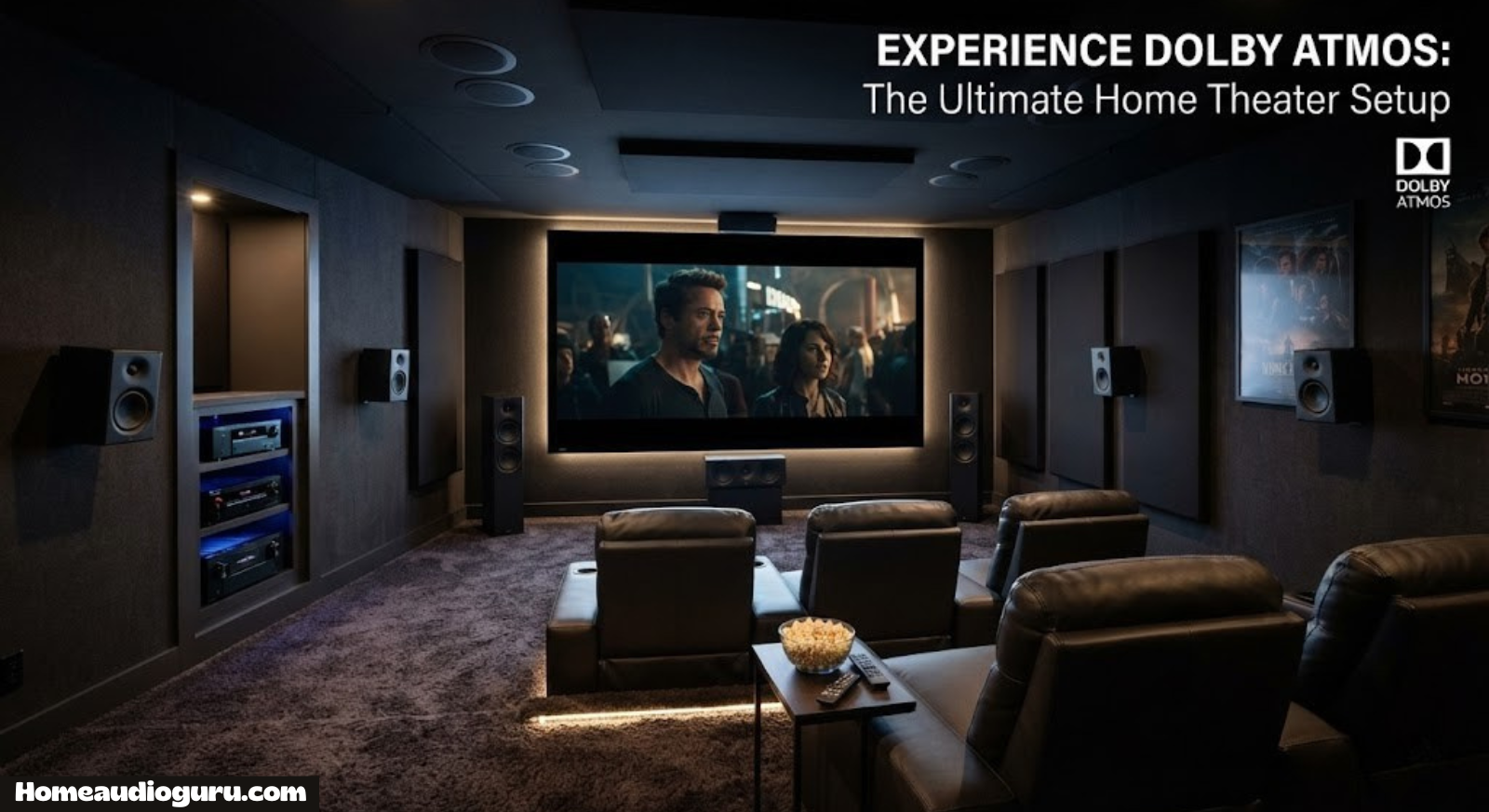
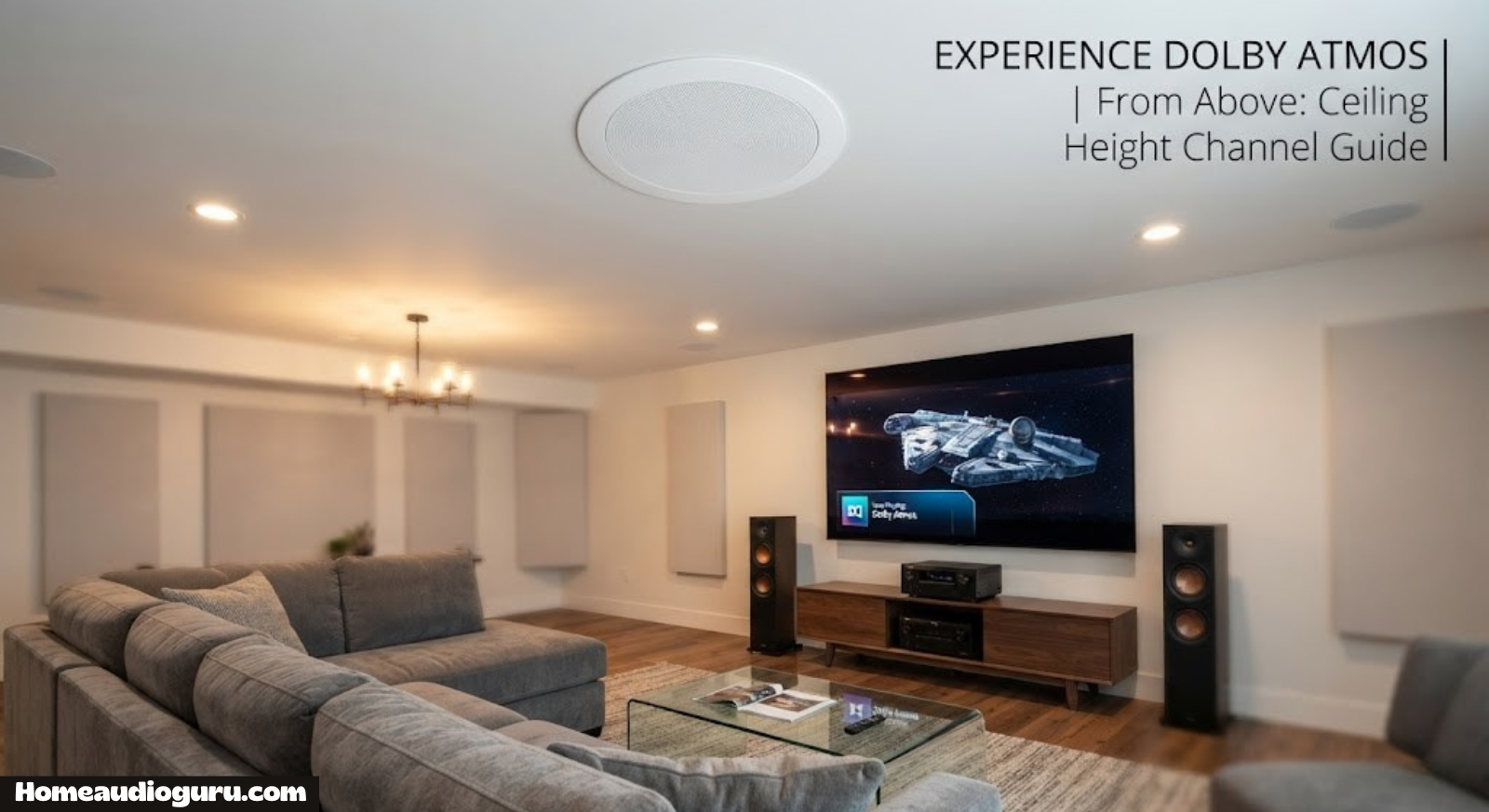
What Dolby Atmos Actually Means
In the simplest terms, Dolby Atmos is a surround sound format created by Dolby Laboratories that adds height to your audio. Traditional surround sound systems — think 5.1 or 7.1 — place sound around you on a flat horizontal plane: front, sides, and back. Dolby Atmos adds a vertical dimension, so sound can move above your head as well as around it.
That’s the one-sentence version. But the more interesting answer is how it creates that effect, because the method Dolby chose is genuinely different from every surround format that came before it. Instead of mixing audio into fixed channels (left, center, right, surround left, surround right, and so on), Dolby Atmos treats individual sounds as independent “objects” that can be placed anywhere in a 3D space and moved dynamically as a scene unfolds.
So when a helicopter flies from the front-left of a movie screen, arcs overhead, and disappears behind you, a properly Atmos-mixed soundtrack doesn’t just fake that motion with clever channel blending — it actually places that helicopter sound in three-dimensional space and lets your Atmos-enabled system figure out which speakers should reproduce it, and how loud each one should be, based on your room’s specific speaker layout.
How Dolby Atmos Is Different From Regular Surround Sound
To appreciate what Atmos changes, it helps to understand what came before it. Formats like Dolby Digital 5.1 and Dolby TrueHD 7.1 are channel-based. That means during the mixing process, every sound in a movie is permanently assigned to one of a fixed number of channels — for example, “front left,” “center,” “surround right.” When that soundtrack gets played back, each channel’s audio simply comes out of the matching speaker. There’s no intelligence involved at playback time; the mix was baked in at the studio.
This works fine, but it has a hard limitation: if your speaker layout doesn’t match the format’s channel layout, compromises have to be made. A 7.1 mix played on a 5.1 system has to be “downmixed,” and a lot of subtlety in the original mix can get lost or blurred in the process.
Dolby Atmos flips this around. Instead of committing sounds to specific channels ahead of time, the mix contains the raw audio for each sound object plus metadata describing where that object should be in 3D space at any given moment. Your Atmos-capable receiver, soundbar, or TV then renders that scene live, matching it to your actual speaker setup — whether that’s two upward-firing speakers on a soundbar or a fully wired 9.1.6 theater room. Learn more about how full receiver channel configurations are laid out if you want the deeper technical picture.
| Feature | Traditional Surround (5.1 / 7.1) | Dolby Atmos |
|---|---|---|
| Audio structure | Fixed channels | Sound “objects” + metadata |
| Height sound | No | Yes |
| Adapts to your speaker layout | No — needs downmixing | Yes — renders dynamically |
| Max channel count | Usually 8 (7.1) | Up to 34 speaker feeds |
| Works with soundbars | Yes, basic virtual surround | Yes, with real height simulation |

Want to Hear the Difference for Yourself?
A budget-friendly Atmos soundbar is the easiest way to experience height-channel audio without rewiring your whole living room.
Check Prices on AmazonObject-Based Audio, Explained Without the Jargon
The phrase “object-based audio” gets thrown around a lot, so let’s ground it with a simple analogy. Imagine you’re directing a play. In the old channel-based world, you’d tell each actor exactly which spot on stage to stand in and never move — the mix was fixed to specific “seats” (speakers) in the room. In the object-based world, you instead tell each actor who they are and what they’re doing — “you are a bird, you fly from stage left to the rafters and then out the back door” — and the stage crew (your Atmos processor) figures out, in real time, exactly which physical positions best represent that motion given the actual layout of the room.
In technical terms, a Dolby Atmos mix contains:
- Bed channels — a base layer similar to a standard 7.1 or 5.1 mix, used for ambient background sound and dialogue that doesn’t need to move.
- Audio objects — individual sound elements (a car engine, a raindrop, a gunshot, a line of dialogue) that carry their own metadata.
- Positional metadata — coordinates and movement paths describing where each object should sit in 3D space over time.
Up to 128 simultaneous audio objects and channels can exist in a single Dolby Atmos mix in professional cinema formats, though consumer versions are scaled down for home playback while preserving the same core idea.
A Short History of Dolby Atmos
Dolby Atmos was first introduced for movie theaters, debuting commercially with Pixar’s “Brave” in mid-2012. The format was built to solve a problem sound engineers had complained about for years: no matter how many surround channels you added, sound was still stuck on a flat plane. Adding overhead speaker arrays to cinemas let mixers finally place rain, aircraft, explosions, and ambient atmosphere genuinely above the audience.
It didn’t take long for Dolby to bring the technology home. By the mid-2010s, AV receiver manufacturers began shipping Atmos-decoding hardware, and soundbar makers found a clever workaround for people without ceiling speakers: upward-firing drivers that bounce sound off the ceiling to simulate height without any wiring. That innovation is a huge part of why Atmos became a mainstream home theater feature rather than a niche cinema-only format.
From there, Dolby extended the format beyond movies entirely — into music streaming, gaming, and even mobile devices, which we’ll cover further down this guide.
How Dolby Atmos Actually Works, Step by Step
1. The Mix Is Created With Object Metadata
A sound engineer working in an Atmos-certified studio mixes dialogue, effects, and music, and assigns spatial movement data to individual objects using specialized software rather than manually routing everything to fixed channels.
2. The Mix Is Encoded
That object-based session gets encoded into a delivery format — most commonly Dolby TrueHD with Atmos metadata on Blu-ray discs, or Dolby Digital Plus with Atmos metadata for streaming services, where file size matters more.
3. Your Device Decodes It
Your AV receiver, Atmos soundbar, or Atmos-capable TV reads that metadata stream and figures out, using its own internal renderer, how to distribute each audio object across the speakers it actually has connected.
4. The Renderer Adapts to Your Room
This is the clever part. The same Atmos soundtrack sounds appropriately spatial whether it’s played on a 2-speaker Atmos soundbar or a wired 24-speaker home theater, because the renderer scales the mix to match your specific hardware rather than requiring one “correct” configuration.
Understanding Channel Configurations: 5.1.2, 7.1.4, and Beyond
You’ll often see Dolby Atmos systems described with three numbers, like 5.1.2 or 7.1.4. Once you know the code, this is easy to decipher:
- First number — the count of standard speakers around you (front left/right, center, surround left/right, etc.)
- Second number (.1) — the subwoofer channel for bass.
- Third number — the count of height/overhead speakers dedicated to Atmos.
So a 5.1.2 setup has five main speakers, one subwoofer, and two height speakers. A 7.1.4 setup steps up to seven main speakers, one sub, and four height speakers — enough for a much more precise overhead soundstage. If you want to understand how each channel role is chosen and wired, our guide on receiver channels explained covers it in more depth, and our walkthrough on connecting speakers to a receiver is worth bookmarking before you start running wire.
| Configuration | Main Speakers | Subwoofers | Height Speakers | Best For |
|---|---|---|---|---|
| 5.1.2 | 5 | 1 | 2 | Entry-level Atmos, smaller rooms |
| 5.1.4 | 5 | 1 | 4 | Balanced budget theater rooms |
| 7.1.2 | 7 | 1 | 2 | Wide rooms wanting more surround width |
| 7.1.4 | 7 | 1 | 4 | Enthusiast home theaters |
| 9.1.6 | 9 | 1 | 6 | Dedicated theater rooms, largest spaces |
The Hardware You Actually Need
Getting Dolby Atmos into your living room can be as simple or as involved as you want. Here’s the realistic breakdown, from easiest to most immersive.
Option 1: An Atmos-Enabled Soundbar
The lowest-friction path. Soundbars with upward-firing drivers bounce sound off your ceiling to simulate overhead audio without any extra wiring. Results vary depending on ceiling height and room shape, but modern flagship soundbars do a genuinely convincing job.
Option 2: An AV Receiver + Add-On Height Speakers
For a more accurate and powerful result, an Atmos-capable AV receiver paired with either ceiling-mounted speakers or upward-firing add-on modules that sit on top of your existing front speakers gives you true, discrete height channels rather than a simulated bounce effect. If you’re unsure how much amplifier power you’ll need for your room size, our guide on how many watts you need for a receiver is a good next stop, and setting up a home theater receiver walks through the wiring process end to end.
Option 3: A Full Wired Ceiling-Speaker Theater
The gold standard. In-ceiling speakers, professionally positioned according to Dolby’s published specifications, deliver the most accurate and immersive overhead imaging possible. This is the setup serious home theater rooms are built around, typically paired with a receiver offering automatic speaker calibration — see our guide on calibrating receiver speakers to get the most out of a system like this.
Soundbar Route — Pros
- No wiring or ceiling work required
- Budget-friendly entry point
- Simple to move or reposition
Soundbar Route — Cons
- Effect depends heavily on ceiling height/material
- Less precise object placement than discrete speakers
- Weaker performance in open-plan rooms

Building a Discrete Atmos System?
An Atmos-certified AV receiver is the brain of any serious home theater setup — here are current top-rated options.
Shop Atmos ReceiversAtmos Soundbars vs. AV Receivers: Which Should You Choose?
This is one of the most common questions people ask once they understand what Dolby Atmos means. The honest answer depends on your room, your budget, and how much you care about precision versus convenience. Our detailed comparison of a receiver vs. soundbar goes deep on this, but here’s the short version specific to Atmos performance.
| Atmos Soundbar | AV Receiver + Speakers | |
|---|---|---|
| Setup difficulty | Very easy | Moderate to advanced |
| Cost to get started | Lower | Higher |
| Height accuracy | Simulated (bounce) | True discrete channels |
| Upgrade path | Limited | Highly expandable |
| Best room type | Apartments, smaller living rooms | Dedicated theater rooms |
If you already own a soundbar and are wondering whether it can pull double duty, our piece on connecting a receiver to your TV is useful once you decide to step up to a full receiver-based setup.
Where You Can Actually Watch or Hear Dolby Atmos
Understanding what Dolby Atmos means is one thing — actually accessing Atmos content is another. The good news is that Atmos support has become widespread across nearly every major platform:
- Streaming video: Many titles on major streaming platforms are mixed in Dolby Atmos, typically flagged on the title’s info page or in the audio settings menu.
- Blu-ray discs: Most 4K UHD Blu-ray releases of major films include a Dolby Atmos audio track as their premium audio option.
- Gaming consoles: Current-generation consoles support Atmos for supported titles, either natively or through app-specific playback.
- Music streaming: Spatial audio mixes are available through several major music streaming services (covered in the next section).
One important caveat: your source device, your receiver or soundbar, and your speaker output all need to support Atmos for the full effect to actually play back — if any link in that chain only supports standard surround, the system will typically fall back to a regular surround or stereo downmix.
Dolby Atmos Music, Explained
Dolby Atmos isn’t only for movies anymore. Dolby Atmos Music applies the same object-based, spatial approach to music mixing, letting artists and engineers place instruments, vocals, and effects around and above the listener instead of confining everything to a left/right stereo image.
In practice, this means a well-mixed Atmos track might place a string section slightly overhead, a vocal dead-center and forward, and ambient reverb tails trailing off behind you — creating a sense of space that traditional stereo simply can’t reproduce. Several major streaming platforms now offer large Atmos Music catalogs, playable on compatible headphones (using Atmos’s binaural rendering) or on full Atmos speaker setups.
If your primary listening space is more casual, a compact wireless speaker with virtual surround processing paired with a service offering Atmos tracks can still deliver a noticeably wider, more three-dimensional sound compared to standard stereo playback — our best Bluetooth speakers for home roundup is a good starting point if this is your primary use case.
Dolby Atmos for Gaming
Gaming was a natural extension for object-based audio, since games already generate sound dynamically based on where objects and characters are in a 3D game world — which maps almost perfectly onto how Atmos itself works. Footsteps behind you, a plane flying overhead, gunfire echoing off nearby walls: all of these benefit enormously from genuine height and positional audio, and competitive gamers in particular value the improved directional cues Atmos-capable headsets and speaker setups can provide.
Current-generation consoles and gaming PCs both support Atmos playback, either through licensed headset software or full home theater output, giving gamers one more reason to consider an Atmos-capable receiver as the centerpiece of a combined movie-and-gaming setup.
Pros and Cons of Dolby Atmos
Pros
- Genuinely more immersive, three-dimensional sound
- Scales gracefully from soundbars to full theater rooms
- Wide and growing content library across movies, music, and games
- Renders automatically to match your specific speaker layout
Cons
- True discrete height channels require extra speakers and wiring
- Effect quality varies significantly between entry-level and premium gear
- Not every piece of content is mixed in Atmos
- Requires an Atmos-compatible chain end-to-end to hear the full effect
Dolby Atmos vs. DTS:X: What’s the Difference?
DTS:X is Dolby Atmos’s main competitor, built around a very similar object-based philosophy. The core concepts — sound objects, height channels, adaptive rendering — are nearly identical between the two formats. The practical differences mostly come down to content availability and hardware support rather than a dramatic difference in sound quality.
| Aspect | Dolby Atmos | DTS:X |
|---|---|---|
| Speaker layout requirement | Fixed recommended positions | More flexible speaker placement |
| Content availability | Broader across streaming and disc | Common on Blu-ray, more limited streaming presence |
| Hardware support | Extremely widespread | Widespread on receivers, less common on soundbars |
| Consumer awareness | Very high (market leader) | Lower, more enthusiast-focused |
Most modern Denon, Yamaha, Onkyo, and Marantz receivers support both formats, so in practice you rarely need to choose one over the other — your gear will simply decode whichever format the content was mixed in.
How to Buy Your First Dolby Atmos Setup
If everything above has convinced you it’s time to actually build an Atmos system, here’s a sensible way to approach it based on budget and commitment level.
Budget Tier: Atmos Soundbar
Perfect if you want a noticeable upgrade without any wiring project. Look for a soundbar explicitly listed as Dolby Atmos compatible with upward-firing drivers, not just “virtual surround.”
Mid Tier: Compact Home Audio System With Atmos Support
A step up in immersion without going full theater-room. Our best home audio systems guide and setup walkthrough are good companion reads here, along with our picks for a home stereo system under $500 if budget is the main constraint.
Enthusiast Tier: Full AV Receiver + Discrete Speakers
The most accurate and expandable option. Combine an Atmos-certified receiver with front, surround, and height speakers, then run automatic room calibration for the most accurate result. If you’re building an ambitious dedicated theater room, our best home theater system under $10,000 guide lays out what a serious build actually costs.

Ready to Build a Full Atmos Room?
Speaker packages bundled with dedicated height modules make discrete Atmos setups much easier to plan and buy.
Browse Atmos Speaker PackagesCommon Mistakes When Setting Up Dolby Atmos
- Mismatched height speaker angle: Upward-firing modules need to be positioned correctly relative to your seating position and ceiling height, or the bounce effect fails to sound overhead at all.
- Skipping calibration: Automatic room calibration tools built into most Atmos receivers meaningfully improve height imaging — skipping this step is one of the most common reasons people say Atmos “doesn’t sound like much” in their room.
- Assuming all content is Atmos: Not every show or movie is mixed in Atmos; check the audio track listing before assuming your system is underperforming.
- Underpowered amplification: Adding height channels increases total speaker count, and underpowered receivers can struggle to drive a full setup cleanly — revisit our wattage guide before finalizing your gear list.
- Poor cable management on ceiling runs: Plan wiring routes before mounting ceiling speakers, since retrofitting is far more disruptive than planning ahead.
Frequently Asked Questions About Dolby Atmos
Is Dolby Atmos worth it?
For most home theater enthusiasts, yes — the added sense of height and space is one of the most noticeable upgrades you can make to a home theater, especially when paired with content actually mixed in the format.
Do I need special speakers for Dolby Atmos?
You need either dedicated height/ceiling speakers, upward-firing add-on modules, or a soundbar with built-in upward-firing drivers. Standard surround speakers alone cannot reproduce the height layer.
Can a soundbar really do Dolby Atmos?
Yes, though the effect is simulated by bouncing sound off the ceiling rather than using true discrete height channels. Results vary based on ceiling height, material, and room shape, but quality Atmos soundbars can be quite convincing.
What’s the difference between Dolby Atmos and 7.1 surround sound?
7.1 surround is channel-based and confined to a horizontal plane around the listener. Dolby Atmos is object-based and adds height, letting sound move above the listener as well.
Does Dolby Atmos work with headphones?
Yes. Dolby Atmos uses binaural rendering technology to simulate a full 3D soundstage through regular stereo headphones, which is how Atmos Music and Atmos-supported games deliver spatial audio without any speakers at all.
Is Dolby Atmos the same as spatial audio?
Dolby Atmos is one specific implementation of the broader “spatial audio” concept. Other companies use their own spatial audio branding and technology, but Atmos is the most widely adopted format across the industry.
What does 5.1.2 mean in Dolby Atmos terms?
It describes a speaker layout: 5 standard surround speakers, 1 subwoofer, and 2 height/overhead speakers dedicated to the Atmos layer.
Do all AV receivers support Dolby Atmos?
No — Atmos decoding requires specific hardware and licensing, so always confirm Atmos support explicitly before buying a receiver rather than assuming it’s included.
Can I add Dolby Atmos to an existing surround system?
Often, yes. If your current receiver supports Atmos decoding, adding upward-firing height modules or ceiling speakers can upgrade an existing 5.1 or 7.1 system into a 5.1.2 or 7.1.4 Atmos setup without replacing your other speakers.
Does Dolby Atmos require a subwoofer?
A subwoofer isn’t strictly required for the height-channel effect itself, but it’s a standard part of virtually every Atmos configuration (the “.1” in 5.1.2, for example) because low-frequency effects still play a major role in overall immersion.
Why doesn’t my Dolby Atmos setup sound like it has height?
The most common causes are incorrect speaker angle or placement, skipped automatic calibration, playing non-Atmos content, or a break somewhere in the Atmos-compatible chain between your source and your speakers.