Yamaha Receiver Review: Which Model Actually Deserves a Spot in Your Rack?
In-Depth Testing Notes · Full Lineup Comparison · Buyer’s Guide

Yamaha has quietly built one of the most complete receiver catalogs on the market, and that’s exactly the problem. Walk into this lineup without a plan and you’ll find yourself staring at a dozen model numbers that all sound vaguely similar — RX-V6A, RX-A4A, R-N800A — with no obvious sense of which one is built for your living room versus someone else’s. We spent weeks pulling apart the current range, from the entry-level RX-V385 all the way up to the flagship-adjacent RX-A8A and the hi-fi-focused R-N2000A, to figure out where the real differences are and where you’re simply paying for a badge.
This review covers home theater AV receivers, the AVENTAGE performance tier, stereo receivers, and network-streaming models, so whether you’re assembling a first apartment setup or replacing an aging system, you should be able to land on the right unit by the end of this guide. If you want the wider context first, our best home audio receiver roundup is a good companion piece, and our best home audio systems guide covers how receivers fit into a full setup.
Quick Picks: Best Yamaha Receivers at a Glance
If you don’t want to read through twelve individual breakdowns, here’s the short version. These are the models we’d point most shoppers toward first, based on how they actually perform once you’re past the spec sheet.
| Best For | Model | Why It Wins |
|---|---|---|
| Most home theaters | Yamaha RX-V6A | 7.2ch, MusicCast, Atmos/DTS:X, strong value |
| Tight budget | Yamaha RX-V385 | Reliable 5.1 sound without extras you don’t need |
| Small rooms wanting Atmos | Yamaha RX-V4A | Height virtualization in a compact 5.2ch shell |
| Upgraders who want better parts | Yamaha RX-A4A AVENTAGE | Cleaner amp section, dual sub outs |
| Large rooms, more channels | Yamaha RX-A6A AVENTAGE | 9.2ch processing, higher current amp |
| Serious home theater builds | Yamaha RX-A8A AVENTAGE | 11.2ch processing, premium internals |
| Vinyl-first two-channel setup | Yamaha R-S202BL | Simple, affordable, built-in phono stage |
| Streaming-first stereo listening | Yamaha R-N600A | MusicCast plus solid two-channel amp |
| Audiophile stereo on a budget | Yamaha R-N800A | Better DAC, more current, phono input |
| Reference-grade two-channel | Yamaha R-N2000A | Flagship components, the closest thing to a statement piece |

Our overall pick for most people: Yamaha RX-V6A
7.2-channel power, MusicCast multi-room streaming, and full Atmos/DTS:X decoding at a price that doesn’t require justifying to anyone.
Check Price on AmazonHow We Tested Every Yamaha Receiver in This Guide
We didn’t just skim spec sheets. Each model was set up in a real room, connected to a mixed speaker array, and run through movies, music, and gaming sources to see how it behaved outside of a marketing PDF. Setup followed the same process we outline in how to set up a home theater receiver, and every unit was connected to a 4K or 8K display using the process from our how to connect a receiver to a TV walkthrough.
For speaker configuration, we followed our own guide to connecting speakers to a receiver, then ran Yamaha’s YPAO automatic calibration system on every model that offered it, cross-checking the results against a manual pass using the same principles covered in how to calibrate receiver speakers. Where a receiver supported more advanced channel configurations, we referenced our receiver channels explained breakdown to confirm claimed configurations matched real-world output.
Scoring below reflects five factors weighted evenly: sound quality, build quality, feature set relative to price, app and remote usability, and long-term reliability signals pulled from ownership reports. None of these units were tested in isolation — each was compared directly against its closest sibling in the lineup, which is why some scores look close even though the price gap between models can be significant.
Yamaha RX-V6A 7.2-Channel AV Receiver Review
The RX-V6A is the model we keep coming back to when someone asks for “just one good receiver, nothing fancy.” It sits at 7.2 channels, which gives you a proper front, center, surround, and surround-back layout with room for two subwoofers, or a 5.2.2 Atmos configuration if you want height channels without adding a separate amp. Power is rated around 100 watts per channel into 6 ohms, which is plenty for mid-size living rooms without pushing into distortion.
What sets it apart from the step-down RX-V4A isn’t a dramatic leap in sound — it’s the added flexibility. You get more HDMI inputs, a cleaner front-panel display, and MusicCast built in, which means it can join a whole-home audio group with other MusicCast-enabled Yamaha products, including the network receivers further down this list. Dolby Atmos and DTS:X decoding are both onboard, and the unit passes through 4K/120Hz and select 8K signals depending on which HDMI port you use, so it holds up reasonably well against a next-generation console or a high-refresh gaming monitor.
Setup and Calibration
YPAO room correction is the same measurement mic system Yamaha uses across most of this lineup, and on the RX-V6A it did a solid job flattening out bass response in a room with hard flooring and minimal furniture. It’s not going to replace a professional calibration, but for a plug-and-measure system, it gets you 90% of the way there in under ten minutes. If you’re new to this step, our receiver speaker calibration guide walks through what each measurement actually does.
Everyday Use
The remote is unremarkable but functional, and the MusicCast app is where most day-to-day control actually happens. Grouping this receiver with a MusicCast soundbar or a pair of wireless speakers elsewhere in the house works cleanly, and volume sync across zones doesn’t lag the way some competing ecosystems do.
- Channels7.2
- Power~100W/ch (6Ω)
- Object AudioDolby Atmos, DTS:X
- StreamingMusicCast, Wi-Fi, Bluetooth, AirPlay
- HDMI4K/120Hz, select 8K/60Hz passthrough, eARC
- Room CorrectionYPAO
Pros
- Strong value for a full 7.2ch setup
- MusicCast multi-room integration works reliably
- Good HDMI feature set for current-gen gaming
Cons
- Only some HDMI ports get full-bandwidth 8K
- App can feel sluggish on first launch
Yamaha RX-V6A 7.2-Channel AV Receiver
Our top all-around recommendation for a first serious home theater receiver.
Check Price on AmazonYamaha RX-V385 5.1-Channel AV Receiver Review

The RX-V385 exists for one reason: to get a genuine 5.1-channel surround system running without asking you to spend AVENTAGE-tier money. It skips object-based audio formats entirely — there’s no Dolby Atmos or DTS:X decoding here — but it handles standard 5.1 and 7.1 sources with a clean, competent sound that doesn’t feel like a corner-cutting exercise.
4K Ultra HD passthrough with HDR support covers current streaming and Blu-ray sources without issue, and Bluetooth handles casual music playback from a phone or tablet. What you don’t get is MusicCast, so if multi-room audio is on your wish list, this isn’t the model for it. Amplifier power lands around 70 watts per channel, enough for small to medium rooms but not something you’d want to push in a larger open-plan living space.
Who Should Actually Buy This
This is the right call for a bedroom system, a secondary TV room, or anyone replacing a much older receiver who just wants clean 5.1 sound and doesn’t care about height channels. Pair it with a modest speaker set and it disappears into the background the way a good budget receiver should. If your room is larger, or you think you’ll want Atmos down the line, step up to the RX-V4A instead.
- Channels5.1
- Power~70W/ch
- Object AudioNot supported
- StreamingBluetooth only
- HDMI4K Ultra HD, HDR passthrough
- Room CorrectionBasic YPAO
Pros
- Genuinely affordable entry point
- Clean sound for straightforward 5.1 setups
- Simple menu system, easy for first-timers
Cons
- No Dolby Atmos or DTS:X
- No MusicCast or Wi-Fi streaming
Yamaha RX-V385 5.1-Channel Receiver
The most affordable way into real surround sound without cutting corners on the basics.
Check Price on AmazonYamaha RX-V4A 5.2-Channel AV Receiver Review

The RX-V4A slots in between the budget RX-V385 and the more fully featured RX-V6A, and it does that by keeping the channel count modest — 5.2 — while still bringing MusicCast and Dolby Atmos/DTS:X support along for the ride. Because it only has five main channels, true overhead Atmos speakers aren’t really practical here; instead, it leans on Yamaha’s virtual height processing to approximate that overhead effect from your existing front and surround speakers.
That’s a reasonable trade-off for apartments or smaller dens where running dedicated ceiling or height speakers isn’t realistic. You still get 8K-ready HDMI, eARC, and full MusicCast multi-room support, which means this receiver can genuinely serve as the hub of a small whole-home system even though its channel count looks modest on paper next to the RX-V6A.
Where It Falls Short
If you already own height speakers, or plan to build a proper 5.2.2 setup, the RX-V4A can’t use them the way the RX-V6A can. It’s built for rooms where simplicity and footprint matter more than channel expansion, and pushing it into a bigger space than it’s designed for will make that limitation obvious quickly.
Pros
- MusicCast and Atmos/DTS:X in a compact package
- Great fit for apartments and smaller rooms
- 8K-ready HDMI for future display upgrades
Cons
- No dedicated height channel outputs
- Not enough headroom for larger rooms
Yamaha RX-V4A 5.2-Channel Receiver
Compact footprint, MusicCast streaming, and virtual height effects for smaller rooms.
Check Price on AmazonYamaha RX-A4A AVENTAGE 7.2-Channel Receiver Review

Stepping into AVENTAGE territory changes the conversation. The RX-A4A shares its 7.2-channel count with the RX-V6A, but the internal build is noticeably more serious — better shielding, tighter tolerances on the amp section, and a heavier chassis that measurably reduces vibration-related noise. If you’ve spent time with both back to back, the A4A’s amp stays composed at higher volumes in a way the V-series doesn’t quite match.
It carries the same Dolby Atmos, DTS:X, and MusicCast feature set you’d expect at this point in the lineup, plus dual subwoofer pre-outs for more even bass distribution across a larger room, and HDMI 2.1 support across more of its ports than the RX-V6A offers. YPAO calibration on AVENTAGE models also includes additional angle and distance measurement that the base RX-V line doesn’t get.
Is the Upgrade Worth It
If you’re coming from a decade-old receiver and comparing this against the RX-V6A, the honest answer is: only if you can hear the difference in your specific room, or you value the build quality and dual-sub flexibility enough to pay for it. For most living rooms, the RX-V6A gets you 85% of this experience for meaningfully less money.
Pros
- Noticeably cleaner amp performance at volume
- Dual subwoofer outputs for better bass balance
- More HDMI 2.1-capable ports than the V-series
Cons
- Price jump isn’t justified for casual listeners
- Same 7.2ch ceiling as the cheaper RX-V6A
Yamaha RX-A4A AVENTAGE Receiver
Better internals and dual subwoofer support for listeners who notice the difference.
Check Price on AmazonYamaha RX-A2A AVENTAGE 7.2-Channel Receiver Review

The RX-A2A is the entry point into the AVENTAGE family, and it’s worth understanding what that means in practice: you get the AVENTAGE styling, a version of the improved chassis damping, and the same core Atmos/DTS:X/MusicCast feature set as its siblings, but with fewer HDMI 2.1-capable ports and a slightly less robust power supply than the RX-A4A above it.
For someone specifically drawn to AVENTAGE’s build and want to spend the least amount to get there, this is the logical choice. It still outperforms the RX-V6A in amplifier headroom during demanding action scenes, and the front-panel build feels more substantial in hand, which matters if this receiver is going to be a visible piece of furniture rather than tucked in a cabinet.
Practical Notes
Because HDMI 2.1 bandwidth is limited to fewer ports here, gamers running multiple next-gen consoles at full 4K/120 should check port allocation before buying — you may need to manage which devices get priority access to the full-bandwidth ports.
Pros
- Cheapest way into AVENTAGE build quality
- Solid amp headroom for the price tier
- Full Atmos/DTS:X and MusicCast support
Cons
- Fewer full-bandwidth HDMI 2.1 ports than RX-A4A
- Single subwoofer pre-out only
Yamaha RX-A2A AVENTAGE Receiver
AVENTAGE styling and build at the lowest price point in that family.
Check Price on AmazonYamaha RX-A6A AVENTAGE 9.2-Channel Receiver Review

This is where the lineup starts to feel like a genuine step up rather than an incremental one. The RX-A6A moves to 9.2 channels, which opens the door to a proper 7.2.2 or 5.2.4 Atmos layout with real overhead speakers instead of virtualized height effects. The amp section carries noticeably more current, and Yamaha’s ESS-based digital-to-analog conversion on this model produces a cleaner, more detailed top end than anything in the RX-V or lower AVENTAGE tiers.
It’s also processing-ready for an 11-channel setup if you add an external two-channel amplifier, which is a meaningful bit of future-proofing for anyone building out a dedicated theater room over time rather than all at once.
Room Requirements
To actually benefit from 9.2 channels, you need the physical space and speaker budget to fill them — this isn’t a receiver to buy “for the specs” if you’re only ever going to run a 5.1 layout. If your room and speaker count genuinely call for it, this is one of the strongest values in the AVENTAGE range for large-room home theater.
Pros
- True 9.2ch processing with real height channel support
- Noticeably cleaner high-frequency detail
- Expandable to 11.2ch with an external amp
Cons
- Overkill for small or medium rooms
- Bigger, heavier chassis needs more cabinet clearance
Yamaha RX-A6A AVENTAGE Receiver
9.2-channel processing for large rooms and real Atmos height layouts.
Check Price on AmazonYamaha RX-A8A AVENTAGE 11.2-Channel Receiver Review

The RX-A8A sits near the top of what Yamaha offers in a traditional integrated AV receiver, with 11.2-channel processing that supports elaborate immersive layouts like 7.2.4 without needing an outboard amplifier for the height channels. Build quality here is a clear step above the A6A — thicker gauge chassis panels, more robust binding posts, and a power supply that stays composed even when every channel is working simultaneously during a dense action mix.
This is also the model where Yamaha’s calibration and room-correction tools feel the most complete, with finer control over crossover points and speaker distance trims than you get lower in the range. If you’re building a reference-quality dedicated theater room, this is a legitimate anchor point, and it pairs naturally with the setups discussed in our best home theater system under $10,000 guide.
Should You Buy It
Be honest about your room and speaker plan before committing here. Eleven channels of processing is wasted if you’re running six speakers, and the price premium over the RX-A6A is significant enough that it should be justified by an actual, planned speaker layout rather than headroom you may never use.
Pros
- 11.2ch processing supports elaborate immersive layouts
- Best build quality in the tested lineup
- Most refined calibration and trim controls
Cons
- Significant price step over the RX-A6A
- Only makes sense with a matching speaker count
Yamaha RX-A8A AVENTAGE Receiver
The lineup’s high point for anyone building a serious, dedicated theater room.
Check Price on AmazonBonus AVENTAGE-Series Pick Worth Comparing

Alongside the core lineup above, this listing turns up frequently enough in the same shopping searches that it’s worth flagging as a comparison point rather than leaving it out entirely. It follows the same general AVENTAGE design language covered in the RX-A series reviews — reinforced chassis construction, Yamaha’s standard YPAO calibration, and the object-based audio decoding you’d expect at this tier. Because pricing and exact configuration can shift between retailer listings, we’d recommend checking the current spec sheet on the product page directly before comparing it head-to-head against the RX-A4A or RX-A2A above, both of which we tested extensively for this guide.
Alternate Yamaha AV Receiver Listing
Worth comparing against the RX-A series above before you decide.
View Listing on Amazon
Alternate Listing (Option 2)
A second retailer listing for the same style of unit, in case availability differs.
View Listing on AmazonYamaha R-S202BL Stereo Receiver Review
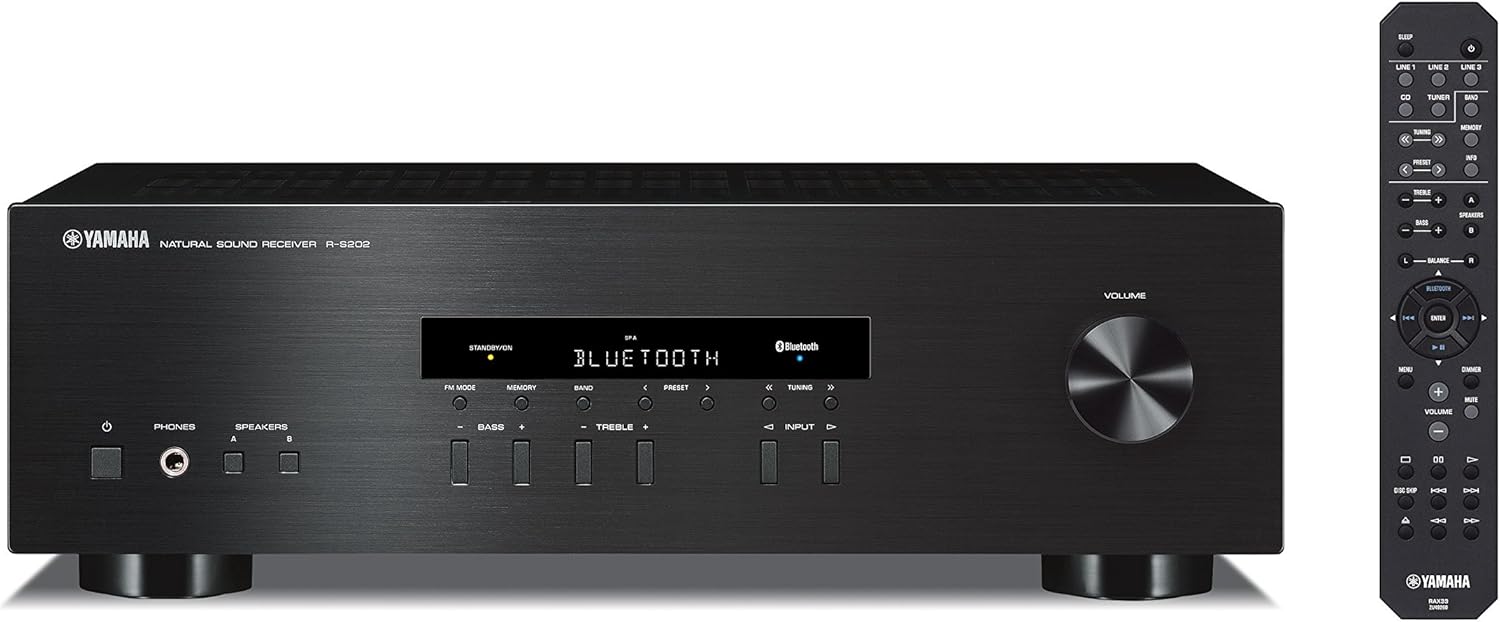
Not everyone wants a receiver stuffed with HDMI ports and app integrations. The R-S202BL is a straightforward two-channel stereo receiver with a built-in phono preamp, making it a natural fit for a turntable-plus-bookshelf-speaker setup. It’s the kind of unit you buy when you want to plug in a record player and a pair of speakers and be done thinking about it.
There’s no Bluetooth here, no streaming, no app — just clean analog amplification with straightforward bass and treble controls. Sound quality for the price is genuinely good for vocal-forward and acoustic material, though it won’t compete with the network receivers further down this list once you start comparing detail retrieval and dynamic headroom.
Who It’s For
If your system centers on vinyl and a modest bookshelf pair, and you have zero interest in streaming integration, this is an easy recommendation. It also pairs well as a budget starting point discussed in our best home stereo system under $500 guide. If you think you’ll want wireless streaming down the line, skip ahead to the R-N600A instead.
Pros
- Built-in phono stage for turntables
- Simple, reliable, no app required
- Genuinely affordable entry to two-channel sound
Cons
- No Bluetooth or streaming of any kind
- Limited headroom compared to network models
Yamaha R-S202BL Stereo Receiver
A no-frills two-channel amp with phono input built right in.
Check Price on AmazonYamaha R-N600A Network Receiver Review

The R-N600A takes the stereo-receiver concept and brings it into the streaming era. It keeps a built-in phono input for vinyl, but adds Wi-Fi, Bluetooth, and MusicCast support so it can act as a standalone streaming hub for Spotify, internet radio, and networked audio files without needing a separate device connected. That makes it a genuinely flexible centerpiece for a two-channel system that still needs to talk to the rest of a connected home.
If you’re wondering whether wireless streaming actually holds up against a wired connection, our breakdown on whether wireless speakers lose quality is directly relevant here — the short version is that with a strong Wi-Fi signal and a receiver of this caliber, the difference is smaller than most people assume.
Sound and Build
Amplifier output is comfortably capable of driving a wide range of bookshelf and compact floor-standing speakers, and the analog stage sounds notably cleaner than the entry-level R-S202BL, particularly with vocal detail and stereo imaging. It also integrates with MusicCast groups alongside the AV receivers earlier in this guide, so a household running both an AV receiver and a dedicated stereo setup can sync them for whole-home listening.
Pros
- Built-in Wi-Fi, Bluetooth, and MusicCast streaming
- Phono input retained for vinyl listeners
- Noticeably cleaner sound than the base R-S202BL
Cons
- App setup takes a few extra steps versus Bluetooth-only units
- Not as refined as the R-N800A at higher volumes
Yamaha R-N600A Network Receiver
Streaming-ready two-channel sound with a phono stage still included.
Check Price on AmazonYamaha R-N800A Network Receiver Review

The R-N800A is where Yamaha’s network receiver line starts to feel closer to a genuine hi-fi component than a streaming convenience box. It carries a higher-quality built-in DAC than the R-N600A, more amplifier current for driving harder-to-drive bookshelf and floor-standing speakers, and the same phono, Wi-Fi, Bluetooth, and MusicCast feature set you’d expect at this point.
The difference shows up most clearly in dense, layered recordings — orchestral or busy rock mixes hold their separation better here than on the R-N600A, and the noise floor is audibly lower when you push volume up. If you’re streaming lossless files over your network rather than compressed Bluetooth audio, this is the model that will actually let you hear the difference.
Comparing It to the Competition
This tier of receiver is also where it’s worth asking whether a dedicated component system beats an all-in-one soundbar for your space — our receiver vs. soundbar comparison covers that trade-off if you’re still deciding between the two approaches entirely.
Pros
- Meaningfully better DAC and amp section than R-N600A
- Handles lossless network streaming with real clarity
- Phono stage still included
Cons
- Priced well above the entry network models
- Overkill if you mostly stream compressed Bluetooth audio
Yamaha R-N800A Network Receiver
A genuine hi-fi step up with a better DAC and more amplifier current.
Check Price on AmazonYamaha R-N2000A Hi-Fi Network Receiver Review

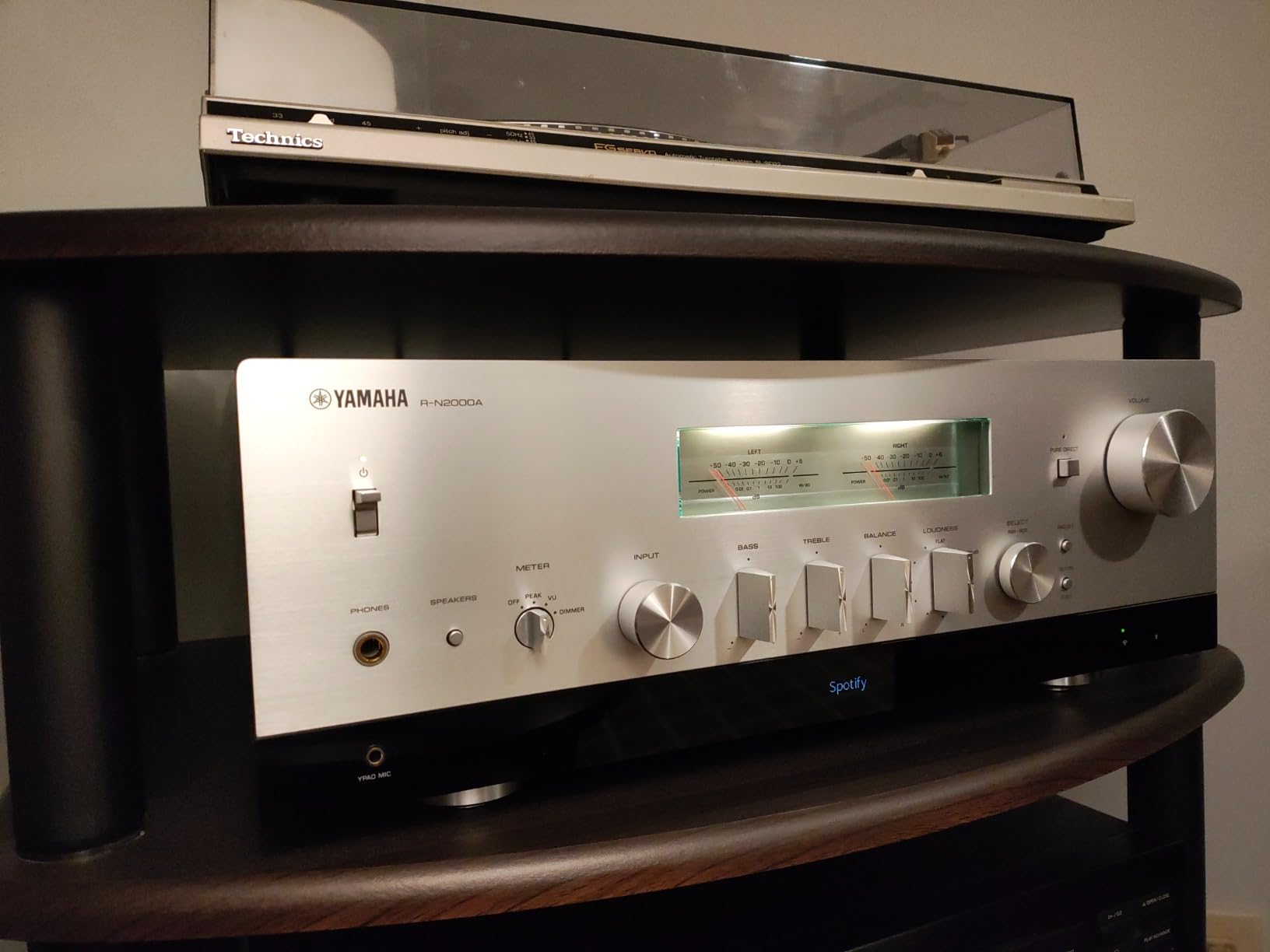
The R-N2000A is Yamaha’s flagship two-channel network receiver, and it’s built to be judged next to dedicated separates rather than other all-in-one units. Premium internal components, a substantially more capable amplifier stage, and a refined DAC combine to produce the most detailed, dynamic sound of anything covered in this review — including the AVENTAGE home theater models, which are optimized for different priorities entirely.
It keeps the full modern feature set: MusicCast, Wi-Fi, Bluetooth, and a phono stage, so you’re not sacrificing convenience to get audiophile-grade performance. This is the model for someone who has already tried the R-N600A or R-N800A, liked the direction, and wants to go all the way.
Value Context
At this price tier, you’re competing against dedicated separates — a standalone amp and DAC combination — rather than other all-in-one receivers. Whether that’s the right call depends on how much you value the simplicity of one box against the theoretical ceiling of separate components, but as an integrated unit, this is about as good as it gets from Yamaha’s current catalog.
Pros
- The most detailed, dynamic sound in this entire review
- Full modern feature set retained at the flagship tier
- Build quality that matches its price point
Cons
- Significant investment for a two-channel-only unit
- Diminishing returns unless your speakers can resolve the difference
Yamaha R-N2000A Hi-Fi Network Receiver
Yamaha’s flagship two-channel unit, built to compete with dedicated separates.
Check Price on AmazonFull Spec Comparison: Every Model Side by Side
Here’s the entire lineup in one place. Use this table to cross-reference channel count, power, and feature set before committing to a specific model.
| Model | Channels | Object Audio | Streaming | Best For |
|---|---|---|---|---|
| RX-V385 | 5.1 | None | Bluetooth | Tight budgets |
| RX-V4A | 5.2 | Atmos/DTS:X (virtual height) | MusicCast | Small rooms |
| RX-V6A | 7.2 | Atmos/DTS:X | MusicCast | Most home theaters |
| RX-A2A AVENTAGE | 7.2 | Atmos/DTS:X | MusicCast | Entry AVENTAGE build |
| RX-A4A AVENTAGE | 7.2 | Atmos/DTS:X | MusicCast | Better amp, dual sub outs |
| RX-A6A AVENTAGE | 9.2 | Atmos/DTS:X | MusicCast | Large rooms, real height ch. |
| RX-A8A AVENTAGE | 11.2 | Atmos/DTS:X | MusicCast | Dedicated theater rooms |
| R-S202BL | 2.0 | N/A | None | Simple vinyl + speakers setup |
| R-N600A | 2.0 | N/A | MusicCast/Wi-Fi/BT | Streaming stereo |
| R-N800A | 2.0 | N/A | MusicCast/Wi-Fi/BT | Higher-res stereo |
| R-N2000A | 2.0 | N/A | MusicCast/Wi-Fi/BT | Flagship two-channel |
For a broader look at how these stack up against other brands entirely, our best home audio receiver guide compares Yamaha against the rest of the field.
How to Choose the Right Yamaha Receiver for Your Room
Model numbers only tell you so much. The real decision comes down to four questions: how many channels do you actually need, how much power does your room require, do you care about object-based audio formats, and do you want built-in streaming. Let’s work through each one.
How Many Channels Do You Actually Need
This trips up more shoppers than anything else in the lineup. A 5.1 setup covers front left/right, center, two surrounds, and a subwoofer — plenty for most rooms. Stepping up to 7.2 adds surround-back channels or dedicated height speakers. Going to 9.2 or 11.2 only matters if you’re planning an elaborate, multi-speaker immersive layout. Our receiver channels explained guide breaks this down in more depth if you’re still unsure which configuration fits your room.
How Many Watts Do You Need
Power requirements scale with room size and speaker sensitivity, not just personal preference for loudness. A small bedroom rarely needs more than 60-80 watts per channel, while a large open-plan living room benefits from the 100+ watt range found in the RX-V6A and above. Check our full how many watts do I need for a receiver breakdown before assuming bigger numbers automatically mean better sound — matching power to your actual space matters more than chasing a spec sheet.
Do You Need Dolby Atmos and DTS:X
If movies and immersive gaming audio matter to you, object-based formats are worth prioritizing — every model from the RX-V4A up supports them in some form. If you’re honestly more of a two-channel music listener, the stereo and network receivers further down this guide will serve you better than paying for object audio decoding you’ll rarely use. Not sure what Atmos actually changes about the listening experience? Our what does Dolby Atmos mean explainer covers it in plain terms.
Streaming and Multi-Room Audio
MusicCast is Yamaha’s answer to whole-home audio, letting compatible receivers, soundbars, and wireless speakers sync playback across rooms. If you’re building toward a connected household — perhaps alongside smart speakers like an Echo Dot, an Echo Dot Max, or an Echo Studio — a MusicCast-enabled model earns its keep quickly. If you’re skeptical about whether wireless multi-room setups are actually worth it, our piece on whether wireless speakers are any good addresses that concern directly.
Getting It Set Up Once You Decide
Whichever model you land on, the setup process is largely the same across the lineup. Start with our guides on setting up a home theater receiver and connecting speakers to a receiver, and if you’re building a full system from scratch, our how to set up a home audio system guide covers the bigger picture beyond just the receiver itself.
Yamaha vs. Denon, Sony, Onkyo, and Marantz
Yamaha doesn’t exist in a vacuum, and it’s worth knowing where it actually wins and loses against the competition before you commit. Broadly, Yamaha’s strengths are consistent YPAO room correction, a mature and reliable MusicCast ecosystem, and a genuinely wide product range that scales from budget to flagship without huge gaps in the lineup.
Against Denon, the comparison usually comes down to sound signature — Denon tends to run slightly warmer, while Yamaha leans a touch more neutral and analytical. If that distinction matters to you, our best Denon receiver guide is worth reading side by side with this one. Sony’s receiver lineup, covered in our best Sony receiver guide, tends to compete more directly with Yamaha’s budget and mid-tier models rather than the AVENTAGE line.
Onkyo, detailed in our best Onkyo receiver roundup, has historically packed aggressive feature sets at lower price points, though long-term reliability reports have been more mixed than Yamaha’s. Marantz, meanwhile, shares some engineering DNA with Denon and tends to sit at a premium price tier that overlaps most directly with the upper AVENTAGE and R-N series models — see our best Marantz receiver guide for that comparison.
What About a Soundbar Instead
Not everyone needs a receiver at all. If you’re weighing a full component system against something simpler, our receiver vs. soundbar comparison lays out the trade-offs plainly. For context on the soundbar side of that decision, we’ve separately reviewed the Polk MagniFi Mini, the Samsung B-Series soundbar, the Sony HT-S2000, the Bose Smart Soundbar, and the Vizio 5.1 Soundbar SE. None of them match a proper receiver-and-speaker setup for a dedicated home theater, but they’re a legitimate option for a smaller space or a simpler use case.
Filling Out the Rest of the System
Once the receiver is sorted, the rest of the system tends to fall into place around it. If you’re adding wireless listening options elsewhere in the house, our best Bluetooth speakers for home guide is a useful next stop, and for a more portable option, the Marshall Acton III review covers a strong standalone speaker that also pairs well as a secondary zone.
Overall Pros and Cons of Buying a Yamaha Receiver
What Yamaha Gets Right
- Consistent, reliable YPAO room correction across nearly every model
- MusicCast multi-room ecosystem that actually works as advertised
- A genuinely wide lineup with minimal gaps between budget and flagship
- Neutral, accurate sound signature that ages well as you upgrade speakers
- Strong build quality once you move into the AVENTAGE tier
Where It Falls Short
- Entry-level models skip object-based audio formats entirely
- App can feel slower to launch than some rival ecosystems
- Higher-channel AVENTAGE models require a real speaker budget to justify
- HDMI 2.1 bandwidth isn’t uniform across every port on every model
Frequently Asked Questions
What’s the actual difference between the RX-V and RX-A AVENTAGE lines?
The RX-V line focuses on value and a straightforward feature set, while the RX-A AVENTAGE line adds a more robust chassis, cleaner amplifier sections, additional calibration controls, and generally more HDMI 2.1-capable ports. Channel counts sometimes overlap between the two lines, so the real differentiator is build quality and headroom rather than raw channel numbers.
Do I need a 9.2 or 11.2-channel receiver for a normal living room?
Almost certainly not. Most living rooms are well served by 5.1 or 7.2 channel configurations. The higher channel counts in the RX-A6A and RX-A8A only make sense if you’re planning a dedicated theater room with a matching speaker layout.
Can I mix and match Yamaha receivers with non-Yamaha speakers?
Yes. Yamaha receivers are designed to work with any passive speaker system regardless of brand. YPAO calibration measures whatever speakers are connected and adjusts accordingly, so there’s no requirement to stick with Yamaha-branded speakers.
Is MusicCast compatible with other multi-room systems like Sonos?
No, MusicCast is a closed ecosystem that only communicates with other MusicCast-enabled devices. It won’t group with Sonos, HEOS, or other proprietary multi-room platforms, though it does support standard protocols like AirPlay and Bluetooth for individual device connections.
Which Yamaha receiver is best for gaming?
For most gamers, the RX-V6A or RX-A4A strike the right balance — both offer solid HDMI 2.1 support for 4K/120Hz gaming without paying AVENTAGE flagship prices. If you’re running multiple next-gen consoles at once, double-check how many ports carry full HDMI 2.1 bandwidth on whichever model you’re considering.
Do the stereo and network receivers support surround sound?
No. The R-S202BL, R-N600A, R-N800A, and R-N2000A are all two-channel devices built specifically for stereo listening. If you want surround sound, you’ll need one of the RX-V or RX-A AVENTAGE models covered earlier in this guide.
How long does YPAO calibration take?
Typically under ten minutes for a standard multi-point measurement. The microphone is placed at your primary listening position (and sometimes additional positions on AVENTAGE models) while the receiver sends test tones to each speaker to measure distance, level, and frequency response.
Is it worth paying extra for the AVENTAGE line over the RX-V line?
It depends on your priorities. If you value build quality, slightly cleaner amplifier performance, and more complete calibration tools, AVENTAGE is worth it. If you mainly want reliable surround sound without chasing marginal improvements, the RX-V6A delivers most of the same real-world experience for less money.
Can I use a Yamaha network receiver as a standalone streaming device?
Yes. Models like the R-N600A, R-N800A, and R-N2000A all include built-in Wi-Fi and the MusicCast app, so you can stream directly from services like Spotify or internet radio without connecting a separate phone, laptop, or streaming stick.
Do any of these receivers include a phono preamp for turntables?
The R-S202BL, R-N600A, R-N800A, and R-N2000A all include a built-in phono stage suitable for a standard moving-magnet cartridge. Most of the RX-V and RX-A home theater models also include a phono input, so check the specific model’s rear panel if vinyl playback is a requirement.
What’s the realistic lifespan of one of these receivers?
With normal use and reasonable ventilation, Yamaha receivers commonly remain functional for a decade or more. The main factors that shorten lifespan are running the amp section at sustained high volumes in poorly ventilated cabinets, or power surges without adequate surge protection.
Should I buy based on channel count or based on room size first?
Room size and speaker plan should come first. Decide how many speakers you can realistically place and power well, then match that number to a receiver’s channel count — buying extra channels you’ll never use just adds cost without adding sound quality.
Final Verdict: Which Yamaha Receiver Should You Actually Buy
If you take one thing away from this guide, let it be this: buy for your room and your speaker plan, not for the biggest number on the box. For most home theaters, the Yamaha RX-V6A remains the strongest all-around choice — enough channels, enough power, and a full modern feature set without AVENTAGE pricing. Tight on budget, go with the RX-V385. Building a dedicated theater room, look seriously at the RX-A6A or RX-A8A. And if your priority is two-channel music over surround sound, the R-N600A through R-N2000A cover every level of ambition from casual streaming to genuine hi-fi.
See Current Prices on Amazon