Sony Receiver Review: Which Model Actually Deserves a Spot in Your Living Room
A hands-on breakdown of Sony’s current stereo and home theater receiver lineup — from the budget-friendly STR-DH190 to the flagship STR-AZ7000ES — so you can pick the right unit without wading through spec sheets.

Why Trust This Sony Receiver Review
Shopping for a receiver is one of those tasks that sounds simple until you actually start comparing model numbers. Sony alone sells everything from a bare-bones two-channel stereo unit to a thirteen-channel flagship that costs as much as a used car, and the naming scheme doesn’t make the differences obvious. STR-DH190, STR-AN1000, STR-AZ3000ES — unless you already know what those letters mean, you’re guessing.
This guide walks through every current Sony receiver worth considering, explains who each one is actually built for, and points out where the money goes as you move up the range. It’s written for people who want a system that sounds good in their specific room, not for spec-sheet collectors who just want the biggest number on the box.
If you’re earlier in the process and haven’t settled on Sony specifically, it’s worth stepping back and reading a broader roundup of the best home audio receivers across brands first, since Yamaha, Denon, Onkyo, and Marantz all compete directly in the same price brackets Sony occupies.
The Sony Receiver Lineup at a Glance
Sony’s current receiver range splits cleanly into three tiers. At the entry level sits the STR-DH190, a stereo-only unit for turntables and bookshelf speakers. One step up is the STR-DH590, a genuine 5.2-channel home theater receiver at a price that doesn’t require much justification to a spouse. Above that, the STR-AN1000 introduces 8K passthrough and object-based surround decoding for people building a proper media room.
Then the lineup jumps into Sony’s premium ES series — STR-AZ1000ES, STR-AZ3000ES, STR-AZ5000ES, and STR-AZ7000ES — which scale from 7.2 channels up to a genuinely enormous 13.2 channels. These are the receivers Sony builds for people who’ve already committed to a dedicated theater room and want the electronics to match.
| Model | Channels | Best For | Approx. Tier |
|---|---|---|---|
| STR-DH190 | 2.0 | Turntables, bookshelf speakers, simple stereo listening | Entry |
| STR-DH590 | 5.2 | First home theater setup, small-to-medium rooms | Entry-Mid |
| STR-AN1000 | 7.2 | 8K gaming, Atmos in a mid-size living room | Mid |
| STR-AZ1000ES | 7.2 | Dedicated theater rooms wanting ES-series build quality | Premium |
| STR-AZ3000ES | 9.2 | Larger rooms, height channels, multi-zone audio | Premium |
| STR-AZ5000ES | 11.2 | Serious home theaters with full Atmos height layers | Flagship-Adjacent |
| STR-AZ7000ES | 13.2 | Reference-grade, largest rooms, maximum channel count | Flagship |
Before diving into each unit, it helps to understand what “channels” actually means for your room — a topic covered in more depth in this piece on receiver channels explained. Getting this right up front saves you from buying more (or less) receiver than your speaker layout can actually use.
Check Price on Amazon
Sony STR-DH190 2-ch Home Stereo Receiver Review
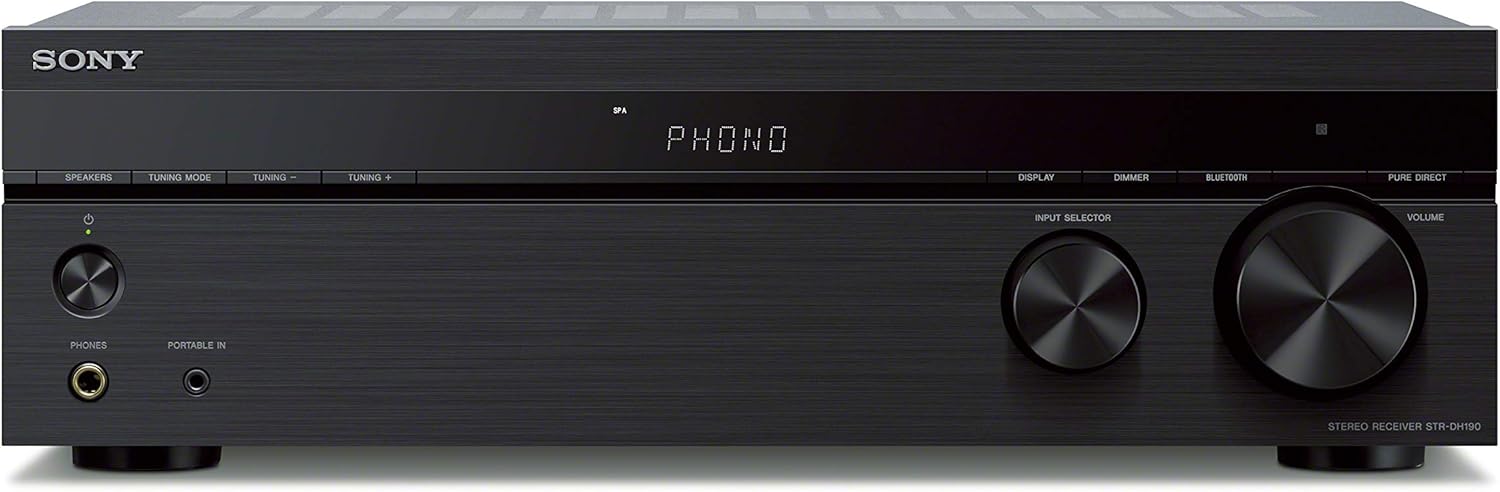
The STR-DH190 is Sony’s answer to a question a lot of people are quietly asking: what if I don’t want a home theater at all, I just want my turntable and a decent pair of bookshelf speakers to sound good? This is a pure two-channel receiver, and that simplicity is the entire point.
It includes a built-in phono stage, which matters more than it sounds like it should. Without one, a turntable connected directly into a line-level input sounds thin and quiet — you’d need a separate phono preamp, which is one more box and one more cable run. The DH190 skips that requirement entirely, so a turntable plugs straight in and plays at a normal volume with proper tonal balance.
Bluetooth is on board too, which turns this into a genuinely flexible little unit — vinyl on one input, phone streaming on another, no switching hardware required. Power output sits in the range that’s comfortable for bookshelf speakers in a bedroom, home office, or small living room; it’s not going to drive large floor-standing towers to reference volume, but that was never the design brief.
Pros
- Built-in phono input, no separate preamp needed
- Bluetooth streaming included
- Simple, uncluttered front panel
- Genuinely affordable entry point into real hi-fi
Cons
- No surround sound or HDMI switching
- Power output limits it to smaller speakers/rooms
- No app control or advanced room calibration
If you’re still deciding between a receiver-based setup and something simpler, this comparison of a receiver vs soundbar lays out the tradeoffs clearly — though for turntable owners specifically, a receiver like this one is really the only sensible route.
Check Price on Amazon
Sony STR-DH590 5.2 Channel Receiver Review

The STR-DH590 is the receiver most people picture when they think “home theater receiver” — a genuine 5.2-channel unit with enough HDMI inputs to handle a TV, a game console, and a streaming box without constant cable swapping. This is the natural upgrade path for anyone who has a soundbar and has realized it can’t do what a proper 5.1 speaker layout does.
It supports 4K passthrough with HDR formats, which was the sensible ceiling for a receiver in this price bracket, and it includes Sony’s Digital Cinema Auto Calibration to set speaker levels and distances automatically rather than asking you to do it by ear with a tape measure. Bluetooth is included for casual phone streaming, and the amplifier section is voiced to sound punchy on movie soundtracks without turning harsh at higher volumes.
Where it makes the most sense is a first real home theater build — five speakers plus a subwoofer, replacing whatever soundbar or TV speakers were doing the job before. Anyone coming from a soundbar setup will notice the difference in dialogue clarity and surround immersion almost immediately.
Pros
- True 5.2-channel surround sound at an accessible price
- Automatic speaker calibration included
- Multiple HDMI inputs with 4K/HDR passthrough
- Noticeably better than any soundbar at this price
Cons
- No 8K support or advanced object-based audio
- Limited to 5.2 channels — no height speakers
- Basic app/streaming feature set compared to pricier models
If you’re not sure how many speakers your room actually needs, the guide on how many watts you need for a receiver and this walkthrough on how to connect speakers to a receiver are worth reading before you buy, since wiring mistakes are the most common reason people think their new receiver “sounds wrong.”
Check Price on Amazon
Sony STR-AN1000 7.2ch 8K Receiver Review

The STR-AN1000 is where Sony’s lineup starts to feel like a genuine home theater centerpiece rather than a step-up from a soundbar. It supports 7.2 channels, which opens the door to either a wider surround array or a pair of height channels for Dolby Atmos, and it passes through full 8K video — future-proofing that matters if you’ve invested in a high-end TV or plan to.
Object-based surround formats are fully supported here, meaning Dolby Atmos and DTS:X sound the way they’re meant to — audio that moves overhead and around the room rather than just left-right-center. For gamers, the HDMI 2.1 features (variable refresh rate, low-latency passthrough) make this a genuinely strong pairing with a current-generation console or gaming PC.
Bluetooth and Wi-Fi streaming are both built in, along with support for major streaming services directly through the receiver, so it functions as a music hub as much as a movie amplifier. Build quality steps up from the DH-series noticeably — heavier chassis, better binding posts, more refined amplifier sections.
Pros
- 7.2 channels supports full Atmos height-channel setups
- 8K passthrough and HDMI 2.1 gaming features
- Built-in Wi-Fi and multi-service streaming
- Noticeably better build quality than entry models
Cons
- Priced well above the DH-series
- Overkill for small rooms or basic 5.1 setups
- Menu system takes time to fully learn
Not sure what Dolby Atmos actually adds to a room? This explainer on what Dolby Atmos means breaks it down without the marketing language, and it’s worth reading before deciding whether the extra channels here are worth paying for versus stopping at the DH590.
Check Price on Amazon
Sony STR-AZ1000ES 7.2 CH Receiver Review

The ES badge on Sony receivers has meant something for decades — it’s the designation for units built with better components, more rigid chassis construction, and tighter quality control than the consumer-grade line. The STR-AZ1000ES keeps the same 7.2-channel count as the AN1000 but wraps it in that ES-grade build, along with a more refined amplifier section that produces noticeably tighter, more controlled bass and cleaner high frequencies at higher volumes.
This is the entry point into Sony’s serious home theater tier — the receiver for someone who has a dedicated room, has already chosen speakers with some care, and wants electronics that won’t be the weak link. 8K support carries over from the AN1000, along with full Atmos and DTS:X decoding, but the ES treatment shows up in details like a heavier power supply and more resistant, higher-quality internal wiring.
Pros
- ES-grade build quality and component selection
- Cleaner, more controlled amplification than the AN1000
- Full 8K and Atmos/DTS:X support
- Strong entry point into Sony’s premium tier
Cons
- Same 7.2 channel count as the cheaper AN1000
- Meaningful price jump for the build-quality upgrade
- Best value only if you can actually hear the difference in your room
If you’re weighing whether the jump to ES-series is worth it, it helps to first nail down room calibration on whatever you already own — see this guide on how to calibrate receiver speakers, since a poorly calibrated cheap receiver can sound worse than a well-calibrated one costing half as much.
Check Price on Amazon
Sony STR-AZ3000ES 9.2 CH Receiver Review

Stepping up to 9.2 channels, the STR-AZ3000ES is built for rooms where a basic 5.1 or 7.1 layout genuinely doesn’t fill the space — larger living rooms, dedicated home theaters with wider seating, or setups that want a full Atmos height layer without compromise. The extra two channels typically go toward front-height or top-middle speakers, giving overhead effects real presence rather than a faint suggestion of them.
Multi-zone audio support becomes genuinely useful at this tier too — the ability to send a different source to a second room or patio while the main theater plays something else, all from one unit. The amplifier section carries the same ES-grade philosophy as the AZ1000ES but with more current on tap to comfortably drive the additional channels without strain.
Pros
- 9.2 channels for full-height Atmos layouts
- Multi-zone audio for whole-home setups
- ES-grade amplification with more headroom
- Handles larger, wider rooms with ease
Cons
- Unnecessary channel count for small-to-medium rooms
- Higher price bracket than most home users need
- Requires more speakers to actually use all channels
Planning a wider speaker layout to match those extra channels? This piece on how to connect speakers to a receiver covers wiring for larger multi-channel arrays, which gets noticeably more involved once you’re running height and surround-back channels together.
Check Price on Amazon
Sony STR-AZ5000ES 11.2 CH Receiver Review

At 11.2 channels, the STR-AZ5000ES is built for people who’ve stopped asking “do I need this many speakers” and started asking “how do I get the most accurate overhead layer possible.” This supports a full front-height and rear-height Atmos configuration simultaneously, along with wide front channels for a genuinely enveloping soundstage that a 7.2 or 9.2 setup simply can’t replicate.
The internal amplifier design at this tier uses more isolated power stages to keep channels from interfering with each other electrically — a detail that matters more as channel count climbs, since a shared, undersized power supply is where cheaper multi-channel receivers start to show weakness under sustained high volume.
Pros
- 11.2 channels for a complete height-and-width Atmos layout
- More isolated, higher-current amplifier design
- Reference-level detail retrieval for critical listening
- Genuinely future-proof for evolving surround formats
Cons
- Significant investment — needs matching speakers to justify it
- Setup and calibration take real time to get right
- Diminishing returns unless the room is properly treated
At this level, room acoustics start to matter as much as the receiver itself. It’s worth reviewing the fundamentals in how to set up a home theater receiver before committing to an 11-channel layout, since poor speaker placement can undercut even the best amplification.
Check Price on Amazon
Sony STR-AZ7000ES 13.2 CH Receiver Review

The STR-AZ7000ES sits at the very top of Sony’s receiver range, with 13.2 channels available — enough to run a full front, surround, and dual-height layer simultaneously, or to add wide and back-surround channels on top of a complete Atmos configuration. This isn’t a receiver most living rooms need, and Sony doesn’t pretend otherwise; it’s built for people constructing a reference-grade dedicated theater from scratch.
Everything about the internal design reflects that goal — the most robust power supply in the lineup, the most refined DAC and amplification stages Sony puts in a receiver, and the most thorough room calibration software Sony offers, since a system this capable needs equally capable measurement and tuning to actually sound its best rather than just technically support more speakers.
Pros
- 13.2 channels — the largest configuration Sony offers
- Reference-grade amplification and DAC quality
- Most advanced room calibration in the lineup
- Built for the largest, most ambitious home theaters
Cons
- Flagship pricing — a serious investment
- Complete overkill outside a dedicated theater room
- Needs professional-grade speaker matching to shine
If a 13-channel system is on the table, it’s also worth benchmarking against a full home theater system build to see how the total cost compares to buying speakers and electronics separately versus as a package.
Check Price on Amazon
Full Comparison Table
Laid out side by side, the jump in capability — and price — across the lineup becomes much clearer. Use this as a quick reference rather than reading every spec column as equally important; for most living rooms, channel count and HDMI generation matter far more than headline power figures.
| Model | Channels | Video | Atmos/DTS:X | Wi-Fi | Ideal Room Size |
|---|---|---|---|---|---|
| STR-DH190 | 2.0 | N/A (audio only) | No | No | Small / Office |
| STR-DH590 | 5.2 | 4K/HDR | No (standard surround) | No | Small-Medium |
| STR-AN1000 | 7.2 | 8K | Yes | Yes | Medium |
| STR-AZ1000ES | 7.2 | 8K | Yes | Yes | Medium-Large |
| STR-AZ3000ES | 9.2 | 8K | Yes | Yes | Large |
| STR-AZ5000ES | 11.2 | 8K | Yes | Yes | Large / Dedicated |
| STR-AZ7000ES | 13.2 | 8K | Yes | Yes | Very Large / Dedicated |
How to Choose the Right Sony Receiver for Your Room
The honest answer to “which one should I buy” depends almost entirely on three things: what you already own, how big the room is, and whether you care about overhead sound. Start with speakers — if you’re keeping an existing stereo pair and a turntable, the DH190 does everything you need and nothing you don’t. If you’re building a first home theater from a soundbar upgrade, the DH590 is the natural landing spot.
Once Dolby Atmos height channels enter the picture, the AN1000 becomes the practical minimum, since it’s the cheapest model with genuine object-based audio decoding and 8K passthrough for current and next-gen consoles. From there, the ES-series models (AZ1000ES through AZ7000ES) are really about room size and ambition rather than any single missing feature — bigger rooms and larger speaker arrays justify the jump to more channels and more current on tap.
A rough rule of thumb: measure your seating distance from the front speakers and count how many speaker positions your room can physically and acoustically support. As a general guideline, a room under roughly 150 square feet rarely benefits from more than 5.1 channels, since the extra speakers end up too close together to create a meaningful sense of separation. Rooms in the 150-300 square foot range are the sweet spot for 7.2 setups, giving enough physical distance between surround and height speakers to actually notice the difference. Beyond that, 9.2 and above starts making sense, particularly in rooms with vaulted or unusually high ceilings where a single pair of height channels doesn’t cover the full listening area evenly. Buying a 13-channel receiver for a room that can only fit five speakers just leaves eight channels unused — money better spent on better speakers for the channels you’ll actually use. This same logic applies to comparing receiver-based systems generally against pre-packaged options in the best home audio systems roundup, where all-in-one systems trade flexibility for simplicity.
| If you have… | Consider… |
|---|---|
| Turntable + bookshelf speakers only | STR-DH190 |
| TV + 5.1 speaker layout, first theater setup | STR-DH590 |
| Gaming console + want Atmos height channels | STR-AN1000 |
| Dedicated theater room, want ES build quality | STR-AZ1000ES |
| Larger room, wide + height channel layout | STR-AZ3000ES |
| Full height layer, critical listening priority | STR-AZ5000ES |
| Reference theater build, largest speaker array | STR-AZ7000ES |
Key Features Explained
Channels and What They Actually Mean
Each number before the decimal point in a spec sheet (like the “7” in 7.2) refers to a powered speaker channel — front left, front right, center, surrounds, and so on. The number after the decimal refers to subwoofer outputs. More channels mean more physical speaker positions the receiver can drive independently, which is what makes surround and height effects possible in the first place. For a deeper breakdown, the receiver channels explained guide covers exactly how each channel maps to a physical speaker position.
Dolby Atmos and DTS:X
These are object-based surround formats, meaning sound is treated as individual objects that move through 3D space rather than being locked to a fixed channel. That’s what makes rain or a helicopter sound like it’s genuinely moving overhead rather than just playing louder from one speaker. It requires height channels (ceiling-mounted or upward-firing speakers) to actually render the vertical dimension, which is why this feature only becomes meaningful from the AN1000 upward.
8K Passthrough and HDMI 2.1
This determines whether the receiver can pass a high-resolution, high-refresh-rate video signal from a source (console, streaming box, PC) to a TV without becoming a bottleneck. For current-generation gaming consoles and high-end TVs, HDMI 2.1 features like variable refresh rate matter for smooth, tear-free gameplay.
Automatic Room Calibration
Every model in this lineup includes some form of automatic calibration, using an included microphone to measure speaker distance, volume balance, and room acoustics, then adjusting settings accordingly. It’s not a substitute for good speaker placement, but it corrects for a lot of small errors that would otherwise go unnoticed.
Setup and Calibration Tips
Getting a new receiver sounding right usually comes down to a handful of details that are easy to overlook. First, run the automatic calibration with the microphone at actual seated ear height, not on the floor or a low table — the measurement is only as accurate as its placement. Second, double-check speaker wire polarity; a single reversed connection on one speaker will noticeably thin out the bass and blur the center image even though nothing sounds obviously “broken.”
For anyone connecting a receiver to a TV for the first time, running audio through HDMI-ARC or eARC rather than optical keeps things simplest and preserves the highest quality surround formats. The full walkthrough at how to connect a receiver to a TV covers the cable and port choices in detail, including common mistakes that cause no-sound or lip-sync issues.
Once the basic connections are sorted, it’s worth doing a manual pass after the automatic calibration finishes — nudging the subwoofer level down slightly if bass feels bloated, or adjusting center channel volume if dialogue feels buried under effects. Automatic systems get you 90% of the way there; the last adjustments are best done by ear over a few days of normal use.
Sony vs Other Receiver Brands
Sony’s receivers tend to compete most directly on value and video feature sets — the STR-AN1000 and DH590 in particular offer capability that’s hard to match at their respective price points. Where Sony sometimes trails competitors is in the depth of app-based control and the size of the enthusiast community offering firmware tweaks and tips, areas where brands like Denon and Yamaha have a longer track record.
If you’re cross-shopping, it’s worth reading the dedicated breakdowns for best Yamaha receivers, best Denon receivers, best Onkyo receivers, and best Marantz receivers before finalizing a decision, since each brand voices its amplifiers slightly differently and personal taste in tonal balance matters more than any single spec once you’re comparing similarly-priced units.
Frequently Asked Questions
Is the Sony STR-DH190 good enough for a turntable?
Yes — it includes a built-in phono stage designed specifically for turntables, so no separate preamp is needed. It’s one of the more turntable-friendly budget receivers currently available.
Do I need Dolby Atmos for a good home theater experience?
Not strictly. A well-set-up 5.1 system on something like the STR-DH590 sounds excellent for most content. Atmos adds a genuine upgrade in immersion, but it requires height speakers and a receiver with 7.2 or more channels to actually use.
What’s the real difference between the AN1000 and the ES-series models?
Primarily build quality and amplifier refinement. The ES designation reflects Sony’s higher-tier component selection and more rigorous manufacturing standards, which typically results in cleaner sound and better long-term reliability at higher volumes.
How many speakers do I actually need for the AZ7000ES’s 13.2 channels?
Up to 13 individually powered speakers plus two subwoofers, though most people won’t use every channel. It’s designed for maximum flexibility in large dedicated theater rooms rather than a requirement to fill every position.
Can these receivers power large floor-standing speakers?
The entry-level DH190 and DH590 are best matched with bookshelf or smaller floor-standing speakers. The AN1000 and ES-series models have more current on tap and pair comfortably with larger, less efficient speakers.
Is 8K passthrough actually necessary right now?
For most people, not yet — 4K remains the dominant content resolution. But since receivers tend to stay in service for many years, 8K support on the AN1000 and above is a reasonable piece of future-proofing.
Do Sony receivers support multi-room audio?
The ES-series models, starting with the AZ3000ES, include multi-zone support for sending audio to a second area of the home. The DH-series and AN1000 are single-zone units.
How much power do I need for my room size?
It depends on room volume, speaker sensitivity, and listening distance more than any single number. The guide on how many watts you need for a receiver walks through the calculation in more detail.
Is it worth buying an ES-series model for a small apartment?
Generally no. The extra channels and power headroom are wasted in a small room, and a DH590 or AN1000 will likely sound just as satisfying at normal apartment volumes for a fraction of the cost.
Do these receivers work with smart speakers or voice assistants?
The AN1000 and ES-series models include Wi-Fi and broader streaming integration that pairs well with smart home ecosystems, though voice control depth varies. Comparing streaming setups against dedicated devices like the Amazon Echo Dot or Echo Studio can help decide how much you want the receiver itself to handle.
Should I upgrade from a soundbar to one of these receivers?
If you want genuine surround immersion rather than a wide stereo-like effect, yes. The receiver vs soundbar comparison covers exactly what changes when you move from a single bar to a full multi-speaker layout.
What’s the easiest model in this lineup to set up for a beginner?
The STR-DH590 strikes the best balance of capability and simplicity — automatic calibration handles most of the technical work, and the menu system is straightforward compared to the deeper feature sets in the ES-series.
Getting the Most Out of Your Receiver Long-Term
A receiver is one of the few pieces of home theater gear that genuinely lasts a decade or more if it’s treated reasonably well, but a few habits make a real difference in how long that lifespan actually stretches. Ventilation is the biggest one — every model in this lineup, from the compact DH190 up to the AZ7000ES, generates real heat under sustained use, and tucking one into a closed cabinet with no airflow is the single most common cause of premature amplifier failure. Leave at least a few inches of clearance above and behind the unit, and if it’s going into an enclosed cabinet, make sure there’s a vented back panel or a small fan moving air through.
Firmware updates are worth checking every few months, particularly on the Wi-Fi-connected models like the AN1000 and ES-series units, since Sony periodically pushes fixes for HDMI handshake issues, streaming service changes, and occasional calibration bugs. These updates are usually painless — most models check automatically when connected to a network — but it’s easy to forget about a receiver once it’s set up and working, so a quick manual check now and then catches anything that slipped through.
Speaker wire connections are another area worth revisiting periodically, especially in a room where furniture gets rearranged or pets have access to the cabling. A loose binding post or a few strands of bare wire touching the wrong terminal can cause anything from a channel dropping out entirely to a persistent hum that’s maddening to diagnose. A five-minute check of every connection once or twice a year avoids most of these headaches before they start.
Who Should Skip a Sony Receiver Entirely
As thorough as this lineup is, a traditional receiver isn’t the right answer for everyone, and it’s worth being honest about that before spending money in the wrong direction. If your living situation genuinely can’t accommodate multiple speakers — a small rental apartment, strict rules on wall-mounted or floor-standing hardware, or simply a strong preference for minimal visible equipment — a well-reviewed soundbar will likely make you happier than any receiver on this list, regardless of channel count. The receiver vs soundbar comparison is worth revisiting here, because the honest answer for a lot of renters and minimalists is that a soundbar is simply the better fit, not a compromise.
Similarly, if music is the primary use case and movies are occasional, a simpler two-channel amplifier or an all-in-one system reviewed in the best home audio systems guide might serve better than even the STR-DH190, particularly if streaming convenience matters more than raw audio purity. And for anyone drawn to the idea of wireless flexibility over wired precision, it’s worth reading honestly about whether wireless speakers lose quality and whether wireless speakers are any good before assuming a wired receiver setup is automatically the superior path — for a lot of casual listeners, it genuinely isn’t the deciding factor people expect it to be.
Planning a Realistic Budget Around Your Receiver
One of the most common mistakes in building a system around any of these receivers is spending most of the budget on the electronics and leaving very little for speakers. In almost every case, speakers have a bigger impact on how a system actually sounds than the receiver driving them — a mid-range receiver paired with genuinely good speakers will usually outperform a flagship receiver paired with mediocre ones. A reasonable rule of thumb is to spend roughly as much on speakers combined as you spend on the receiver itself, and to lean toward the lower end of the receiver lineup if that means freeing up budget for better speakers.
This is particularly relevant when comparing the jump from the STR-AN1000 to the STR-AZ1000ES. Both offer the same 7.2 channel count and largely the same feature set — the difference is purely in build quality and amplifier refinement. For someone still assembling their first serious speaker set, that difference is much harder to hear than it is on paper, and the money saved by choosing the AN1000 is often better spent on a subwoofer upgrade or a stronger center channel speaker, since dialogue clarity and bass impact tend to matter more to everyday viewing than incremental amplifier refinement.
If budget is the primary constraint and you’re building from nothing, it can also help to look at what a complete system costs when planned holistically rather than piece by piece — the breakdown in best home stereo system under $500 is a useful reference point for how far a modest budget can actually stretch when spent thoughtfully.
What to Pair With Your New Receiver
A receiver on its own is just an amplifier and a switchboard — the rest of the system determines how it actually sounds and feels to use day to day. For the entry-level DH190 and DH590, pairing with efficient bookshelf speakers keeps power demands modest while still delivering satisfying volume in most rooms. As you move up toward the AN1000 and ES-series models, larger floor-standing speakers and dedicated subwoofers start to make more sense, since these receivers have the current on tap to drive them properly without strain.
It’s also worth thinking beyond the main speaker layout. Many people supplement a receiver-based system with a smart speaker for casual, everyday listening in other rooms — something like the Amazon Echo Dot for background music, or a more capable unit like the Amazon Echo Studio or Marshall Acton III for a bedroom or kitchen that doesn’t warrant running speaker wire. None of these replace what a receiver-driven main system does, but they round out a home’s overall audio setup in the spaces a dedicated theater room doesn’t reach.
Final Verdict
There isn’t a single “best” Sony receiver — there’s a best one for your specific room, speakers, and budget. For a simple stereo setup built around a turntable, the STR-DH190 remains a genuinely excellent, no-nonsense choice. For a first real home theater, the STR-DH590 delivers surround sound that will make a soundbar feel obviously limited by comparison. Anyone chasing Atmos height effects and 8K-ready gaming should look to the STR-AN1000 as the practical starting point, while the ES-series — AZ1000ES through AZ7000ES — exists for people building dedicated theater rooms where channel count, amplifier headroom, and component quality genuinely make an audible difference.
Whichever model fits your situation, take the time to calibrate it properly and place speakers thoughtfully — the receiver is only half of how a system ultimately sounds. Combined with the setup and buying guides linked throughout this review, you should have everything needed to make a confident choice.
Shop Sony Receivers on Amazon