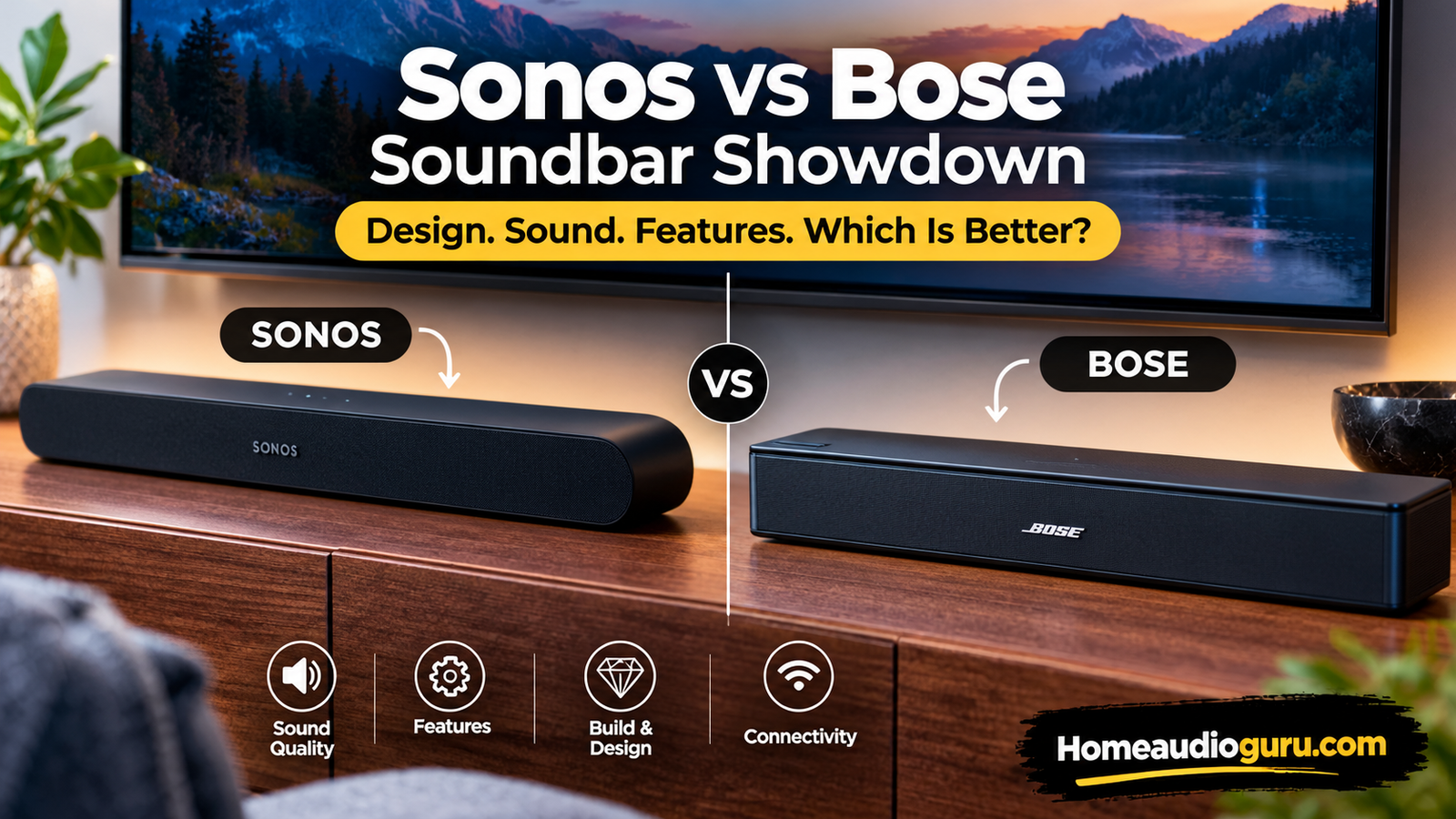
Sonos vs Bose: Which Home Audio Brand Actually Deserves Your Money?
Both brands make speakers people are proud to own. They just solve different problems. Here is how to tell which one fits your room, your TV, and your habits.
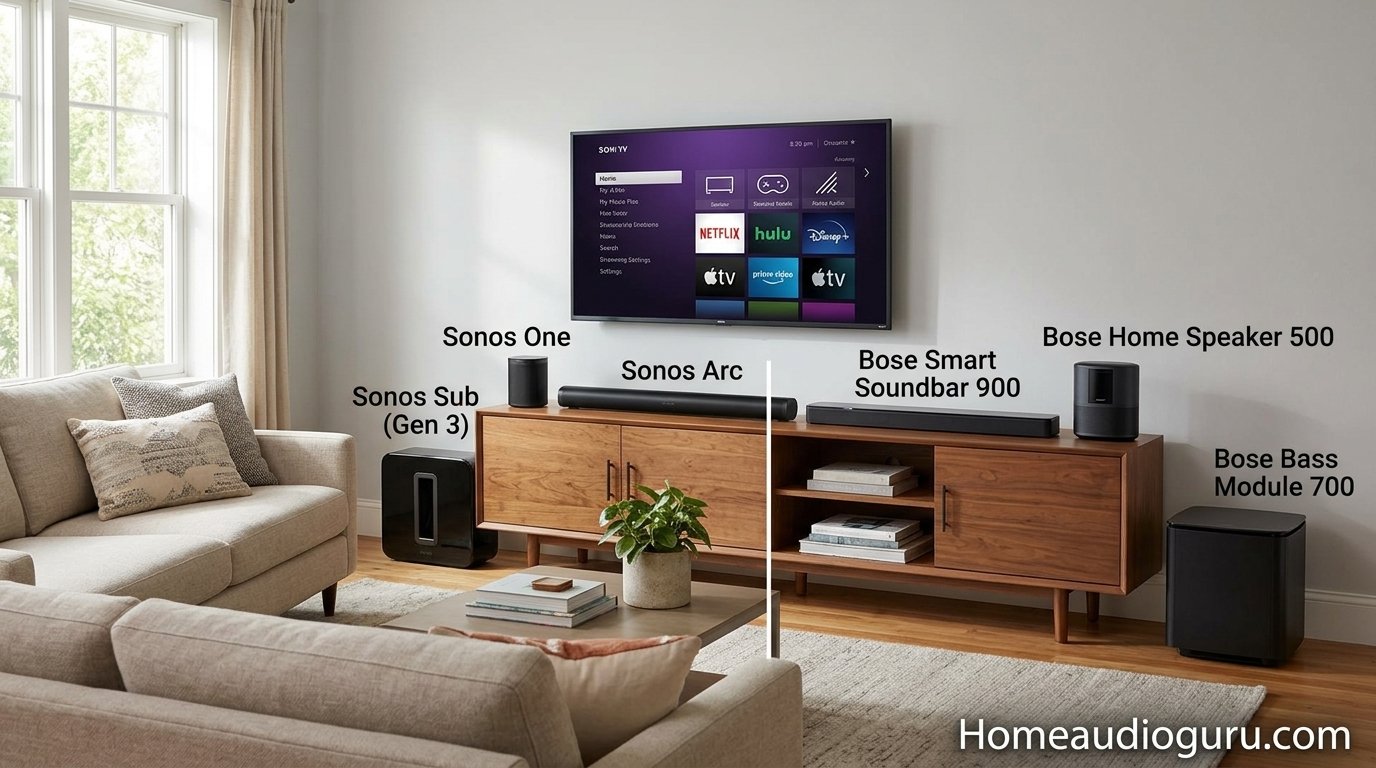
Walk into any electronics store and you will notice the same thing: the Sonos shelf and the Bose shelf sit a few feet apart, both full of sleek, premium-looking gear, both carrying prices that make you pause. Neither brand is trying to be the cheapest. Both promise better sound than your television or phone can deliver. So how do you choose?
The honest answer is that the sonos vs bose question is less about which company makes the better speaker and more about what kind of listener you are. One brand is built around a system you grow over time. The other is built around polished, self-contained products that sound good the moment you plug them in. Once you understand that split, most of the decision makes itself.
This guide walks through the real differences: sound character, soundbars, surround setups, multi-room audio, smart features, apps, portables, design, and value. If you are still mapping out your whole setup, our roundup of the best home audio systems is a useful companion to read alongside this one.
The Short Answer: Sonos vs Bose at a Glance
Choose Sonos if you want a system that expands room by room, you care about synchronized whole-home audio, and you like the idea of adding a subwoofer and surround speakers to a soundbar later.
Choose Bose if you want a clear, balanced, easy-to-love sound from a single product, you want Bluetooth as a fallback, and you value simplicity over expandability.
That is the headline, and for a lot of readers it is enough. But the details matter, because each brand has areas where it clearly pulls ahead and areas where it quietly lags. Here is a side-by-side snapshot before we dig into each category.
| Category | Sonos | Bose |
|---|---|---|
| Core idea | Modular, expandable ecosystem | Polished standalone products |
| Sound character | Neutral, detailed, tunable to the room | Warm, smooth, vocal-friendly |
| Multi-room | Excellent, long-established | Good, more limited |
| Surround expansion | Wide range of add-ons | Fewer, tied to specific soundbars |
| Bluetooth playback | Only on select models | Common across the lineup |
| Portable speakers | A few strong options | A deeper, more varied range |
| Best for | Whole-home and home theater builders | One-room simplicity and travel |
Keep this table in mind as you read. It will start to feel obvious once we get into how each brand actually behaves in a living room.
Want to see what both brands are selling right now?
Compare Sonos and Bose on AmazonTwo Brands, Two Philosophies
Sonos started with a simple, slightly radical idea: wireless speakers should talk to each other over your home network, not over Bluetooth. Every product the company has released since then fits into that idea. A Sonos speaker is rarely meant to live alone forever. It is the first piece of a system.
Bose has a different history. For decades the company has built its reputation on engineering that makes a small product sound bigger than it should, and on noise-cancelling technology that made its headphones famous. Its home audio products follow that spirit. They are designed to impress straight out of the box, with minimal tuning and minimal fuss.
What that means in practice
If you buy a Sonos soundbar, you are also buying into a platform. Add a wireless subwoofer next month, drop a pair of small speakers behind the couch next year, and park another speaker in the kitchen whenever you like. They all appear in one app and play in sync.
If you buy a Bose soundbar, you are buying a very good soundbar. You can usually add a bass module or surround speakers from the same family, and you can link Bose speakers together, but the story is more contained. For many households that is a feature, not a flaw. Fewer pieces means fewer decisions.
Sonos approach: strengths
- Grows with you, one room at a time
- Deep multi-room and grouping controls
- Room-tuning tools that adapt sound to your space
Sonos approach: trade-offs
- Costs add up as you expand
- Limited Bluetooth on many models
- Heavy reliance on the app
Bose approach: strengths
- Great out-of-the-box sound
- Broad connectivity, including Bluetooth
- Simple, low-maintenance ownership
Bose approach: trade-offs
- Smaller expansion ecosystem
- Multi-room is less seamless
- Less flexibility for custom setups
Start with a Sonos system you can grow over time.
Browse Sonos on AmazonSound Quality Head to Head
Specs only tell you so much. Two speakers with similar numbers can sound completely different, and sound is the reason you are shopping at all. So let us talk about the character of each brand rather than chasing measurements.
The Sonos sound
Sonos tends to aim for a neutral, detailed presentation. Vocals are clear, instruments are separated, and the bass is present without being exaggerated on most models. The company leans heavily on room tuning, which uses microphones to measure how your space affects the sound, then adjusts the output to compensate. In a room with awkward corners or lots of hard surfaces, that can make a real difference.
The result is a sound that rewards careful listening. You notice texture in acoustic recordings and precision in dialogue. It is rarely flashy, but it is honest, and it scales well when you add more speakers.
The Bose sound
Bose leans warmer and smoother. The company is known for tuning that makes voices sound full and forward, which is why many people find Bose soundbars especially good for dialogue-heavy shows and news. Bass tends to be rounded and comfortable, with a pleasing weight that does not need a separate subwoofer in smaller rooms.
Where Sonos can feel analytical, Bose can feel inviting. It is the difference between a studio monitor and a favorite pair of broken-in headphones. Neither is wrong. They suit different ears and different rooms.
Which one wins?
Neither wins outright, and anyone who says otherwise is oversimplifying. If you like to hear every layer of a mix and plan to tune the system to your room, Sonos usually satisfies. If you want something that sounds rich and pleasant immediately, with clear speech and minimal tinkering, Bose often does.
If you have ever wondered whether going wireless costs you fidelity, it is worth reading our breakdown on whether wireless speakers lose quality. The short version is that modern wireless systems from both brands are good enough that room acoustics and speaker placement matter far more than the wireless link itself.
| Sound trait | Sonos | Bose |
|---|---|---|
| Tonal balance | Neutral to slightly bright | Warm and smooth |
| Dialogue clarity | Very clear, natural | Very clear, forward |
| Bass character | Controlled, scales with a sub | Full and rounded |
| Room correction | Strong, central to the brand | Available on select models |
| Music detail | Excellent separation | Smooth, easy to enjoy |
Prefer a warmer, vocal-friendly sound?
See Bose speakers on AmazonSoundbars Compared: Entry, Mid-Range, and Flagship
For most people, the sonos vs bose decision is really a soundbar decision. A television is the most common reason someone buys either brand, because built-in TV speakers are universally thin. So let us compare the two lineups tier by tier.
Entry level: Sonos Ray vs Bose Smart Soundbar 300
The Sonos Ray is a compact, wallet-friendlier soundbar that connects with an optical cable. It has no HDMI port, which keeps things simple but limits it to basic setups. Our Sonos Ray review covers where it shines and where the missing HDMI hurts.
Bose counters with its smaller Smart Soundbar models, which include an HDMI connection and wider connectivity options like Bluetooth. If you want to plug into your TV with a single cable and also stream from a phone without any app, the Bose route is friendlier. If you want to grow into a bigger system later, the Sonos route is more flexible.
Mid-range: Sonos Beam (Gen 2) vs Bose Smart Soundbar 600
This is the most contested tier, and the one most readers should care about. The Sonos Beam (Gen 2) packs Dolby Atmos support into a surprisingly compact bar, delivers excellent dialogue, and plays nicely with the rest of the Sonos ecosystem. We tested it in depth in our Sonos Beam Gen 2 review.
Bose answers with a soundbar that also supports Atmos and leans into a wide, enveloping presentation with strong speech clarity. It adds Bluetooth, which the Beam lacks, and works with both major voice assistants and several casting standards. If you read our Bose Smart Soundbar review, you know the pattern: easy to live with, pleasing to hear, a little less expandable.
Flagship: Sonos Arc line vs Bose Smart Ultra Soundbar
At the top end, both brands go big on Dolby Atmos. Sonos builds its flagship bars around a full-size design that fills a large room, and they pair beautifully with a Sonos subwoofer and rear speakers. Bose’s flagship uses its own spatial processing to create height and width effects from a single bar, and it is one of the most convincing single-bar surround experiences available.
If you want to understand what Atmos actually adds, our explainer on what Dolby Atmos means breaks down height channels in plain language.
| Tier | Sonos | Bose |
|---|---|---|
| Entry | Ray: compact, optical input, no HDMI | Smaller Smart Soundbar: HDMI plus Bluetooth |
| Mid-range | Beam (Gen 2): compact, Atmos, HDMI eARC | Smart Soundbar 600: Atmos, Bluetooth, wider casting support |
| Flagship | Arc line: full-size, Atmos, expandable | Smart Ultra: strong single-bar spatial effect |
| Expansion | Subwoofers, surround speakers | Bass module, surround speakers |
Prefer to see how other brands stack up before committing? Our Sonos vs JBL comparison and our JBL Bar 500 review offer useful context on the competition.
Ready to upgrade your TV sound?
Shop Sonos soundbars on AmazonBuilding a Home Theater: Surrounds, Subs, and Expansion
A soundbar is a great first step, but plenty of people eventually want the real thing: bass you can feel and effects that move behind your head. This is where the brands diverge most sharply.
The Sonos way
Sonos makes expansion almost effortless. Start with a soundbar, add a wireless subwoofer, then pair a set of small speakers as rear channels. Everything is wireless apart from power, and the app walks you through each addition. You can start small and keep building without throwing anything away.
The same flexibility works in reverse. A speaker that serves as a rear channel today can move to a bedroom later. Sonos gear has a way of finding a second job, which softens the sting of the price.
The Bose way
Bose offers a bass module and surround speakers designed to pair with its soundbars. The experience is also wireless and also straightforward, but the choices are narrower, and many add-ons only work with certain soundbars. For someone who wants a clean upgrade path with fewer decisions, that is fine. For a tinkerer, it can feel confining.
When a receiver makes more sense
Neither brand replaces a traditional receiver and passive speaker setup if you want maximum power and flexibility. If you are weighing that route, our guide on receiver vs soundbar lays out the trade-offs, and our picks for the best home audio receiver are a good starting point. Larger budgets might also want to look at our guide to the best home theater system under $10,000.
- Small apartment or bedroom: a single soundbar from either brand is usually plenty.
- Medium living room: a mid-range bar plus a subwoofer gives a big jump in impact.
- Large dedicated room: consider a flagship bar with surrounds, or step up to a receiver system.
Add a wireless subwoofer for bass you can feel.
Find subwoofers on AmazonMulti-Room and Whole-Home Audio
This is the category where Sonos earned its reputation, and it is still the strongest argument for choosing the brand. A Sonos system treats every speaker in your home as part of one network. You can play different songs in different rooms, group any combination into a synchronized zone, or send the TV audio from your soundbar to a speaker in another room.
Control is fast and consistent. Grouping rooms takes a couple of taps, volume can be adjusted per room or as a group, and playback stays tightly in sync. If you throw parties or simply like music following you from the kitchen to the patio, that smoothness is hard to beat.
How Bose handles it
Bose supports grouping across its newer smart speakers and soundbars, and it also plays well with standards like AirPlay 2 and Chromecast, which let you group speakers from different brands. The experience works, and for a two or three-speaker home it is perfectly good. But it is not as deep or as polished as Sonos when you scale up to many rooms.
What about cross-brand setups?
One practical note: because both brands support open standards, you are not locked into a single choice. Plenty of households run a Sonos soundbar in the living room and a Bose portable on the patio. They will not group in a single native app, but they can coexist peacefully.
If you are new to wireless audio and wondering whether it is dependable, our article on whether wireless speakers are any good addresses the common worries about lag, dropouts, and sound quality.
Build a synced, whole-home setup room by room.
Explore multi-room speakersStreaming, Voice Control, and Smart Features
Modern speakers are as much software as hardware, so the way each brand handles streaming and voice control deserves its own look.
Streaming services and standards
Sonos supports a huge catalog of streaming services directly in its app, and its search function pulls results from all of them into one place. It also supports AirPlay 2 on most current products, which makes it easy for Apple users to send audio from a phone, tablet, or laptop.
Bose supports a strong list of services as well, and it leans more on built-in standards such as AirPlay 2, Chromecast, and Spotify Connect. That approach means you can often skip the Bose app entirely and just cast from whatever app you are already in. Many Bose models also include Bluetooth, which is a genuine convenience when guests want to play something quickly.
Voice assistants
Both brands offer voice control, but their approaches differ. Sonos supports Alexa and its own voice control on supported speakers, with a focus on privacy and quick commands. Bose offers broader assistant support across much of its smart lineup. If you already live in a particular voice ecosystem, check that the specific model you want works with it before you buy.
| Feature | Sonos | Bose |
|---|---|---|
| Wi-Fi streaming | Yes, core feature | Yes |
| Bluetooth | Select portable and newer models | Common across lineup |
| AirPlay 2 | Yes, on most products | Yes, on smart models |
| Chromecast built-in | Limited | Yes, on smart models |
| Spotify Connect | Yes | Yes |
| Voice control | Alexa and Sonos Voice Control | Alexa and Google Assistant on many models |
If voice is your priority, it is also worth looking at what a dedicated smart speaker can do. Our Amazon Echo Studio review shows how a voice-first speaker compares with what these two brands offer.
Want voice control plus great sound?
Shop smart speakersApp and Setup Experience
A speaker you struggle to set up is a speaker you resent. Both brands have worked hard on setup, but the day-to-day software experience is very different.
Sonos app
The Sonos app is the control center of the whole system. It handles setup, music search, grouping, room tuning, equalizer settings, and sleep timers. In recent years the app went through a major redesign that drew plenty of criticism from longtime users, and the company has been working to address those complaints with updates. If you are comfortable with apps and like deep control, it is capable. If you prefer not to open an app at all, Sonos can feel like more of a commitment than you want.
Bose Music app
The Bose Music app is simpler and more focused. It covers setup, basic controls, and a handful of sound settings. Because Bose supports so many casting and Bluetooth options, you can use the app sparingly or not at all. Its simplicity is its strength, though power users may wish for more advanced options.
Setup tips for either brand
- Place the soundbar centered below the television and keep it clear of obstructions.
- Use a strong Wi-Fi connection, or an Ethernet cable if the product supports it.
- Run room calibration after you have finished moving furniture.
- Keep subwoofers off the floor corner if bass sounds boomy.
For a broader walkthrough that applies to nearly any setup, see our guide on how to set up a home audio system.
Pick the system that matches how you like to set things up.
Browse wireless soundbarsPortable and Smart Speakers
Not every speaker sits under a television. Plenty of people want something that moves from the kitchen to the backyard, or that sits on a shelf and plays music all day.
Sonos portables and smart speakers
Sonos offers a small number of portable speakers that double as part of the home system. When you are home they join your Wi-Fi network and group with other rooms. When you are out they switch to Bluetooth. Its smart speakers, which include models with spatial audio support, bring the same sound philosophy to a shelf-sized package.
Bose portables and smart speakers
Bose has a deeper bench of portables. The SoundLink family covers everything from a pocket-sized speaker to a larger, louder model made for outdoor use, and the sound is consistently full for the size. Bose tends to win on rugged, grab-and-go convenience, since Bluetooth pairing is simple and battery life is generally strong.
Where the competition fits
If portability is your main goal, both brands face serious competition. Our JBL Charge 5 review shows how a popular alternative stacks up, and our list of the best Bluetooth speakers for home helps you compare more options at a glance.
Choose Sonos portables for
- Wi-Fi grouping at home
- One app for everything
- Spatial audio on larger models
Choose Bose portables for
- Wider model selection
- Easy Bluetooth pairing
- Rugged, travel-friendly designs
Find a portable speaker for the patio or the trip.
Shop portable speakersDesign, Build Quality, and Room Fit
You will see these products every day, so looks matter. Both brands design with restraint, but they land in different places.
Sonos favors clean, minimal shapes in matte black or white, with simple fabric or perforated grilles and discreet touch controls. The aesthetic is modern and intentionally quiet, designed to blend into a room rather than shout. Soundbars are slim and low, which helps them tuck under televisions without blocking the screen or the remote sensor.
Bose tends to use soft curves and premium materials, with a slightly more familiar consumer-electronics feel. Its soundbars are often a touch taller and may include a front display or indicator lights. Neither approach is better, but if you are particular about how gear looks beside a wall-mounted television, measure carefully and check product photos in real rooms.
Placement considerations
- Under a TV stand: check the height of the soundbar so it does not block the screen.
- Wall mounting: look for included brackets or buy a compatible mount.
- Open shelves: a compact bar behaves differently from a wide bar, so match size to space.
- Small rooms: avoid oversized flagship bars that overpower the space.
Match your soundbar to your TV and your space.
Browse compact soundbarsPricing and Long-Term Value
Both brands sit in the premium tier, and neither is the right pick if your only goal is the lowest possible price. But value is not only about the sticker.
Upfront cost
Entry-level products from each brand are priced competitively against each other, and mid-range bars land close together. The gap opens up when you factor in expansion. Adding a subwoofer and surrounds to a Sonos system can push the total well above the cost of a single Bose bar, simply because there is more to buy. That does not make it worse value. It makes it a different kind of purchase.
Long-term value
Sonos products tend to remain useful for years, because they can be repurposed as your needs change. A soundbar can move to a bedroom, a speaker can become a rear channel, and software updates keep improving features over time. Bose products are also durable, and because they work well on their own, they rarely feel incomplete.
Where to save
- Watch for seasonal sales on both brands, especially around major shopping events.
- Consider last-generation models, which are often discounted once new versions arrive.
- Buy only what your room needs. A subwoofer is not mandatory for a small space.
If your budget is tight, our roundup of the best home stereo system under $500 shows what you can build for much less than either brand’s flagship gear.
Check current prices before you decide.
See today’s soundbar pricesWhich One Should You Buy?
After all of that, the choice comes down to a few honest questions. Answer them and you will probably know.
| If this sounds like you | Go with | Why |
|---|---|---|
| You want music in many rooms | Sonos | Best-in-class grouping and control |
| You plan to add a sub and surrounds | Sonos | Widest expansion options |
| You want plug-in-and-enjoy simplicity | Bose | Great sound with minimal setup |
| You need Bluetooth for guests | Bose | Bluetooth across most models |
| You love dialogue clarity and warm tone | Bose | Smooth, vocal-forward tuning |
| You like detail and room tuning | Sonos | Neutral sound and strong calibration |
| You travel with your speaker | Bose | Deeper portable range |
A practical rule of thumb
If your plan involves more than one room, lean Sonos. If your plan involves one room and no future expansion, lean Bose. If you are somewhere in the middle, start with the soundbar that sounds best to you in a store and trust your ears. Both brands are reliable enough that there is no wrong answer, only a better fit.
Ready to pick your side?
Compare both on AmazonFrequently Asked Questions
Is Sonos better than Bose?
Neither is better across the board. Sonos is stronger for multi-room audio and expandable home theater setups, while Bose is stronger for simple, great-sounding standalone products and Bluetooth convenience. The better brand is the one that fits how you listen.
Which brand has better sound quality?
Sonos usually offers a more neutral, detailed sound that can be tuned to your room, while Bose tends to deliver a warmer, smoother sound with strong dialogue. Personal taste and room acoustics decide which one sounds better to you.
Can I use Sonos and Bose speakers together?
Not in one native app, but you can often group them using open standards such as AirPlay 2 on supported devices. Many people simply keep a Sonos system in one area and a Bose portable elsewhere.
Do Sonos speakers work over Bluetooth?
Only some of them. Sonos is built around Wi-Fi, and Bluetooth appears mainly on select portable and newer models. If Bluetooth matters to you, confirm the specific model before purchasing.
Which soundbar is better for dialogue?
Both are very good at dialogue. Bose often sounds more forward and warm with voices, while Sonos sounds clear and natural. If you struggle to understand speech, look for dialogue-enhancement settings on whichever model you choose.
Do I need a subwoofer with a Sonos or Bose soundbar?
Not necessarily. In small to medium rooms a good soundbar may provide enough bass on its own. A subwoofer makes the biggest difference for movies and in larger spaces, where low-frequency impact matters more.
Which brand is easier to set up?
Bose is usually a little simpler because you can often use Bluetooth or casting without the app. Sonos setup is still straightforward, but it relies more on its app, especially for room tuning and expansion.
Is Dolby Atmos worth paying extra for?
If you watch a lot of movies and streaming shows with Atmos soundtracks, it can add a convincing sense of height and space. If you mostly watch regular television, the benefit is smaller. Our guide on Dolby Atmos explains what to expect.
Which brand is better for a whole-home audio setup?
Sonos is the stronger choice for whole-home audio. Its grouping, synchronization, and per-room control are more mature and more flexible than what Bose offers.
Are Sonos and Bose worth the price compared with cheaper brands?
For many people, yes, especially in terms of build quality, software support, and ease of use. That said, competitors offer strong value, so it is worth comparing them before you commit.
Which brand is better for travel and outdoor use?
Bose generally has the broader portable lineup, with models designed for travel and outdoor use. Sonos portables are good, but fewer in number.
Should I buy a receiver instead of either brand?
A receiver and passive speakers can deliver more power and flexibility, but they cost more in space, wiring, and setup time. If you want a clean, simple solution, a soundbar from either brand is easier.
Final Thoughts: Sonos vs Bose
The sonos vs bose debate ends up being refreshingly clear once you know what you want. Sonos rewards people who think in systems, who want music to follow them through the house, and who enjoy building a setup over time. Bose rewards people who want a great sound in one room right now, with minimal fuss and maximum convenience.
Both make products that sound better than almost any television or phone speaker, and both are backed by years of engineering and support. Pick the one that matches your room, your habits, and your plans for the next few years, and you will be happy with either. Start with the soundbar, listen closely, and let your own ears break the tie.
Make your choice and start enjoying better sound today.
Shop Sonos and Bose on Amazon