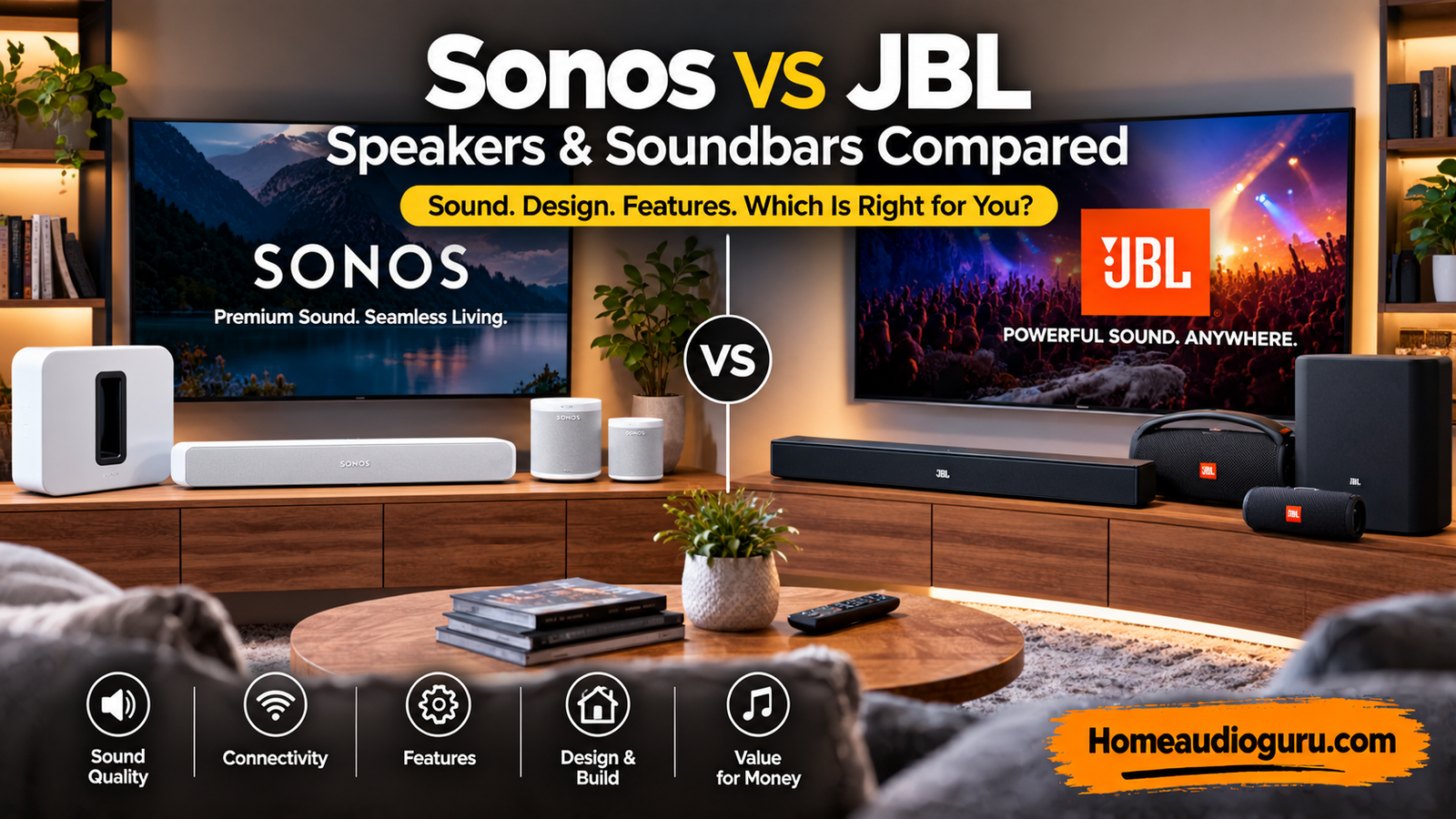
Sonos vs JBL: Which Brand Deserves a Place in Your Home?
Polished multiroom ecosystem or big, punchy sound at friendlier prices? We break down sound, soundbars, portables, apps, durability, and value so you can buy once and be happy.
Walk into any electronics store or scroll through any “best speaker” list and two names keep surfacing: Sonos and JBL. One is the minimalist darling of design-conscious households, famous for speakers that talk to each other across every room. The other is the veteran of concert halls and cinemas, now selling everything from pocket-sized Bluetooth cylinders to full Dolby Atmos soundbars at prices that rarely make you wince.
Both are excellent. Neither is perfect. And the “right” answer depends far less on spec sheets than on how you actually live: do you want one seamless system running through the whole house, or do you want a loud, tough speaker you can toss in a backpack and a soundbar that punches above its price?
This guide walks through the real differences between the two brands, from sound signature and software to durability and long-term cost. If you are still early in your planning and want the broader landscape first, our roundup of the best home audio systems is a good companion read. Otherwise, let’s settle this.
1. Quick Verdict: Sonos vs JBL at a Glance
Before we dig into the details, here is the bird’s-eye view. Think of Sonos as a curated, closed-garden experience where everything is designed to work together and the software does a lot of heavy lifting. Think of JBL as a sprawling catalog where you pick the exact tool for the job, from a clip-on speaker for the gym to a flagship soundbar with detachable surrounds.
| Category | Sonos | JBL |
|---|---|---|
| Core strength | Multiroom Wi-Fi ecosystem, polished app | Variety, value, rugged portables |
| Sound signature | Balanced, controlled, tuned to the room | Punchy, bass-forward, lively |
| Soundbars | Beam (Gen 2), Ray, Arc | Bar 300, Bar 500, Bar 1000 |
| Portables | Roam, Move (fewer options) | Go, Clip, Flip, Charge, Xtreme, Boombox |
| Bluetooth on every model | Only on select models | Yes, nearly across the range |
| Ecosystem lock-in | High (Sonos-only grouping) | Low to moderate |
| Typical price feel | Premium | Budget to upper-mid |
If you only remember one thing from this table, make it the last two rows. Sonos asks you to commit to its platform in exchange for polish. JBL asks for less commitment and gives you more flexibility. That tradeoff shapes almost every section that follows.
Want to browse both lineups side by side?
Shop Sonos on AmazonPrefer the value-packed catalog?
Shop JBL on Amazon2. Two Different Philosophies
Sonos built its reputation on a simple idea: wireless audio should be as easy as flipping a light switch. The company pioneered whole-home streaming long before it was fashionable, and everything it makes still carries that DNA. Speakers join a shared Wi-Fi network, you group them in an app, and music plays in sync from room to room. The hardware is designed to disappear into your decor, and the engineering priority is consistency rather than raw power.
JBL, a Harman brand with a long history in professional audio, comes at things from the opposite direction. It has decades of experience building speakers for stages, studios, and cinemas, and that heritage shows in the way its consumer products lean into energy and impact. The catalog is huge. You can spend the price of a lunch on a tiny clip-on speaker or invest in a serious home theater bar, and the company is happy to meet you at either end.
What this means in practice
With Sonos, you are buying into a system. Each new speaker makes the whole setup more valuable, but you are also nudged to keep buying Sonos. With JBL, you are buying individual products. Your Charge speaker will happily pair with your phone, your laptop, and your friend’s tablet, and it does not care what else you own.
- Sonos mindset: “Build one beautiful system and control it from one app.”
- JBL mindset: “Pick the right speaker for the moment and enjoy big sound.”
- Sonos buyer: values simplicity, aesthetics, and long-term software support.
- JBL buyer: values flexibility, durability, and bang for the buck.
Neither philosophy is wrong. They simply optimize for different people. If you have ever debated Sonos against another premium rival, our breakdown of Sonos vs Bose covers how those two compare on similar ground.
Start with the lineup that matches your philosophy.
See Sonos Wireless Speakers3. Sound Quality Face-Off
Sound is subjective, but certain patterns hold true. Sonos tunes its speakers to sound controlled and clear, with a midrange that makes vocals feel present and a low end that stays tight instead of boomy. Many Sonos models also support Trueplay, a tuning feature that uses a microphone to measure how your room affects the sound and adjusts the speaker to compensate. In a cluttered living room with hard floors and bare walls, that can make a noticeable difference.
JBL leans toward a more exciting presentation. Bass is generally generous, highs have sparkle, and dynamics feel punchy. That signature suits pop, hip-hop, electronic music, and action movies particularly well. Critics sometimes describe the tuning as “fun” rather than “neutral,” and that is a fair summary. If you like a speaker that makes a statement, JBL delivers. If you prefer a speaker that stays out of the way and lets the recording speak, Sonos tends to feel more refined.
Bass, volume, and clarity
For raw loudness and bass impact per dollar, JBL usually wins. Its larger portables and party speakers are built to fill backyards and gatherings. Sonos speakers can get plenty loud for homes and apartments, but they are engineered for balance at living-room volumes rather than for filling a patio.
Stereo imaging and soundstage
Sonos has invested heavily in spatial audio on its newer speakers, with upward-firing drivers on some models to bounce sound off the ceiling. JBL’s higher-end soundbars do something similar, and its flagship model goes a step further with detachable rear speakers. The result is that both brands can create a wide, enveloping soundstage when you spend at the upper end of their lineups.
Sonos sound: strengths
- Clean, balanced midrange
- Room tuning on supported models
- Consistent character across the lineup
Sonos sound: tradeoffs
- Less raw bass and volume per dollar
- Can feel restrained for bass lovers
JBL sound: strengths
- Energetic, bass-forward tuning
- Very loud portables
- Strong value at every price point
JBL sound: tradeoffs
- Less neutral, more “colored”
- Tuning varies more between models
One more thought on wireless quality. People often wonder whether going wireless costs you fidelity. The honest answer depends on the codec, the signal strength, and the source file, and we unpack it in do wireless speakers lose quality and are wireless speakers any good. Spoiler: Wi-Fi streaming, which Sonos uses heavily, generally preserves quality better than basic Bluetooth.
Compare real-world listening impressions and buyer reviews.
Browse Wireless Speakers4. Soundbars & Home Theater
This is where the rivalry gets serious, because both brands sell some of the most popular soundbars on the market. If your main goal is to upgrade thin television speakers, here is how the two lineups stack up.
| Model | Best for | Notable features |
|---|---|---|
| Sonos Ray | Small rooms, tight budgets | Compact bar, optical connection, no HDMI, no Dolby Atmos |
| Sonos Beam (Gen 2) | Most living rooms | HDMI eARC, Dolby Atmos support, voice assistants, Wi-Fi streaming |
| JBL Bar 300 | Value-focused buyers | Compact Atmos-capable bar, solid output, simple setup |
| JBL Bar 500 | Mid-size rooms | 5.1 channel design, wireless subwoofer, Dolby Atmos, multiple streaming options |
| JBL Bar 1000 | Serious movie fans | Detachable wireless surrounds, large wireless sub, immersive format support |
Sonos soundbars
The Sonos Beam Gen 2 is the brand’s sweet spot. It is compact enough to sit under a mid-size TV, supports Dolby Atmos, and offers excellent dialogue clarity. If you only have a small budget or a small room, the Sonos Ray trades features for simplicity. It lacks HDMI, so you connect through optical, which means a few conveniences like some control passthrough are limited. The big draw is that either bar can later be expanded with a subwoofer and rear speakers, turning a simple bar into a true surround system over time.
JBL soundbars
JBL’s answer is to give you more hardware immediately. The JBL Bar 500 ships with a wireless subwoofer in the box, and the JBL Bar 1000 includes both a subwoofer and detachable surround speakers that charge on the bar itself. For people who want a complete movie setup in a single purchase, that is a compelling pitch. You get real low-frequency impact straight away, rather than adding it later.
Other bars worth a look
If neither brand quite fits, the market has plenty of alternatives. Our reviews of the Bose Smart Soundbar, Samsung B-Series, Sony HT-S2000, Vizio 5.1 SE, and Polk MagniFi Mini show how crowded the field is. If you are budgeting for something bigger, the guide to the best home theater system under $10,000 shows what a no-compromise build looks like.
Ready to upgrade your TV sound?
Check Sonos Beam Gen 2Want a complete kit in one box?
Check JBL Bar 5005. Multiroom & Whole-Home Audio
If you only read one section for a home with several rooms, make it this one. Multiroom is Sonos’ home turf. Speakers connect over Wi-Fi, appear as rooms in the app, and can be grouped, ungrouped, and volume-adjusted individually. You can play different songs in the kitchen and the bedroom, or the same playlist everywhere, and the sync is tight enough that walking between rooms does not produce echo.
Sonos also lets you use two identical speakers as a stereo pair, or pair a soundbar with rear speakers and a subwoofer, all through the same app. Because the platform has been refined for years, setup tends to be quick, and adding a new room usually takes only a few minutes.
How JBL handles multiroom
JBL supports multiroom in a few different ways, depending on the product. Its Wi-Fi speakers can join systems through built-in casting features and AirPlay, and many of its Bluetooth speakers offer PartyBoost, which links compatible speakers for louder, wider sound. Newer models also support Auracast, a Bluetooth broadcast technology that can send audio to many compatible speakers at once.
The catch is consistency. Because JBL’s lineup is so broad, not every speaker supports every feature, and the experience can feel a little more fragmented than Sonos’ unified app. That is the cost of variety. For party use or a patio, it is perfectly fine. For a polished, whole-home setup where every room is expected to behave the same way, Sonos is more convincing.
- Choose Sonos if you want room-by-room control, stereo pairing, and a single app for everything.
- Choose JBL if you want cheap extra speakers for specific moments rather than a permanent grid.
If you are planning a multi-room build and want to understand the wiring, network, and placement fundamentals, our walkthrough on how to set up a home audio system is a practical starting point.
Build your whole-home system one room at a time.
Explore Sonos Era Speakers6. Portable & Bluetooth Speakers
Here the script flips. Portable audio is where JBL absolutely dominates the conversation. The company sells a full ladder of Bluetooth speakers, each designed for a specific lifestyle, and most are rated to resist water and dust. There is a speaker small enough to clip onto a bag, one sized for a beach towel, and others built like boomboxes that can anchor a backyard barbecue.
| Speaker | Size / use | Why people buy it |
|---|---|---|
| JBL Clip | Ultra-portable, clips to bags | Cheap, rugged, great for hikes |
| JBL Go | Pocket-sized | Tiny and colorful, easy gift |
| JBL Flip | Everyday portable | Balanced size and sound |
| JBL Charge | Mid-size with power bank | Long battery, can charge your phone |
| JBL Xtreme / Boombox | Large, party-ready | Loud, deep bass, strong battery |
| Sonos Roam | Small portable | Wi-Fi at home, Bluetooth outside |
| Sonos Move | Large portable | Premium sound, Wi-Fi and Bluetooth |
The JBL Charge 5 remains a favorite in this category because it balances weight, battery life, and sound in a way that works for pool days and living rooms alike. If you are weighing a whole class of options, our guide to the best Bluetooth speakers for home compares plenty of competitors too.
Where Sonos fits
Sonos offers fewer portable models, but they are interesting. They bridge two worlds: on your home Wi-Fi they behave like regular Sonos speakers, and away from home they switch to Bluetooth. That hybrid design is clever, especially for people already invested in the Sonos ecosystem. However, the Sonos portables cost noticeably more than comparable JBL options and do not match JBL’s brute-force volume.
Why JBL wins portables
- Huge range of sizes
- Rugged, waterproof designs
- Better value and louder output
Where Sonos still shines
- Seamless handoff between Wi-Fi and Bluetooth
- Excellent app control at home
- Cohesive design language
Find the right JBL portable for your lifestyle.
Shop JBL Charge 57. App, Software & Smart Features
Software is the beating heart of Sonos. The app unifies music services, room controls, EQ, system updates, and speaker setup into a single interface. You can search across multiple streaming services at once, build queues, and set alarms. In recent years the company has gone through a controversial app redesign that frustrated some longtime users, and it has been working to improve stability and restore missing features. Even so, the underlying platform remains one of the best in the business, and most owners describe daily use as smooth.
Voice control is another Sonos strength. Many models support Amazon Alexa, and some also include the company’s own voice assistant, which processes commands on the device for added privacy and speed. Pairing a speaker with Apple AirPlay 2 or a casting protocol further expands how you can send music.
JBL’s software story
JBL uses a different approach, with a mix of its own app and built-in platform support. On Wi-Fi models, you will typically find Google Chromecast, AirPlay 2, and Alexa support. On Bluetooth models, a companion app lets you adjust EQ, update firmware, and pair multiple speakers. It works well, but the experience is not as unified as Sonos. Two JBL products can feel quite different to use, depending on their generation and category.
- Sonos advantages: single app, cross-service search, strong stereo pairing, consistent updates.
- JBL advantages: simpler products that work without any app, broad casting support, easy Bluetooth pairing.
- Voice assistants: both brands support popular assistants, though specific models vary.
Smart-speaker fans may also want to compare these with an Echo. See our reviews of the Amazon Echo Dot, Echo Dot Max, and Echo Studio to see where a voice-first speaker fits into the mix.
Prefer a voice-first speaker to compare?
Check Echo Studio8. Design, Build & Durability
Sonos is a design-first company. Its speakers are typically finished in clean, matte colors with minimal visible branding, soft edges, and subtle controls. They are meant to look at home on a bookshelf, a kitchen counter, or a media console without screaming for attention. Build quality is generally excellent, and the products feel premium in the hand.
JBL’s design language is bolder. Fabric grilles, rubberized bodies, prominent logos, and bright color options make its portables unmistakable. This is a feature rather than a bug if you want a speaker that survives sand, splashes, and the occasional drop. Many JBL portables carry strong ingress-protection ratings, which means they can handle rain, pool splashes, and dust far better than your average home speaker.
Durability and weather resistance
JBL is the safer choice for outdoor and adventure use. Sonos does offer weather-resistant options, but the lineup is narrower and priced higher. For indoor use, both brands hold up well, and Sonos’ long software-support history means older speakers continue to receive attention for years.
Aesthetic alternatives
If you want a speaker that doubles as a statement piece, you might also look at models with a retro or luxury feel. Our Marshall Acton III review highlights how strong design can influence a buying decision just as much as specs.
| Design factor | Sonos | JBL |
|---|---|---|
| Look | Minimalist, understated | Bold, sporty, colorful |
| Materials | Matte plastics, premium finishes | Rubber, fabric, rugged shells |
| Outdoor toughness | Limited, select models | Strong across portable range |
| Home decor fit | Excellent | Good, varies by model |
Choose a speaker that looks as good as it sounds.
View Sonos Era 3009. Connectivity & Compatibility
Connectivity is where practical differences really show up in daily life. Sonos prioritizes Wi-Fi because it supports higher-quality, multiroom streaming and does not tie up your phone. Some Sonos speakers also include Bluetooth, a line-in, or an Ethernet port, but the exact mix depends on the model. The upside is stability: music keeps playing even if you leave the room with your phone.
JBL leans on Bluetooth, which is universally supported by phones, tablets, and laptops. That makes JBL speakers extremely easy to use with any device, anywhere. Pair once, and you are done. Higher-end models add Wi-Fi, AirPlay 2, and Chromecast so you can stream without draining your phone’s battery.
Soundbar and TV connections
For televisions, HDMI eARC is the most important connection, because it passes high-quality audio and lets your TV remote control the soundbar volume. The Sonos Beam Gen 2 and JBL’s mid- and high-tier bars support it. If your TV is older or has limited ports, the guide on how to connect a receiver to a TV explains similar connection logic that applies to soundbars too.
When a receiver beats both
Not every household wants a wireless bar. If you crave true separates, you may be better served by an AV receiver with passive speakers. We cover that path in the best home audio receiver guide, along with a handy comparison in receiver vs soundbar. For immersive formats, it helps to understand what Dolby Atmos means before you buy. And if you go the receiver route, our guides on setting up a home theater receiver, connecting speakers to a receiver, and calibrating receiver speakers will save you headaches.
Sonos connectivity wins
- Reliable Wi-Fi streaming
- Strong AirPlay 2 integration
- Great cross-service control
JBL connectivity wins
- Bluetooth on nearly everything
- Works without a home network
- Auracast and PartyBoost options
Need the right cables and adapters?
Shop HDMI eARC Cables10. Pricing & Long-Term Value
Price is where JBL tends to win the first round and Sonos tries to win the long game. At almost every tier, JBL gives you more drivers, more power, or more included accessories for the same money. Its soundbars arrive with subwoofers in the box. Its portables undercut most premium rivals. For shoppers who want to spend wisely, that matters.
Sonos justifies its premium with longevity, software support, and ecosystem benefits. A Sonos speaker bought today is expected to receive updates for many years, and adding a second room later can feel effortless. Over time, the cost of Sonos may feel more reasonable than the sticker price suggests, especially if you use your speakers daily and expand gradually.
Total cost of ownership
Consider what you are actually buying. A Sonos soundbar with a separate subwoofer and rear speakers can climb in price quickly. A JBL bar with a subwoofer included may cost far less up front. On the other hand, if you only ever want a single compact speaker and a TV bar, the gap may shrink considerably.
| Budget tier | Sonos option | JBL option |
|---|---|---|
| Entry | Sonos Ray, Era 100 class speakers | JBL Go, Clip, Flip, Bar 300 |
| Mid-range | Beam Gen 2, Roam | JBL Charge, Bar 500, Authentics |
| Premium | Arc, Era 300, Move | JBL Bar 1000, Boombox, PartyBox |
If you are building a budget-focused system and considering traditional components instead, our list of the best home stereo system under $500 offers a useful reference point for comparison.
Check today’s pricing before you decide.
See JBL Soundbar Deals11. Best Pick by Scenario
Specs are useful, but scenarios settle arguments. Here is how we would steer different buyers.
Small apartment with a TV
The Sonos Beam Gen 2 is a hard recommendation to beat for compact spaces. It is small, clear, and easy to set up. On a tighter budget, the Sonos Ray or JBL Bar 300 can also work well.
Big movie nights
JBL Bar 500 or Bar 1000 are the stronger value plays, because you get a subwoofer and surround capability without piling on accessories. If you do not mind spending more over time, Sonos can reach similar territory with add-on pieces.
Whole-home music
Sonos is the clear winner. Nothing else in this comparison matches its combination of room control, sync, and polish.
Parties, patios, and travel
JBL. Its portables are louder, tougher, and cheaper, and the range is hard to match.
Mixed use: a little of everything
Consider a hybrid: a Sonos soundbar for the living room and a JBL Bluetooth speaker for the backyard. There is no rule saying you need to choose just one brand. Many households do exactly this.
- Choose Sonos if: you want a polished multiroom system, you value design, and you plan to build over time.
- Choose JBL if: you want maximum value, rugged portability, or a complete soundbar kit in one box.
- Choose both if: you want the best of each world.
Pick your setup and start listening.
Browse Soundbars12. Buying Mistakes to Avoid
Even great products disappoint when they are bought for the wrong reasons. Watch out for these common mistakes before you check out.
Buying on specs alone
Wattage, driver counts, and channel numbers are marketing shorthand. A well-tuned small speaker can outperform a poorly tuned large one. If you are curious how power ratings translate to real-world needs when using separates, see how many watts do I need for a receiver and receiver channels explained.
Ignoring your room
A big soundbar in a tiny room can sound muddy, while a small bar in a huge open-plan space can feel thin. Match the product to the room, not just the budget.
Forgetting the ecosystem
If you buy a Sonos speaker today, think about whether you will want to add more later. If you buy JBL, check that the specific model supports the features you need, since not all JBL speakers offer Wi-Fi or multiroom.
Skipping the TV check
Confirm your TV has HDMI eARC or an optical output before you commit. Without the right port, features like TV-remote volume control may not work.
Overlooking returns and warranties
Audio is personal. Buy from a retailer with a flexible return policy so you can test a speaker in your own home. That is the most reliable way to avoid regret.
Shop with confidence and easy returns.
Browse Home AudioFrequently Asked Questions
Is Sonos better than JBL?
Neither is universally better. Sonos is better for polished multiroom systems and a unified app. JBL is better for value, portability, and rugged outdoor speakers. Your use case decides the winner.
Which brand has better sound quality?
Sonos tends to sound more balanced and refined, while JBL sounds more energetic with stronger bass. If you like a lively, punchy sound, JBL may suit you. If you prefer neutrality, Sonos is usually the better match.
Can I use Sonos and JBL speakers together?
Not in the same synchronized group through the Sonos app, since Sonos groups only its own speakers. However, you can use both in the same home, each for different purposes, and some can be targeted through AirPlay 2 or casting protocols.
Is the Sonos Beam Gen 2 better than the JBL Bar 500?
They aim at different buyers. The Beam is compact, clean-sounding, and ecosystem-friendly. The JBL Bar 500 gives you a wireless subwoofer and a bigger, more cinematic sound out of the box, which many movie fans prefer.
Do JBL speakers work with Wi-Fi?
Some do. JBL’s Bluetooth portables mostly rely on Bluetooth, but its higher-end home speakers and soundbars offer Wi-Fi with features like AirPlay 2 and Chromecast. Check the specific model before buying.
Are Sonos speakers worth the extra money?
If you value software polish, multiroom control, and a system that grows with you, many owners say yes. If you mainly want the loudest, most affordable sound, JBL gives you more for less.
Which is better for outdoor use?
JBL. Its portables are built for weather, dust, and rough handling, and the range includes loud party-sized models. Sonos has weather-friendly options, but fewer and at higher prices.
Does Sonos work without Wi-Fi?
Most Sonos speakers need Wi-Fi for full functionality. Some portable models can switch to Bluetooth, but the core experience is designed around a home network.
Which brand is better for movies?
Both do well. Sonos offers clearer dialogue and expandable surround. JBL provides more immediate bass and immersive options in the box. For big, dramatic movie nights, JBL’s higher-end bars are especially appealing.
Should I get a soundbar or an AV receiver instead?
Soundbars are simpler and neater. Receivers with separate speakers offer more power and upgrade flexibility. Read our receiver vs soundbar guide to decide which path matches your space and patience.
Which brand is easier to set up?
JBL Bluetooth speakers are easiest: just pair and play. Sonos takes a few more minutes because of Wi-Fi setup, but the guided process is smooth and the payoff is a more capable system.
Conclusion: Which One Should You Buy?
After weighing sound, software, design, and cost, the answer comes down to how you listen. Sonos is the smarter pick for people who want an elegant, cohesive, whole-home system that is easy to control and easy to grow. JBL is the smarter pick for people who want bigger sound for less money, tough portable speakers, and a soundbar kit that arrives ready for movie night.
If you are still torn, start small. Pick one speaker or soundbar from the brand that matches your biggest need, live with it for a few weeks, and expand from there. Better still, let each brand do what it does best: Sonos in the living room, JBL on the patio. Your ears, your wallet, and your weekend plans will thank you.
Ready to make your move? See current prices and customer reviews.
Compare Sonos & JBL on AmazonAs an Amazon Associate we may earn from qualifying purchases at no extra cost to you.