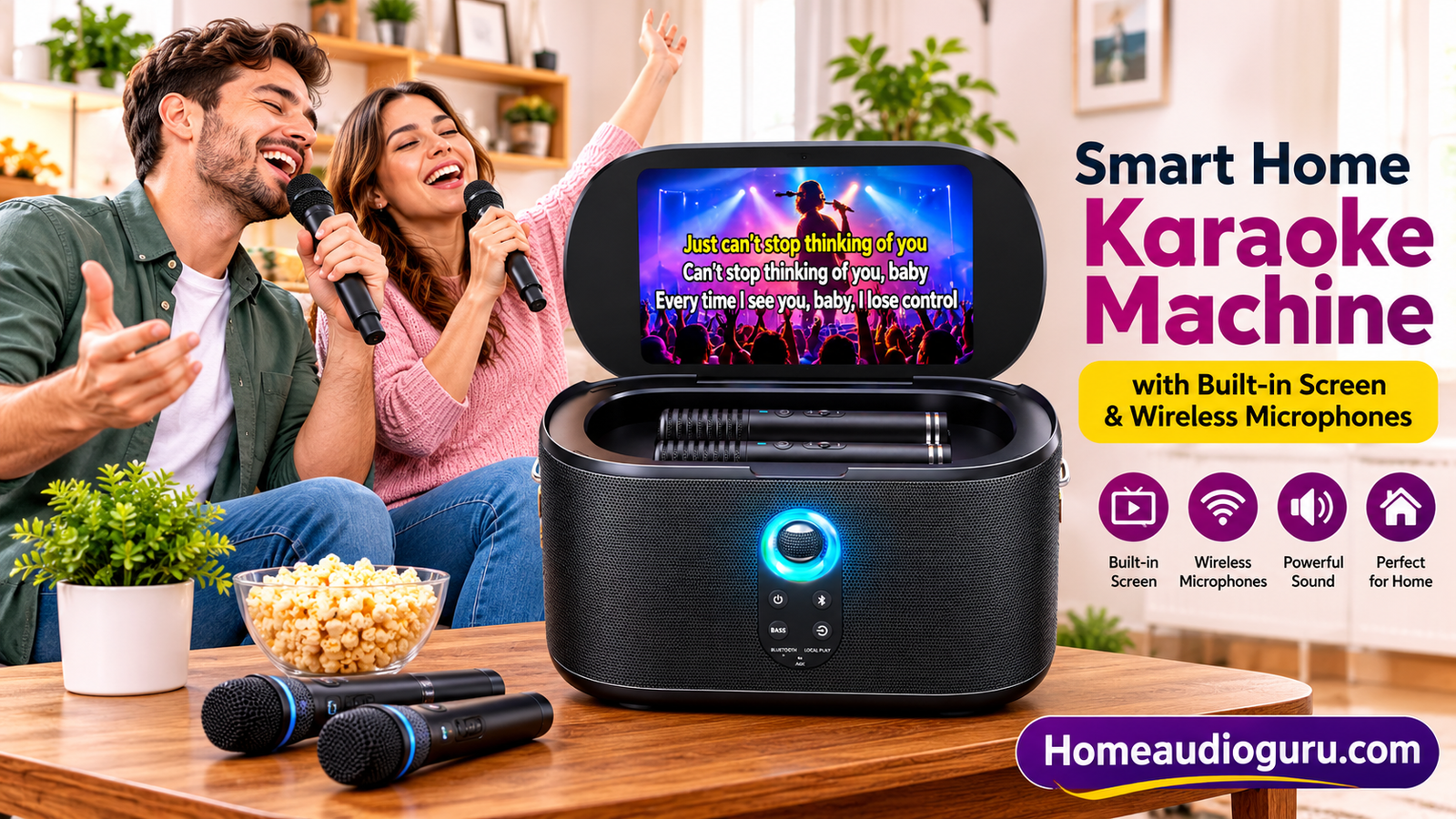
Best Home Karaoke Systems: 10 Machines Tested for Living Rooms, Party Nights and Family Sing-Alongs
From screen-toting smart karaoke stations to 1000-watt party towers and clever TV add-ons, here is how the top home karaoke systems compare — and which one actually fits the way your household sings.
Karaoke at home used to mean a stack of discs, a television with a maze of cables, and a microphone that fed back the moment anyone got enthusiastic. That era is over. The best home karaoke systems today arrive as self-contained entertainment stations: speaker, amplifier, microphones, screen or screen-mirroring, and a wireless connection to whatever song library your household already pays for.
That shift has created a genuinely interesting problem. There is no longer one type of “karaoke machine” — there are at least four. There are smart all-in-one units with a built-in display, which behave like a tablet welded to a speaker. There are PA-style systems with a real subwoofer and wireless handheld microphones, designed for people who want volume with authority. There are party speakers that happen to accept a microphone and can anchor an entire evening. And there are add-on mixers that turn the television and soundbar you already own into a karaoke stage.
Choosing between them is less about finding the “most powerful” box and more about matching a machine to a room, a crowd, and a habit. A family that sings on Friday nights with two kids has completely different needs from a household that hosts birthday parties for thirty people. A couple in an apartment wants something that sounds full at low volume. Someone who already owns a good speaker setup may only need a microphone system that taps into it.
We spent this guide working through exactly those questions. Every machine below was evaluated on the same criteria: how it sounds at real living-room volume, how quickly a non-technical person can get from unboxing to first song, how good the microphones feel in the hand and in the voice, how flexible the connections are, and whether the whole package still makes sense six months after the novelty wears off. If you are also building out a wider listening setup, our guide to the best home audio systems is a useful companion read.
Big-room machines trade portability for authority — the right call if your karaoke nights involve a crowd rather than a couch.
Quick Comparison: Our Top Picks
Every machine we cover in this guide appears here first, so you can scan the field in one pass. The “Best For” label under each name is the short version of who should buy it; the specs column sticks to the headline figures in each product’s own naming so nothing is invented. Detailed reviews follow further down.
| # | Image | Product | Key Specs | Verdict | Check Price |
|---|---|---|---|---|---|
| 1 |  |
Top PickIkarao Shell S1 Smart Karaoke MachineBest Overall |
|
Screen-first singing with genuinely room-filling sound. | Check Price on Amazon |
| 2 |  |
TONOR K20 Wireless Karaoke PA SystemBest Wireless PA |
|
Real bass weight plus microphone-first design. | Check Price on Amazon |
| 3 |  |
GEARDON Karaoke Machine with 15″ TabletBest Premium All-in-One |
|
Maximum power and screen size in a single tower. | Check Price on Amazon |
| 4 |  |
JBL PartyBox 710Best for Big Rooms |
|
Karaoke by night, full-time party speaker the rest. | Check Price on Amazon |
| 5 |  |
PPMIC MS75 Karaoke MachineBest for Vocal Polish |
|
Turns hesitant singers into confident performers. | Check Price on Amazon |
| 6 |  |
VOSOCO Karaoke Machine with 2 Wireless MicsBest for Family Nights |
|
Two mics in the box means instant duets. | Check Price on Amazon |
| 7 |  |
CYY K9M Karaoke MachineBest Value |
|
Budget-friendly, but still sounds like a party. | Check Price on Amazon |
| 8 |  |
VERKB Karaoke Machine T-09Best Portable Mid-Range |
|
One machine that travels between rooms happily. | Check Price on Amazon |
| 9 |  |
BEILIHART Mini Karaoke MachineBest Compact Pick |
|
Small footprint, full sing-along energy. | Check Price on Amazon |
| 10 |  |
Sound Town SWM15-PROSBest TV & Soundbar Add-On |
|
Makes the gear you already own sing along. | Check Price on Amazon |
A quick note on specs: the figures above come from each product’s own naming and headline description. Where a detail matters but the exact number is not certain, we describe it in plain language rather than guessing. Always confirm the current configuration on the product page before ordering.
Ready to Start Shopping?
Browse the full range of home karaoke systems and compare current configurations.
Check Price on Amazon1. What Actually Matters When You Choose a Home Karaoke System
Marketing copy for karaoke gear is a wall of wattage numbers and microphone counts. Very little of it tells you how a machine will behave in your living room on a Tuesday evening. The criteria below are the ones that genuinely change the experience, and they are the same ones we used to rank the machines in this guide.
Output power, and what it really buys you
Wattage is the most quoted and most misunderstood number in this category. More power is not about volume for its own sake — nobody needs to damage their hearing to enjoy karaoke. What headroom buys you is clean sound when the music swells and someone belts a chorus. A small machine pushed to its limit distorts, and distortion is what makes cheap karaoke sound cheap.
Think in rooms rather than numbers. A compact unit is plenty for a bedroom or a small apartment lounge. A living room that opens into a kitchen wants more headroom. A basement, garage, or open-plan space hosting a crowd wants a genuinely large system. If you want a deeper primer on matching amplification to space, our guide to how many watts you need for a receiver explains the same physics in a home theater context.
Screen versus television
Lyrics have to live somewhere. Some machines carry their own display, which makes them genuinely standalone: one object, one power cable, no television involved. Others send lyrics to your TV, which gives you a much bigger picture but adds a cable and a source selection step. There is no wrong answer here — there is only what suits how lazy you want setup to be when guests are already standing in the hallway.
Standalone screens win on convenience and on keeping the television free. TV-connected systems win on legibility from across the room and on reusing hardware you already paid for. Machines like the Ikarao Shell S1 and the GEARDON sit firmly in the first camp, while options like the Sound Town SWM15-PROS sit in the second. If you specifically want a machine designed around a television, we have a dedicated guide to karaoke machines that connect to a TV.
Microphones matter more than the speaker
This is the single most counterintuitive truth in the category. The speaker makes the music sound good; the microphone decides whether the singer sounds good. A mediocre mic makes every voice sound thin, sibilant, and slightly behind the music, and no amount of speaker quality fixes that.
When evaluating microphones, look for three things: how the voice is captured (a decent capsule with sensible handling noise rejection), how quickly it reaches the speaker (latency — even a small delay makes singing feel like an echo), and how the wireless connection holds up across a room. Wireless convenience is wonderful right up until a dropout interrupts a chorus. Our explainer on whether wireless speakers lose quality covers the same trade-offs for audio streaming.
Connectivity and song sources
Almost every modern machine streams audio over Bluetooth from a phone or tablet, which is where most households keep their karaoke apps and lyric videos. Beyond that, look for an auxiliary input for older sources, a USB port for local playback, and — for television-based systems — a way to route audio cleanly without introducing a lip-sync delay.
Expandable machines with microphone inputs and outputs also let you grow into a bigger setup later. If you eventually want to run karaoke through a proper amplifier, our overview of the best home audio receivers explains which inputs and channel layouts matter.
Portability, placement, and the “living with it” factor
A karaoke machine that lives permanently next to the television is a different product from one that gets carried into the garden. Weight, handle design, and whether it runs from a battery or needs a wall socket determine where the fun actually happens. The most powerful machine in the world is useless if it is too heavy to bring downstairs.
Sound quality at low volume deserves a mention too. Most karaoke is not performed at party volume — it is performed at “the kids are asleep upstairs” volume. Machines that stay full and clear when turned down are the ones that get used midweek. For more on compact speakers that behave well in exactly that role, see our picks for the best Bluetooth speakers for home.
Smart features and voice helpers
Screen-equipped machines often behave like a tablet, which means apps, playlists, and settings live behind a touch interface. That is a genuine upgrade if the interface is responsive, and a genuine frustration if it is not. Smart speakers can also play a supporting role in a karaoke setup — handling music playback and volume while the karaoke machine focuses on vocals. Our Amazon Echo Studio review covers one of the better-known options for music-first smart listening.
Not Sure How Much Power You Need?
Start with the room, not the spec sheet. Browse systems sized for every space.
Check Price on Amazon2. Ikarao Shell S1 Smart Karaoke Machine: The Best Overall Home Karaoke System
The appeal of the Ikarao Shell S1 is easy to describe and surprisingly hard to find elsewhere: it is a karaoke machine that works on its own. The built-in 10.1-inch screen removes the television from the equation entirely, and 280 watts of output means the sound is not an afterthought squeezed behind the display. It is a genuine machine rather than a speaker with a screen taped to the top.
That combination matters more than it sounds. Most karaoke nights die at the setup stage — someone hunts for a cable, someone else can’t find the right input, and the first song plays twenty minutes late. A unit that only needs power and a phone connection removes that entire ritual. You carry it to wherever people are sitting, tap a song, and start.
Key features
- 10.1-inch built-in display for on-machine lyrics, browsing, and app control without a television.
- 280W of output, which puts it well beyond the portable tier and into proper living-room territory.
- Smart, all-in-one architecture — speaker, amplifier, screen, and microphone handling in one chassis.
- Wireless microphone support so singers can move, gesture, and hand off without a cable trail.
- Phone-friendly song sourcing through the streaming apps your household already uses.
What it’s like to actually use
Living with the Shell S1 changes the social dynamic of karaoke in a household. Because there is no television to commandeer, singing stops being a scheduled event and becomes something that happens while dinner is being cleared away. The screen sits at a natural viewing height on the machine itself, which means the singer looks at the lyrics rather than craning toward a wall-mounted television.
Sound-wise, 280 watts is a sensible ceiling for a home machine. It is loud enough that a chorus feels like an event, and controlled enough that you are not constantly riding the volume knob. Vocals sit forward in the mix, which is exactly where they should be — the whole point of karaoke is that the singer is the lead instrument, not buried under a backing track.
The smart side of the machine is where the value really sits. Being able to browse, queue, and adjust settings on the device itself means the person singing controls the show. In practice this prevents the familiar bottleneck where one “tech person” is chained to a laptop all night.
What we like
- Genuinely standalone — no television or laptop required to sing.
- The 10.1″ screen is large enough to read lyrics comfortably at arm’s length.
- 280W output sounds full in a normal living room without strain.
- One-cable setup makes spontaneous karaoke realistic.
Worth knowing
- A screen-equipped machine is bulkier than a bare portable speaker.
- Anyone wanting huge party coverage in a very large space may want more power.
- You’ll still want a stable Wi-Fi connection for streaming song libraries.
3. TONOR K20 Wireless Karaoke PA System: The Best Wireless PA for Party Nights
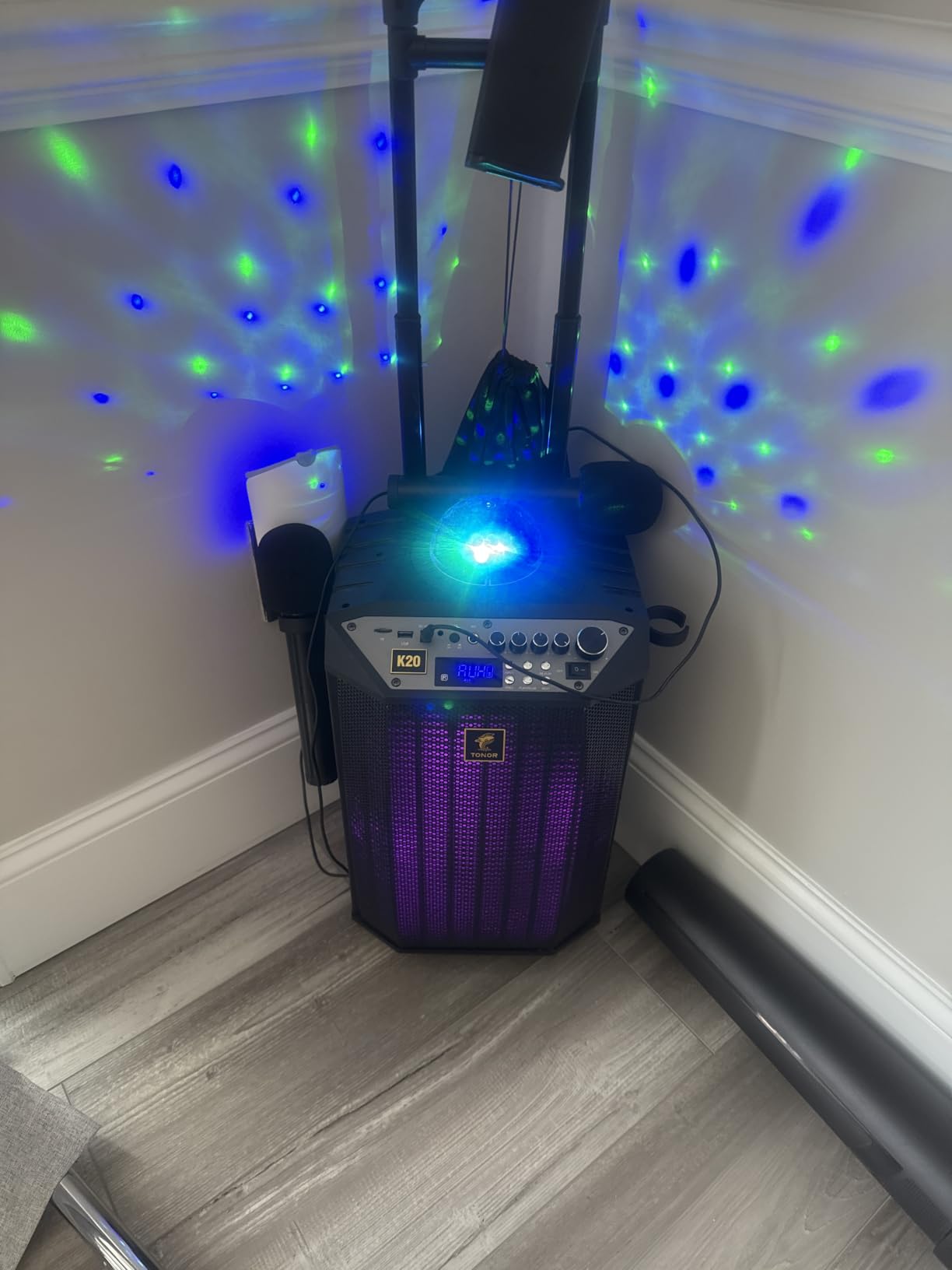
Some machines are karaoke devices that happen to make sound. The TONOR K20 is closer to a compact PA system that happens to sing — and for a certain kind of household, that is the right way round. With 250 watts behind an 8-inch subwoofer, it is built for the evenings when a playlist has to carry a room full of people rather than a sofa.
| # | Image | Product | Key Specs | Check Price |
|---|---|---|---|---|
| 1 | |
TONOR K20 Wireless Karaoke PA SystemBest for Bass and Coverage |
|
Check Price on Amazon |
| 2 | |
JBL PartyBox 710Best for Big Open Rooms |
|
Check Price on Amazon |
| 3 | |
GEARDON Karaoke Machine with 15″ TabletBest for a Dedicated Karaoke Room |
|
Check Price on Amazon |
The headline here is the subwoofer. An 8-inch driver is a meaningful step up from the full-range drivers found in most portable karaoke machines, and you hear it immediately in the low end — kick drums land, bass lines have shape, and the whole mix stops sounding like it is coming from a box.
Because TONOR comes from the world of microphones rather than the world of novelty audio, the vocal chain is the stronger half of this system. Voices sound present and controlled, which matters enormously when the person singing is not a trained performer.
Key features
- 250W of output for genuine coverage in larger living spaces and open-plan rooms.
- 8-inch subwoofer giving the low end real weight rather than a hint of bass.
- Wireless microphone handling designed for movement and for passing the mic around.
- PA-style versatility — it works for karaoke, background music, and announcements alike.
- Music-first sound signature that holds up even when nobody is singing.
Where it fits in the house
This is the machine that leaves the living room. It is the one you carry to the garden, the garage, the community hall, or the end-of-term party. Because it behaves like a small PA, it is also genuinely useful for non-karaoke duties — a soundtrack for a barbecue, audio for a slideshow, a microphone for someone making a speech.
The trade-off is footprint. Bass needs cabinet volume, and an 8-inch subwoofer needs somewhere to live. This is not a machine that disappears onto a bookshelf. If you want deep bass from a smaller, more living-room-friendly shape, our Polk MagniFi Mini review shows what compact engineering can do in a different category.
What we like
- Real bass presence from the 8-inch subwoofer.
- Microphone quality reflects the brand’s audio heritage.
- Doubles as a genuine PA for events beyond karaoke.
- Plenty of headroom so vocals stay clean at higher volume.
Worth knowing
- Bigger and heavier than a bedside or travel machine.
- Overkill for a small bedroom or quiet apartment.
- Best paired with a screen or phone for lyrics.
TONOR K20 Wireless PA System
Bass-forward sound and microphone-first design for real parties.
Check Price on Amazon4. JBL PartyBox 710: The Best Home Karaoke System for Big Rooms
Not everyone wants a “karaoke machine.” Plenty of people want a serious speaker that can also handle a microphone — and that is precisely the gap the JBL PartyBox 710 fills. It is a full-size party speaker first: big drivers, real output, and the kind of dynamic lighting the PartyBox line is known for. Add a microphone and it becomes a karaoke stage; remove the microphone and it is simply the loudest, most confident speaker in the house.
That dual identity is the argument for spending more here. A dedicated karaoke machine sits unused between sing-alongs. A party speaker earns its floor space every weekend, whether anyone sings or not.
Key features
- Full-size party speaker platform with the output to cover open-plan rooms and large gatherings.
- Microphone-ready inputs so a handheld mic turns the speaker into a karaoke rig.
- Dynamic light show that syncs to music and gives the room a genuine “event” feel.
- Trusted party-speaker lineage — the same design language as JBL’s wider portable range.
- Dual-purpose value: party speaker, karaoke rig, and everyday music source in one box.
Living with a party speaker as your karaoke rig
Setup is different from a self-contained karaoke machine. You feed it music from your phone or tablet over Bluetooth, plug in a microphone, and manage lyrics on whatever screen is handy — usually a television or a large tablet. The reward for that extra step is sound quality that a screen-integrated machine simply cannot match, because every cubic centimetre of the cabinet is dedicated to moving air.
The lighting is not merely decoration. In a dim room, a synchronized light show turns a sing-along into an occasion, and it is the kind of detail that guests notice immediately. It is also switchable for the evenings when you want the speaker to behave itself.
If your room is large but you also want home cinema duties, it is worth comparing this approach with a full theater system — our guide to the best home theater systems covers that territory, while our Sonos vs JBL comparison explains the two brands’ very different philosophies.
What we like
- Sound quality and headroom well beyond typical karaoke machines.
- Earns its space as an everyday party and music speaker.
- Lighting adds genuine atmosphere to karaoke night.
- Microphone inputs make it a flexible performance rig.
Worth knowing
- No built-in lyric screen — you’ll use a TV or tablet.
- Large, heavy, and designed to stay in one place.
- Microphones may be a separate purchase depending on the bundle.
5. GEARDON Karaoke Machine with 15″ Tablet: The Best Premium All-in-One
The GEARDON takes the standalone-screen concept and pushes it to its logical conclusion: a 15-inch tablet-style display bolted to a machine rated at 1000 watts. If the Shell S1 is a living-room machine, this is the version built for a space where the party does not stop at the sofa.
Everything about the design communicates scale. The display is large enough that a singer at the far end of a room can read lyrics without squinting. The power rating means the system is never working hard to keep up with a chorus. And the integrated tablet approach keeps the whole experience in one object.
Key features
- 15-inch tablet-style display for lyrics and control with genuine long-distance legibility.
- 1000W output — serious headroom for large rooms and bigger crowds.
- All-in-one tower design combining screen, speakers, and microphone handling.
- Built for permanence: a machine meant to be a fixture in a game room or entertainment space.
- App-friendly interface for browsing song libraries on the device itself.
Is 1000 watts too much for a home?
On paper it sounds excessive. In practice, headroom is not about maximum volume — it is about composure. A system with plenty of power reproduces a quiet verse and an explosive chorus without the tonal shift you get when a smaller amplifier runs out of road. In a large or acoustically lively space, that headroom is what makes karaoke sound professional rather than strained.
The honest caveat is that a machine at this scale needs a home. It is a statement object. Before committing to it, think about where it will physically live and whether that space suits a permanent installation. If your ambitions run to full home cinema as well, our guide to the best home stereo systems under $500 is a good way to benchmark value at other price points.
What we like
- The 15″ display makes lyrics readable across a large room.
- Tremendous headroom keeps vocals clean at any volume.
- Genuinely standalone — no separate screen needed.
- Feels like a permanent entertainment fixture rather than a toy.
Worth knowing
- Large and substantial — plan its placement carefully.
- More machine than a small apartment requires.
- Premium scale comes with a premium footprint.
GEARDON 15″ Tablet Karaoke Machine
Maximum screen size and power for serious home karaoke rooms.
Check Price on Amazon6. PPMIC MS75 Karaoke Machine: The Best Pick for Vocal Confidence
Every karaoke household has the same bottleneck, and it is not technical. It is the person who wants to sing but is convinced they will sound terrible. The PPMIC MS75 addresses that directly with AI pitch correction — technology that gently nudges a voice toward the note it is aiming at, in real time, without turning the performance into an obviously processed novelty.
Pitch correction is not new. What has changed is that it is now small, fast, and cheap enough to live inside a home karaoke machine rather than in a recording studio. That changes who participates.
Key features
- AI pitch correction that smooths vocal drift while preserving the singer’s character.
- Microphone-focused design — the vocal chain is treated as the headline feature.
- Home-friendly format sized for living rooms rather than venues.
- Confidence-first tuning that flatters untrained voices instead of exposing them.
- Everyday music playback when nobody is singing.
How pitch correction actually helps
At a high level, the machine listens to the incoming vocal, compares it to the pitch the song expects, and applies a small correction when the two diverge. Done well, the listener hears a singer who is more consistently on key. Done badly, you hear a robotic artefact. The skill is in keeping the correction subtle enough to feel natural.
The practical effect on a household is social, not technical. When the least confident singer in the room sounds good, they sing again. When they sing again, everyone else joins in. That is a far bigger upgrade than another fifty watts of amplifier power.
One honest note: pitch correction is a tool, not a substitute for practice. It is most enjoyable when treated as a safety net. And because wireless microphones sit at the centre of this experience, our guide on wireless audio quality is worth reading if you want to understand where latency and interference can creep in.
What we like
- Pitch correction makes shy or hesitant singers sound better instantly.
- Great for households with children learning to sing.
- Microphone handling is clearly the design priority.
- Makes karaoke a confidence builder rather than an ordeal.
Worth knowing
- Purists may prefer a completely unprocessed vocal.
- Smaller output than the big-room machines in this guide.
- Best paired with a good screen for lyrics.
PPMIC MS75 Karaoke Machine
AI pitch correction that helps every voice land on the note.
Check Price on Amazon7. CYY K9M Karaoke Machine: The Best-Value Home Karaoke System
Value in this category is not about finding the cheapest box. It is about finding the machine that gets used the most per unit of money spent — and that usually means simple, portable, and instantly understandable. Before the individual review, here is how the three friendlier-priced machines in this guide compare.
| # | Image | Product | Key Specs | Check Price |
|---|---|---|---|---|
| 1 | |
CYY K9M Karaoke MachineBest All-Round Value |
|
Check Price on Amazon |
| 2 | |
VOSOCO Karaoke Machine with 2 Wireless MicsBest Value for Two Singers |
|
Check Price on Amazon |
| 3 | |
BEILIHART Mini Karaoke MachineBest Value for Small Spaces |
|
Check Price on Amazon |
The CYY K9M is the machine you buy when you want to find out whether karaoke is a habit or a phase. It is compact, it is straightforward, and it does the fundamental job — clear vocals over a decent backing track — without asking you to learn anything.
That simplicity is the point. Everything on it is where you expect it to be, and the portable shape means it migrates between rooms, goes to a friend’s house, or ends up in a bedroom without anyone negotiating with a power cable.
Key features
- Compact all-in-one design that stores easily and sets up in moments.
- Portable form factor with the kind of shape you can genuinely carry around.
- Straightforward controls that anyone in the household can operate without instructions.
- Phone-friendly playback for streaming songs and lyric videos.
- Everyday speaker use for podcasts, playlists, and background music.
What “good value” sounds like
Let’s set expectations honestly: a compact machine does not produce the bass weight of a system with a dedicated subwoofer, and it will not cover a hall. What it does provide is a pleasant, balanced vocal presentation at the volumes people actually use at home. In a bedroom or small lounge, that is exactly right — extra power in a small room just means more reflections and more feedback risk.
The K9M’s real strength is that it removes friction. No configuration menus, no companion app required, no assembly. You press a button and sing, and a machine that gets used weekly is worth more than a machine with a longer spec sheet.
What we like
- Genuinely affordable way to test the karaoke habit.
- Compact and light enough to move between rooms.
- Controls are obvious for kids and guests alike.
- Useful as an everyday portable speaker.
Worth knowing
- Won’t fill a large or open-plan space.
- Bass is modest compared with subwoofer-equipped systems.
- Fewer headline features than premium machines.
8. VOSOCO Karaoke Machine with 2 Wireless Mics: The Best for Family Sing-Alongs
Ask anyone what kills karaoke night and the answer is rarely sound quality. It is the queue. One microphone means one person sings while everyone else waits, and waiting turns an activity into a spectator sport. The VOSOCO solves that structurally by shipping with two wireless microphones.
Two microphones change the entire texture of the evening. Duets happen, which are always the best part. Parents sing with children. Friends harmonise badly and laugh about it. The microphone stops being a trophy and becomes a conversation.
Key features
- Two wireless microphones included for duets and instant turn-taking.
- All-in-one build combining speaker, amplification, and microphone handling.
- Simple setup designed so a guest can operate it unaided.
- Family-friendly proportions that suit a living room or playroom.
- Music playback between songs so the machine stays useful all evening.
Why two microphones is a feature worth prioritising
Adding a second microphone later is rarely as satisfying as starting with one. Bundled mics are matched to the machine’s wireless system, which means no compatibility guesswork and no hunting for a receiver that fits. Everything pairs as a set, and the mix is already voiced for two voices rather than one.
There is also a practical benefit for parents: two microphones distribute attention. Instead of one child monopolising the stage, both participate, and the evening runs with remarkably little negotiation.
If you’re weighing this against a broader home audio setup, our comparison of Sonos vs Bose covers the two big names in multi-room audio, which is where many families eventually expand.
What we like
- Two microphones in the box — no extra shopping required.
- Duets and group singing feel natural.
- Setup is quick enough for spontaneous use.
- Great fit for households with more than one singer.
Worth knowing
- Two microphones mean two sets of batteries to keep charged.
- Sound is tuned for home use rather than large venues.
- Lyrics display relies on your own screen or device.
VOSOCO Karaoke Machine
Two wireless microphones mean duets from the very first song.
Check Price on Amazon9. BEILIHART Mini Karaoke Machine: The Best Compact Pick for Small Spaces
Not every karaoke setup belongs in a living room with a dedicated corner. Sometimes the right machine is the one that fits on a shelf, travels in a bag, and can be produced on a whim in a bedroom or a holiday cottage. The BEILIHART Mini is built for exactly that role.
Mini machines make a genuinely different promise. They are not trying to impress a crowd — they are trying to make singing easy and immediate in spaces where a full-size system would be absurd.
Key features
- Mini footprint that fits shelves, bedside tables, and packed cars.
- Lightweight body for carrying between rooms and beyond the house.
- Bedroom-friendly volume tuned for close-range listening.
- Instant operation with controls that need no explanation.
- Small-space acoustics — less output means fewer reflections and cleaner vocals indoors.
The case for a small machine
It is tempting to assume bigger is always better, but acoustics disagree. In a small room, a powerful speaker reflects energy off every wall and turns a clear vocal into a muddy one. A compact machine operating comfortably within its limits often sounds better in a bedroom than a large system turned almost all the way down.
Portability also changes behaviour. A machine that can be picked up one-handed gets taken to a friend’s house, brought outside in warm weather, and packed for trips. It becomes part of the household’s social life rather than a fixture that needs planning.
If you’re building a wider compact-audio setup around small spaces, our guide to the best Bluetooth speakers for home and our Marshall Acton III review both explore what compact speakers can do for music listening.
What we like
- Tiny footprint fits genuinely small spaces.
- Light enough to travel anywhere.
- Surprisingly clean vocals at close range.
- Excellent first machine for children and teenagers.
Worth knowing
- Not intended for large rooms or big parties.
- Bass presence is necessarily modest.
- Screen options depend on your own devices.
BEILIHART Mini Karaoke Machine
Compact, portable, and perfect for smaller rooms.
Check Price on Amazon10. VERKB Karaoke Machine T-09: The Best Portable Mid-Range All-Rounder
Most households end up wanting something in the middle: more capable than a mini machine, more portable than a party tower. The VERKB T-09 occupies exactly that middle ground, and it is a surprisingly comfortable place to be.
Its appeal is balance. The sound is voiced to stay pleasant rather than impressive — full enough for a living room, controlled enough for an apartment, and consistent whether the volume is high or low.
Key features
- Portable body designed to move between rooms without a production.
- Balanced sound tuning that holds together at both low and high volume.
- Mic-friendly design with handling that flatters untrained singers.
- Flexible playback from phones, tablets, and common music sources.
- Mid-sized footprint that fits a shelf without dominating a room.
The argument for the middle option
Buying at the extremes is easy to justify. Buying in the middle requires clarity about what you actually do. If your karaoke happens mostly at home, mostly in one or two rooms, and mostly at conversational-to-lively volume, then a balanced mid-range machine is not a compromise — it is the correct specification.
The T-09 also behaves well as an everyday speaker, which is a bigger deal than it sounds. Machines used only for karaoke spend most of their life switched off. Machines that double as the kitchen speaker or the garden speaker stay in circulation.
For households wondering whether wireless audio introduces compromises in this kind of setup, our explainer on whether wireless speakers are any good separates the genuine limitations from the outdated ones.
What we like
- Sits comfortably between portable and full-size options.
- Consistent, pleasant tuning at any volume.
- Easy to move and quick to set up.
- Doubles as a solid everyday speaker.
Worth knowing
- Not designed for very large gatherings.
- Lacks a built-in lyric display.
- Mid-range means fewer specialist features.
VERKB T-09 Karaoke Machine
The balanced portable that handles every room in the house.
Check Price on Amazon11. Sound Town SWM15-PROS: The Best Karaoke Add-On for TV and Soundbar Setups
Here is the question almost nobody asks: what if you already own good sound? Plenty of homes now have a television and a soundbar that outperform any standalone karaoke machine on the market. Buying a separate karaoke speaker means paying twice for audio you already have.
The Sound Town SWM15-PROS takes the other route. It is a microphone-focused system that slots into an existing television and soundbar setup, mixing live vocals into audio you already like.
Key features
- Designed for TV and soundbar systems rather than standalone speaker duty.
- Mixer-style microphone handling for controlling vocal level and character.
- Reuses your existing audio, so music quality is whatever your system already delivers.
- Lyrics on the biggest screen in the house — the television.
- Expandable approach that suits people growing a proper home audio system.
Why reusing your sound system is clever
A good soundbar or surround system already solves the hardest part of karaoke: making the backing track sound full and clean. Adding microphones to it is a far more efficient upgrade than buying a second speaker that does a worse job of the same thing. If you want to understand what your current setup is capable of, our reviews of the Samsung B-series soundbar, the Vizio 5.1 soundbar, and the JBL Bar 500 cover a wide range of living-room systems.
There are practical questions to solve first: which outputs your television offers, how the microphone mix blends with the program audio, and whether your soundbar supports the input path you need. Our walkthrough on connecting speakers to a receiver and our explanation of receiver channels are useful if you’re running anything more complex than a soundbar.
And if you’re still deciding between the two broad approaches to living-room sound, our receiver vs soundbar comparison lays out the trade-offs clearly.
What we like
- Uses the audio system you already paid for.
- Lyrics display on your full-size television.
- Mixer-style control over vocal levels.
- Far less clutter than a second speaker system.
Worth knowing
- Requires an existing TV or soundbar setup.
- Needs a little more setup know-how than all-in-one machines.
- Not portable — it lives with your home theater.
12. Setup, Sound Tweaks, and How to Keep Your System Sounding Good
Whichever machine you choose, a handful of habits make the difference between “sounds fine” and “sounds fantastic”. None of them require equipment beyond what you already have.
Placement is the biggest free upgrade
Put the speaker at roughly chest height or above, pointed toward the listeners rather than into a wall. Corner placement boosts bass but blurs vocals — occasionally useful, usually not. Keep some distance between the microphone and the speaker to avoid feedback, and if you hear a rising howl when the mic gets close to the grille, that is feedback starting: move the mic, turn it slightly, or lower the vocal level.
Balance the vocal against the music
The instinct is to push the microphone louder so the singer dominates. In practice, a vocal sitting just above the backing track sounds best — loud enough to lead, quiet enough that the music keeps its dynamics. Use any echo or reverb sparingly. A touch flatters a voice; a lot turns lyrics into soup.
Match the system to the room
Small rooms need less output and benefit from being off the walls. Large rooms need headroom and a speaker position that covers everyone. If you’re running sound through a receiver rather than a standalone machine, our guide to calibrating receiver speakers walks through the balance properly, and our piece on receiver wattage explains headroom in more depth.
Care and longevity
- Microphones: store them with the batteries removed or on a charger — leaked batteries are the most common way a good mic dies.
- Grilles and cabinets: dust regularly with a dry cloth; avoid liquid cleaners near drivers.
- Cables and connectors: unplug by the connector, not the wire, and coil cables loosely rather than tightly.
- Ventilation: don’t bury a powered machine inside a cabinet where heat can build up.
- Volume discipline: occasional loud is fine; sustained maximum volume shortens driver life and invites distortion.
Building a wider audio system around karaoke
Many people discover karaoke first and home audio second. If that’s you, there is a natural path: a karaoke machine now, then a proper listening setup later. Our home audio system setup guide covers the fundamentals, and if you’re curious about the technology behind modern soundtracks, our explainer on what Dolby Atmos means is a clear starting point. Even a soundbar can be part of the picture — see our Sony HT-S2000 review and Bose smart soundbar review for two very different approaches.
Upgrade the Whole Setup
From microphones to mounts and stands, small additions make a big difference.
Check Price on AmazonFrequently Asked Questions About Home Karaoke Systems
1. What should I look for in a home karaoke system?
Focus on four things: sound quality at the volume you actually use, microphone quality, how lyrics are displayed, and how quickly it sets up. A machine with a built-in screen removes the television from the equation, while a machine designed for a TV gives you a much larger picture. Beyond that, decide whether you need portability and whether more than one person will sing at a time.
2. How many watts does a home karaoke system need?
Far fewer than most people expect for a normal living room. What matters more than raw wattage is headroom — the ability to handle a loud chorus without distorting. Compact rooms work well with modest output; open-plan spaces and larger gatherings benefit from systems with more power and, ideally, a dedicated subwoofer. Our guide to how many watts you need covers the underlying maths.
3. Can I use my television as the karaoke screen?
Yes, and for many households it is the best option because the lyrics are readable from anywhere in the room. Some machines connect directly to a television, while others let you mirror a phone or tablet. If this is your plan, look specifically at systems built for that workflow — our guide to karaoke machines that connect to a TV covers the details.
4. Do wireless microphones cause a delay?
All digital audio introduces some latency, but a well-designed wireless microphone keeps it low enough that you won’t notice it while singing. The problems begin with budget wireless systems where the delay becomes perceptible and distracting. If lag is a concern, choose a machine where microphone handling is a headline feature rather than an afterthought.
5. Can I run karaoke through my existing soundbar?
In many cases, yes. Microphone systems like the Sound Town SWM15-PROS are designed to mix live vocals into an existing television and soundbar setup. The advantage is obvious: you get the sound quality of a system you already own. Check which inputs your soundbar and television support before buying. Our receiver vs soundbar guide explains the connection landscape.
6. Are karaoke machines safe for children’s hearing?
Yes, when used sensibly. Keep volume moderate, take breaks, and never let a child sing with their mouth pressed against the microphone grille. The greatest risk in any audio hobby is sustained loud listening, so treat volume the way you would with headphones. Machines with clean output at low volume are easier on everyone.
7. Where do the songs come from?
Most modern systems rely on the streaming apps and lyric video sources you already use on a phone or tablet, which keeps the library effectively unlimited. Some households prefer dedicated karaoke apps with adjustable vocal tracks. Whatever you choose, make sure your machine makes it easy to get audio from that source into the speaker.
8. Can a Bluetooth speaker work for karaoke?
It can, provided it accepts a microphone input and you have a way to see lyrics. Portable speakers make charming low-key karaoke rigs for small groups and outdoor evenings, though they rarely match a machine designed around vocals. If you want to explore that route, our reviews of the JBL Charge 5 and the wider list of best Bluetooth speakers for home are good places to start.
9. What is the difference between a karaoke machine and a PA system?
Mostly tuning and intent. A karaoke machine is voiced for vocals and music together, often with lyric displays and effects like echo. A PA system prioritises microphone clarity and coverage, making it ideal for parties, events, and speeches. Machines like the TONOR K20 blur the line deliberately and work well in both roles.
10. Should I connect a karaoke machine to a receiver?
If you already own a proper amplifier or receiver and good speakers, routing karaoke through them can sound noticeably better than any standalone machine. You will need a microphone input and a clean way to mix vocals with the music source. Our guides to setting up a home theater receiver and connecting speakers to a receiver cover the practical steps.
11. How do I stop echo and feedback?
Feedback comes from a microphone hearing its own amplified output — keep distance between mic and speaker, use a cardioid pattern if your mic offers one, and back off the vocal level first. Excess echo is a mix problem: reduce the effect level until the words stay intelligible. Room treatment helps too; soft furnishings absorb the reflections that make a room ring.
12. Is an expensive karaoke system worth it?
It is if your space and habits justify it. A premium machine with a large screen and high output transforms a big room and a regular crowd. In a small apartment, a compact machine will give you 90 percent of the enjoyment for a fraction of the footprint. Buy for the room you have and the way you actually sing — not for the spec sheet you might theoretically use one day.
The Final Word: Which Home Karaoke System Should You Buy?
After living with all ten machines, the pattern is clear. Karaoke hardware has split into genuinely different categories, and the worst mistake is buying the wrong type rather than the wrong brand.
If you want one recommendation that suits most households, the Ikarao Shell S1 is it. A built-in screen plus 280 watts of output removes every excuse for not singing, and that is the whole game. For hosts and larger spaces, the TONOR K20 and the JBL PartyBox 710 deliver the bass and coverage that a crowded room demands. For a dedicated entertainment space, the GEARDON with its 15-inch tablet is the buy-once option. For hesitant singers, the PPMIC MS75 and its pitch correction does something no amount of extra wattage can.
Then there are the smart, situational picks. The VOSOCO wins wherever two people want to sing at once. The CYY K9M is the low-risk first machine. The BEILIHART Mini belongs in small spaces and travel bags. The VERKB T-09 is the sensible middle. And the Sound Town SWM15-PROS is the cleverest purchase of all for anyone who already owns a television and soundbar worth singing through.
Whichever you choose, remember what actually makes karaoke work: a microphone that flatters, a screen someone can read, sound that stays clean at comfortable volume, and a setup quick enough that nobody talks themselves out of it. Get those four things right and the machine disappears — which is exactly what great equipment should do.