Best Retro Bluetooth Speakers: Vintage Looks, Modern Sound
Fourteen characterful speakers that look like they belong on a sideboard in the seventies and stream like they were built yesterday.
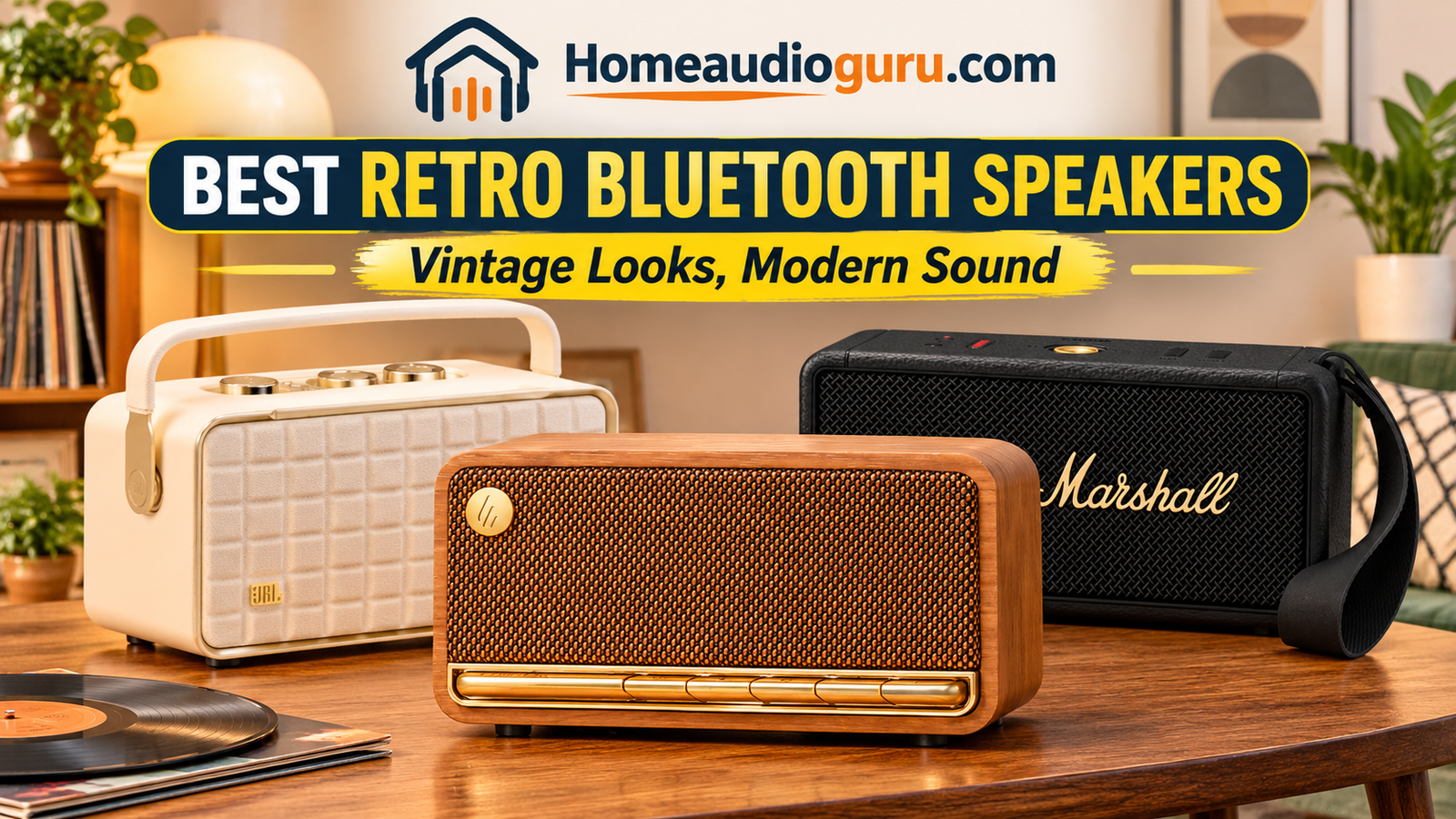
There is a particular kind of pleasure in a speaker that looks like an object from another era and behaves like a modern one. Retro Bluetooth speakers occupy exactly that space: they bring wood grain, woven fabric grilles, physical dials, and warm metal detailing into a room, while streaming music from your phone without ceremony. They are the rare piece of technology that guests walk over to and touch.
But the category is wide, and wide categories are easy to shop badly. At one end sit premium designs from major audio names with genuinely refined sound; at the other sit compact novelty speakers that charm on a shelf but will not fill a room. In between you will find wood-cased table radios with AM/FM tuners, small desk speakers that look like shrunken vintage portables, and radio-speaker hybrids that are happy tuning stations one moment and streaming playlists the next.
We spent time with fourteen of the most interesting options available right now — from the JBL Authentics 300 and the Marshall Middleton down to compact palm-sized designs — and grouped them by the job they actually do best. If you want a wider view of wireless audio for the home first, our guide to the best Bluetooth speakers for home sets the broader context before you settle on a style.

How we approached this list: design authenticity, how the speaker actually sounds in a living space, everyday usability, and whether the retro details are functional rather than decorative. Where a specification could not be confirmed, we describe the experience in general terms instead of guessing numbers.
Quick Comparison: Our Top Picks
Every speaker in this guide appears below, ranked by how well its retro character and modern performance balance each other. Use the table to shortlist, then read the full write-ups further down.
| # | Image | Product | Key Specs | Verdict | Check Price |
|---|---|---|---|---|---|
| 1 |  |
Top Pick JBL Authentics 300 Best Overall |
|
Retro soul with genuinely modern, room-scale performance. | Check Price on Amazon |
| 2 |  |
Marshall Middleton Best Portable |
|
Stage-inspired design that travels anywhere without shrinking the sound. | Check Price on Amazon |
| 3 |  |
Edifier MP230 Best Wood-Grain Design |
|
The prettiest small speaker in the group, and it sings too. | Check Price on Amazon |
| 4 |  |
Victrola Willow Best Table Radio Look |
|
A true vintage radio silhouette that happens to stream beautifully. | Check Price on Amazon |
| 5 | |
ClearClick Retro Radio Best for Casual Listeners |
|
Straightforward retro radio charm without a learning curve. | Check Price on Amazon |
| 6 |  |
Greadio Walnut Radio Best Walnut Finish |
|
Warm walnut styling at a price that invites a second one. | Check Price on Amazon |
| 7 |  |
Dosmix Retro Speaker Best Compact Desk Companion |
|
Tiny footprint, serious charm, perfect beside a keyboard. | Check Price on Amazon |
| 8 |  |
Audiocrazy Espresso Best Conversation Piece |
|
The one people pick up and ask about — and it sounds decent too. | Check Price on Amazon |
| 9 |  |
FREEFISH Retro Speaker Best Modern Radio Hybrid |
|
New-generation wireless with an old-fashioned tuning dial. | Check Price on Amazon |
| 10 |  |
TRENBADER Retro Speaker Best for Bass Character |
|
Extra low-end weight behind a classic radio face. | Check Price on Amazon |
| 11 |  |
YOWGULF Wood Retro Radio Best Classic Cabinet |
|
Looks like it has always lived on your shelf — in a good way. | Check Price on Amazon |
| 12 |  |
PRUNUS J-180 Best Grab-and-Go Radio |
|
Carry it to the kitchen, the porch, or anywhere the day goes. | Check Price on Amazon |
| 13 |  |
Smalody Retro Wood Speaker Best Value Wood Design |
|
Designer looks that stay firmly in budget territory. | Check Price on Amazon |
| 14 |  |
Avantree SP850 Best Radio-First Pick |
|
For people who still want a radio first and a speaker second. | Check Price on Amazon |
Start With the Shortlist
Compare today’s retro Bluetooth speakers side by side.
Check Price on Amazon1. Why Retro Bluetooth Speakers Earn Their Place in Modern Rooms
Technology in the home has spent two decades disappearing. Televisions became black rectangles, speakers became invisible, and phones became the only object with any visual personality left. Retro Bluetooth speakers push back against that. They are deliberately visible — a designed object with texture, warmth, and physical controls — and they happen to play music rather well.
That is not a trivial distinction. A speaker you enjoy looking at gets placed in the room rather than hidden in a cupboard, and a speaker placed in the room gets used. The sideboard in the hallway, the shelf in the kitchen, the desk in the study: these are places where a full multi-speaker setup is impractical but where sound genuinely improves the day.
There is also a social dimension worth mentioning. Guests gravitate toward objects with dials and grilles. A retro speaker becomes a focal point in a way a small black cylinder never will, and that changes how a room feels when music is playing. If you are thinking about audio as part of the wider home rather than a single purchase, our overview of the best home audio systems shows how a single characterful speaker fits into a bigger picture.
The honest trade-offs
Retro styling is not free. Cabinets built to look like vintage radios are often slightly larger than a purely functional design, and some speakers favor warm, rounded sound over analytical detail. Tuners and dials add controls that take a minute to learn. None of these are problems — they are characteristics — but you should choose them knowingly.
- Design value: wood tones, woven grilles, metal accents, and real knobs
- Room presence: works as décor, not just equipment
- Everyday convenience: stream instantly, or tune the radio without a phone
- Placement flexibility: shelf, desk, sideboard, or kitchen counter
See What Retro Options Exist
Browse vintage-styled speakers in every size and finish.
Check Price on Amazon2. What to Look For in a Retro Bluetooth Speaker
Shopping this category means ignoring some of the usual advice. Spec sheets matter less here than how the object lives in your home, so the criteria below are ordered by what actually decides satisfaction rather than what is easiest to print on a box.
Design authenticity versus modern convenience
Some speakers replicate vintage styling closely — wooden cabinets, analog-looking dials, fabric grilles, brass-colored trim. Others borrow only the mood, pairing a retro face with a thoroughly modern interface. Decide which camp you prefer early, because it shapes everything else. If you want the satisfying ritual of turning a real dial, a faithful radio-style design will delight you. If you want invisible modern controls with retro aesthetics, look for a design that hides its buttons rather than celebrating them.
Sound character
Retro-voiced speakers tend toward warmth: emphasized midrange and a slightly softened top end, which flatters vocals and older recordings. Modern-voiced designs aim for balance and clarity across everything. Neither is wrong. Read the sound quality section further down for the longer explanation, and remember that any Bluetooth speaker is best judged against the room it lives in — see whether wireless speakers lose quality for how transmission affects what you hear.
Size and placement
A radio-style cabinet wants shelf space and looks best against a wall. A compact desk speaker wants a small footprint and should not be pushed into a corner. Measure your intended spot before buying; this category is unusually visual, and a speaker that is too large for its shelf will annoy you daily regardless of how well it sounds.
Connectivity
Every speaker here streams over Bluetooth. Beyond that, look for what genuinely helps you: an AM/FM tuner if you listen to radio, an auxiliary input for older devices, or smart features if the speaker will join a wider household system.
Build and finish
Wood-effect surfaces, metal grilles, and fabric coverings vary enormously in quality. Where possible, look at close-up photographs of the finish before committing. A retro speaker is a decorative object first for many buyers, and small details like knob feel and grille weave are what you notice every day.
Signs of a Good Retro Speaker
- Controls that feel deliberate rather than fiddly
- Sound tuned for vocals and everyday listening
- A finish that reads as intentional design
- Setup that takes minutes, not an afternoon
Warning Signs
- Styling that only works from one specific angle
- Controls hidden entirely behind an app
- Radio tuners that require constant readjustment
- Feet or bases that mark furniture surfaces
Shop by What Matters to You
Filter retro speakers by style, size, and features.
Check Price on Amazon3. Retro Styles Compared: Radio Cabinets, Studio Icons, and Desk Companions
Retro is not one look. The fourteen speakers in this guide fall into three distinct design families, and choosing a family usually narrows the field faster than comparing individual models. The table below maps the differences.
| Style | Look | Best Placement | Sound Character |
|---|---|---|---|
| Table radio cabinet | Wood grain, fabric grille, central tuning dial | Sideboard, shelf, kitchen counter | Warm, vocal-friendly, relaxed |
| Studio-inspired premium | Metal grille, textured wrap, brand detailing | Living room, open shelving, desk | Bold, dynamic, room-filling |
| Compact desk retro | Miniaturized vintage radio silhouette | Desk, bedside, windowsill | Clear at close range, intimate |
The table radio family — the Victrola Willow, the YOWGULF cabinet, and similar wood-cased designs — is the most visually nostalgic and the most naturally at home on furniture. The studio-inspired family, represented here by Marshall and by the more architectural designs from JBL, feels contemporary while nodding to stage equipment. The compact family trades scale for charm and is genuinely the right choice for desks and small rooms.
One practical note on interiors: wood-toned speakers pair beautifully with neutral rooms and warm lighting, while the darker studio-style designs suit spaces with metal, concrete, or more industrial textures. If your home leans toward classic audio equipment, a shelf styled around a retro speaker and a proper stereo system can look remarkably cohesive — our guide to the best home stereo systems on a budget covers that path.
Match the Speaker to the Room
Explore retro styles across wood, metal, and compact designs.
Check Price on Amazon4. Premium Retro Speakers: When Design and Sound Both Matter
The two speakers in this section sit at the top of our ranking for the same reason: they take retro styling seriously without letting it dictate the sound. Both are built by companies with long audio histories, and both reward the buyer who wants one speaker to serve a whole room rather than a single listening position.
| Product | Best For | Design Character | Sound Character | Check Price |
|---|---|---|---|---|
| JBL Authentics 300 | Whole-room listening | Mid-century inspired grille and controls | Full, confident, room-filling | Check Price on Amazon |
| Marshall Middleton | Portable, flexible placement | Stage amp styling, textured finish | Bold and energetic for its size | Check Price on Amazon |
JBL Authentics 300
The Authentics 300 is our top pick because it solves the central tension of retro speakers better than anything else in this guide. It looks like a considered mid-century object — the woven grille, the rounded silhouette, the restrained control panel — yet it performs like a modern speaker designed to fill a room rather than decorate a corner.
What stands out in use is the confidence of the sound. It projects outward rather than hugging a shelf, which means you can place it where it looks best and still hear it across a living space. The addition of a handle makes it genuinely movable around the home, so it can follow the day from kitchen to living room without ceremony.
Key Features
- Mid-century inspired design with a warm, textured grille
- Room-filling output that suits living spaces rather than desks
- Portable enough to move between rooms
- Smart-home friendly for households running connected devices
Pros
- Genuinely room-scale sound
- Retro styling that feels authentic, not kitschy
- Handle makes it easy to relocate
- Works well as a household’s main speaker
Cons
- Larger than compact desk options
- More speaker than a small shelf needs
Who it’s best for: anyone who wants one beautiful speaker to serve a whole living space — and who values sound as much as styling.
Marshall Middleton Portable Bluetooth Speaker
Marshall has spent decades making stage equipment, and that lineage shows in every line of the Middleton. The textured wrap, the grille, and the metallic detailing all read as a shrunken amplifier rather than a stylized radio, which gives it a distinctly different character from the wood-cased designs lower in this guide.
Sound-wise, it leans bold. There is a sense of energy and scale that suits louder listening and outdoor use as readily as indoors, and it is the kind of portable speaker that can move from a kitchen counter to a garden table without feeling out of place. If you want the Marshall look in a home-stereo context, our Marshall Acton III review covers the shelf-friendly sibling in detail.
Key Features
- Stage-inspired design language with signature Marshall detailing
- Portable format that travels around the home and beyond
- Confident, energetic sound character
- Robust build suited to everyday handling
Pros
- Instantly recognizable, purposeful design
- Handles louder listening with ease
- Truly portable without sounding small
- Built to survive daily use
Cons
- Stage styling suits some rooms better than others
- Favors energy over delicate detail
Who it’s best for: listeners who want retro attitude, portability, and a speaker that never sounds shy.
Ready for the Premium Tier?
See the speakers that balance design and performance.
Check Price on Amazon5. Wood-Grain Retro Radios: The Sideboard Classics
If your mental picture of a retro speaker is a wooden radio sitting on a polished surface with a warm glow behind the grille, this is your section. These four designs all lean into cabinet styling, and each interprets the classic table radio a little differently.
Edifier MP230 Retro Wood Bluetooth Speaker
Edifier has a reputation for making speakers that sound considerably better than their price suggests, and the MP230 applies that instinct to a charming wood-toned design. Of all the compact speakers here, this is the one that looks most like a piece of furniture scaled down rather than a gadget dressed up.
The woven grille and rounded cabinet feel considered, and the carry handle adds real practicality. It is a natural fit for a shelf, a desk, or a kitchen where you want music present but not dominant.
Key Features
- Warm wood-tone cabinet with woven fabric grille
- Compact enough to move around the home easily
- Balanced output that suits vocals and everyday listening
- Controls that remain simple and unobtrusive
Pros
- Among the most attractive designs here
- Portable without feeling flimsy
- Sound that flatters voices and acoustic music
Cons
- Compact size means compact scale
- Not intended for large open rooms
Who it’s best for: anyone who wants a small speaker that looks like it was designed, not assembled.
Victrola Willow Retro Wood Bluetooth Radio
Victrola has been making record players and radios long enough to understand what makes the form feel authentic, and the Willow is the most convincing vintage radio silhouette in this entire roundup. The dial, the cabinet proportions, and the grille detailing all read as a genuine table radio from an earlier era.
It is equally at home streaming from a phone or sitting on a shelf with the tuner in use, which is precisely the combination retro buyers are after. Few speakers in this guide look this correct and still behave this modern.
Key Features
- Authentic wooden radio styling with a classic tuning dial
- AM/FM radio alongside wireless streaming
- Warm, easygoing sound suited to living spaces
- A design that genuinely reads as vintage
Pros
- The most authentic table radio look here
- Radio and streaming in one cabinet
- Looks excellent on furniture
Cons
- Cabinet styling wants dedicated shelf space
- Less about portability than presence
Who it’s best for: anyone who wants the classic radio look to be genuinely convincing rather than approximate.
YOWGULF AM/FM Wood Retro Radio with Bluetooth
The YOWGULF takes the traditional wooden radio cabinet and gives it wireless streaming, which is a simple idea executed with more taste than most. The proportions feel right — the grille, the dial, the panel detailing all belong together — and it sits comfortably in a room without announcing that it is a modern device.
As a radio it does exactly what a kitchen or bedside radio should: tune stations simply, sit quietly, and be easy to operate without consulting a phone.
Key Features
- Traditional wooden cabinet with classic radio face
- AM/FM tuning for stations, Bluetooth for everything else
- Simple, tactile controls
- Warm presentation that suits everyday listening
Pros
- Timeless cabinet design
- Radio-first operation that anyone can use
- Comfortable, warm sound character
Cons
- Wood cabinet adds bulk
- Built for furniture, not for travel
Who it’s best for: households that want a proper radio with streaming added, not the other way around.
Smalody Retro Wood Bluetooth Speaker
The Smalody is the budget-friendly way into the wood-cabinet look. It does not pretend to be premium, and it does not need to: the cabinet, grille, and proportions deliver the aesthetic at a price that makes buying one for a second room entirely reasonable.
Sound is best described as easygoing rather than revealing, which suits background listening, podcasts, and casual music perfectly. For kitchens, hallways, and spare bedrooms, that is exactly the right character.
Key Features
- Wood-look cabinet with fabric front grille
- Compact footprint for shelves and counters
- Wireless streaming for everyday listening
- Approachable price for multi-room buying
Pros
- Designer aesthetic at a modest cost
- Fits small spaces comfortably
- Good enough for casual, all-day listening
Cons
- Not a critical listening tool
- Finish is stylized rather than luxurious
Who it’s best for: buyers who want the retro look in more than one room without a premium budget.
Love the Wood-Grain Look?
Compare retro wood radios and speakers side by side.
Check Price on Amazon6. Compact Desk Retro Speakers: Small Footprint, Big Personality
Not every room can host a radio cabinet. This group is for desks, bedside tables, windowsills, and shelves where space is measured in centimeters. These speakers are charming first and impressive second, and they are all the better for knowing it.
Dosmix Retro Bluetooth Speaker
The Dosminiature is instantly endearing. Styled like a shrunken vintage radio, it takes up almost no space and yet gives a desk or shelf a focal point that a modern speaker never would. It is the kind of object that makes a workspace feel finished.
At this size, expectations should be set appropriately: it is designed for personal listening at close range rather than filling a room, and it does that job cheerfully and without fuss.
Key Features
- Ultra-compact vintage radio styling
- Wireless playback from phones and tablets
- Light enough to move wherever you need it
- Personal-listening volume that suits desks and bedside use
Pros
- Delightfully small and decorative
- Easy to place anywhere
- Great gift quality
Cons
- Not meant for large rooms
- Personal-scale sound
Who it’s best for: desk dwellers and bedside listeners who want charm within arm’s reach.
Audiocrazy Espresso Retro Speaker
Some speakers are bought for how they sound. The Audiocrazy Espresso is bought for how it looks — and then earns its keep by sounding perfectly respectable. Its retro design language is playful and sculptural, which makes it an ideal gift and a genuine conversation piece on a shelf or side table.
For everyday listening to radio shows, podcasts, and background playlists, it does the job without complaint, and its compact proportions mean it never feels like clutter.
Key Features
- Distinctive espresso-inspired retro design
- Compact, decorative footprint
- Bluetooth playback for everyday audio
- Easy, approachable controls
Pros
- Standout, characterful design
- Works beautifully as a gift
- Unobtrusive in small rooms
Cons
- Design is the main attraction
- Compact scale limits output
Who it’s best for: anyone shopping for a memorable gift or a shelf accessory that plays music.
FREEFISH Retro Bluetooth Speaker
The FREEFISH is interesting because it pairs a thoroughly modern wireless standard with an old-fashioned tuning dial. That combination is genuinely useful: you get contemporary connectivity with the tactile, analog ritual of turning a dial to find a station.
Its FM radio makes it a natural kitchen or bedside companion, and the retro face means it looks like it belongs on a counter rather than beside a charger.
Key Features
- Bluetooth 5.4 for current-generation wireless performance
- FM radio with a classic tuning dial
- Retro styling that suits counters and shelves
- Compact, everyday-friendly format
Pros
- Modern wireless with nostalgic controls
- Radio for phone-free listening
- Fits comfortably in small spaces
Cons
- Styling is deliberately compact and simple
- Best at close-to-medium range
Who it’s best for: radio fans who want modern wireless reliability without losing the dial.
Greadio Vintage Walnut Radio Speaker
Walnut tones are the signature of classic audio furniture, and the Greadio leans into that finish convincingly. It reads as a small vintage radio from across a room, which is exactly the impression retro buyers are hoping for.
As a portable wireless speaker it handles casual listening well, and the price makes it easy to justify placing one in more than one room of the house.
Key Features
- Warm walnut-style finish with classic radio detailing
- Portable format for moving around the home
- Wireless playback from everyday devices
- Comfortable, easygoing sound character
Pros
- Convincing vintage aesthetic
- Easy to move between rooms
- Friendly pricing
Cons
- Everyday rather than audiophile sound
- Finish is stylized rather than real timber
Who it’s best for: buyers who want walnut warmth and retro styling at an approachable price.
Need Something for a Desk or Shelf?
Browse compact retro speakers with real character.
Check Price on Amazon7. AM/FM Retro Radio Speakers: For People Who Still Love the Dial
Streaming dominates, but radio has not gone anywhere. Whether it is a morning show in the kitchen, a game in the workshop, or a station left on quietly in the background, a radio tuner is a genuinely useful feature — and on a retro speaker, it feels completely natural rather than bolted on.
ClearClick Retro AM/FM Radio with Bluetooth
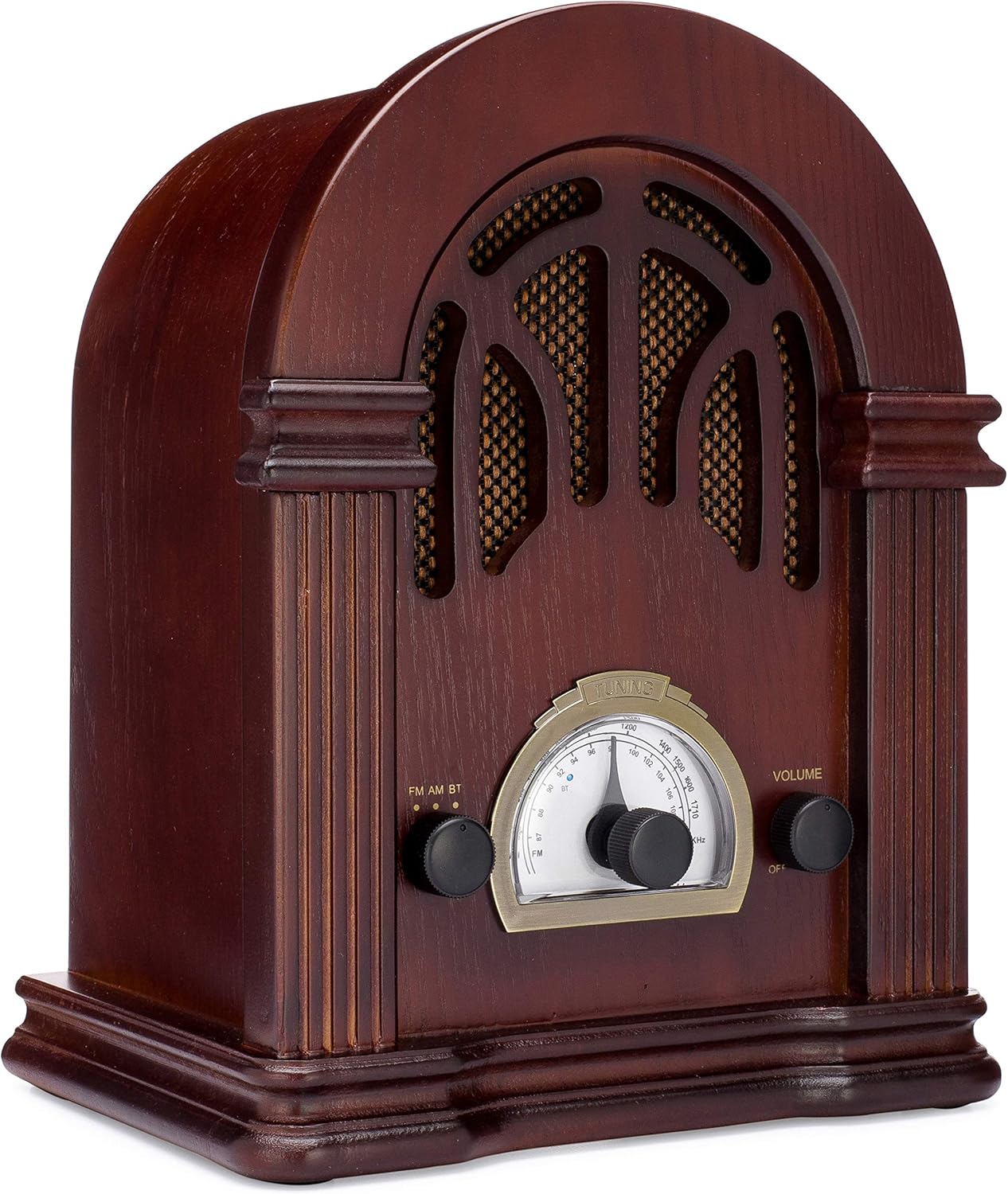
The ClearClick is built for simplicity. Its retro face and straightforward knob controls mean anyone can walk up to it, turn it on, and listen — no pairing ritual, no app, no explanation. That accessibility is underrated, and it makes this a strong choice for households with mixed comfort levels around technology.
It handles both radio and wireless streaming competently, and the styling sits comfortably in traditional interiors.
Key Features
- AM/FM radio alongside Bluetooth streaming
- Simple, tactile knob controls
- Traditional retro styling for living spaces
- Operation that anyone in the household can manage
Pros
- Genuinely simple to use
- Radio and streaming in one device
- Looks at home in classic interiors
Cons
- Designed for ease over advanced features
- Straightforward sound presentation
Who it’s best for: households that want a radio-first device anyone can operate without help.
TRENBADER Retro Bluetooth Speaker
The TRENBADER stands out in this group for one clear reason: it puts a built-in subwoofer behind its classic AM/FM face, which gives it more low-end weight than the typical retro radio. For listeners who want a fuller, warmer sound from a cabinet design, that is a meaningful difference.
It keeps the dial-front styling that makes the category appealing, while delivering a presentation with more body to it — a good fit for music-first listening in kitchens and living rooms.
Key Features
- Classic AM/FM dial tuning
- Built-in subwoofer for added low-end presence
- Wood-tone retro cabinet styling
- Wireless streaming for everyday playlists
Pros
- Noticeably fuller sound than most retro radios
- Traditional dial operation
- Strong visual presence on furniture
Cons
- Bass emphasis suits some genres better than others
- Cabinet size is larger than compact designs
Who it’s best for: listeners who want classic radio styling with a warmer, weightier sound.
PRUNUS J-180 Retro Radio Speaker
The PRUNUS J-180 is built to be carried. Its handle and portable body make it the natural choice for anyone whose listening moves with them — from the kitchen to the porch, from the workshop bench to the garden table.
The retro radio styling keeps it charming rather than utilitarian, which is a harder balance to strike than it sounds. It looks like a radio and behaves like a modern portable.
Key Features
- Portable body with an integrated carry handle
- Retro radio styling with classic front detailing
- Wireless playback for music on the move
- Compact format suited to multi-room use
Pros
- Truly easy to carry around
- Charming vintage appearance
- Works in many rooms and outdoors
Cons
- Portable size means portable scale
- Handle design dominates the silhouette
Who it’s best for: anyone whose speaker follows them through the day rather than sitting still.
Avantree SP850 Bluetooth Radio
Avantree has a track record with practical wireless audio, and the SP850 reflects that thinking. This is a radio-first design: the dial, the display, and the layout all prioritize tuning and listening over app-based control, which makes it refreshingly direct.
Bluetooth streaming is there for when you want your own playlists, but the core experience is a good, simple radio — exactly what some households still want in a kitchen or bedroom.
Key Features
- Radio-led design with straightforward tuning
- Bluetooth streaming for personal playlists
- Compact portable body for flexible placement
- Practical, unfussy operation
Pros
- Excellent radio-first usability
- Compact and easy to place
- Modern wireless when you need it
Cons
- Subtler retro styling than wood cabinets
- Compact format favors personal listening
Who it’s best for: radio listeners who value easy tuning above all else.
Keep the Radio Alive
Compare AM/FM retro radios with modern streaming built in.
Check Price on Amazon8. Sound Quality Explained: What Retro Designs Actually Sound Like
Expectations shape satisfaction more than specifications do, so it is worth understanding what this category generally sounds like before you buy. Retro-styled speakers are rarely tuned for clinical accuracy. Most favor a warm presentation with a strong midrange — the frequencies where vocals, guitars, and radio voices live — and a softened top end that avoids harshness at everyday volumes.
That tuning has a practical benefit: it sounds pleasant at low and moderate levels, which is how most people actually listen at home. Modern pop and electronic music can feel less dramatic on such speakers than on a contemporary design, while acoustic, jazz, vocal, and older recordings often sound more inviting. It is a matter of matching the speaker to your listening rather than hunting for a universal winner.
Size still decides scale
Physics does not take a holiday because a speaker has a wooden cabinet. A compact desk speaker will not move as much air as a larger cabinet design, no matter how good it looks. If you want sound to fill a living space, choose a larger format like the premium picks above; if you listen within a few feet of the speaker, a compact design is entirely appropriate. Our guide to how much power you actually need explains why room size, not marketing numbers, decides how loud a system can comfortably play.
Wireless and what it does to the sound
Bluetooth transmission is mature enough that most listeners will not hear a meaningful loss in casual listening. Where it can matter is in dense wireless environments or with very revealing speakers, and that nuance is covered properly in our piece on whether wireless speakers lose quality. For retro speakers in particular, any transmission softening is largely masked by the warm tuning these designs already use.
Placement changes everything
A retro speaker placed against a wall gains bass reinforcement and sounds fuller. Pulled out into open space, it sounds more even and accurate. Corners exaggerate warmth to the point of muddiness, while bare shelves in reflective rooms can make the treble ring. Small adjustments of a few centimeters genuinely make a difference.
A note on format: single retro speakers are mono or pseudo-stereo by nature. If you want genuine stereo separation and a wider soundstage, a two-speaker system or a fuller home audio arrangement is the natural next step — our explainer on what Dolby Atmos means covers how modern formats shape the listening experience.
Find Your Sound Character
Compare retro speakers by the way they actually sound.
Check Price on Amazon9. Placement and Setup: Making a Retro Speaker Look and Sound Right
Because retro speakers are decorative objects, placement deserves more thought than it would for a purely functional design. The goal is simple: put the speaker where it looks intentional and where the sound reaches the room without harsh reflections.
- Choose the visual anchor. Pick a surface where the speaker can be seen from the main seating area — a sideboard, a shelf at eye level, or a kitchen counter with clear space around it.
- Give it air. Leave a few centimeters around the cabinet. Speakers pressed tightly against walls or inside shelving sound congested.
- Angle toward the room. Where possible, turn the speaker slightly toward where people sit rather than straight at the wall.
- Keep it away from reflective corners. Corners exaggerate bass and can make warm-tuned speakers sound muddy.
- Route the power cable neatly. A visible cable ruins the effect of an otherwise beautiful object; run it along furniture edges or use a simple cable channel.
- Pair once and test. Connect your phone, play something familiar, and adjust position while listening rather than guessing.
If your retro speaker will sit near a larger audio system — a shelf speaker setup or a media console — consider how the pieces look together. A retro design alongside a proper stereo shelf system can be genuinely handsome, and our guide to setting up a home audio system covers the wider arrangement. For raised placement on furniture or stands, our roundup of the best speaker stands is a useful reference.
Multi-room thinking
One of the joys of these speakers is that they are inexpensive enough to place in several rooms. A wooden radio in the kitchen, a compact retro speaker on a desk, and a portable design that moves with you covers a surprising amount of daily listening without any complex system behind it.
10. Bluetooth, Radio, and Connectivity: What You Actually Need
Feature lists on retro speakers can be confusing because they mix decades-old concepts with current wireless standards. Here is a plain-language guide to what each feature does for you.
| Feature | What It Does | Who Needs It |
|---|---|---|
| Bluetooth streaming | Plays music and audio wirelessly from phones and tablets | Everyone — it is the core function |
| AM/FM tuner | Receives broadcast radio without any device connected | Radio listeners, kitchens, workshops |
| Auxiliary input | Connects older players or devices with a cable | Anyone with legacy equipment |
| Smart-home support | Lets the speaker join a connected household system | Homes already running smart devices |
Pairing is straightforward on all of these speakers: put the speaker into pairing mode, select it from your device’s Bluetooth list, and play something. The only recurring annoyance across the category is reconnection after a power interruption — if a speaker refuses to reconnect, remove it from your device’s list and pair again from scratch. That solves it nearly every time.
If you are building a home where music follows you between rooms, it is worth knowing how wireless ecosystems behave. Our look at whether wireless speakers are any good covers the practical strengths and limitations. And for households already invested in smart speakers, reviews of devices like the Amazon Echo Dot show how those compare to dedicated audio designs in everyday use.
Radio reception tips
- Position the speaker near a window or away from large metal objects for cleaner reception
- Extend any built-in antenna fully before scanning for stations
- Rescan periodically, as available stations change
- Expect reception to vary by location — this is normal for any radio
11. Care, Maintenance, and Safety
Retro speakers look after a home’s atmosphere, so a little care keeps them looking and sounding good for years. The good news is that maintenance here is mostly about surfaces and common sense rather than technical servicing.
Keeping the finish looking right
Wood-tone cabinets and textured finishes dislike moisture and harsh cleaners. A dry, soft cloth is enough for routine dusting; for grilles, a soft brush attachment on a vacuum lifts dust without pressing it deeper into the fabric. Avoid sprays applied directly onto the speaker — apply any cleaner to the cloth first, and sparingly.
Everyday habits
- Keep speakers away from direct sunlight, which fades finishes over time
- Do not place drinks on or immediately beside the speaker
- Check that cables sit flush and are not trapped under furniture
- If the speaker is battery powered and will sit unused for a while, store it partially charged rather than flat
Safety basics
Keep power cables away from heat sources and out of walking paths, avoid overloading wall outlets with adapters, and place speakers on stable surfaces — particularly in homes with children or pets. If a speaker shows any sign of electrical fault, stop using it and unplug it.
Fun uses worth knowing about
These speakers are also excellent for lighter duties: background music while cooking, radio in the workshop, or even a small music setup for family sing-alongs. If that last idea appeals, our guides to the best karaoke systems for home and setting up a karaoke system at home show how a modest speaker fits into that picture.
Keep It Looking Good
Simple cleaning and care accessories for speaker finishes.
Check Price on Amazon12. Which One Should You Buy? A Simple Decision Guide
Fourteen speakers is a lot of choice, and choice is only useful when it narrows. Use the short version below to find your category, then read the full review in the matching section above.
- You want the best all-rounder: the JBL Authentics 300 does everything well and looks superb doing it.
- You want portability with attitude: the Marshall Middleton moves around effortlessly and never sounds small.
- You want the most beautiful small speaker: the Edifier MP230 is the standout design in the compact wood category.
- You want an authentic table radio: the Victrola Willow is the most convincing vintage silhouette here.
- You want radio above all else: the Avantree SP850 or the ClearClick both put tuning first.
- You want warm, full sound from a cabinet: the TRENBADER’s added low-end weight is the differentiator.
- You want charm on a budget: the Dosmix, the Greadio, and the Smalody all deliver character without much outlay.
Thinking longer term
A retro speaker is often a gateway purchase. Once music returns to a room, people frequently want more: better stereo separation, deeper bass, or a system that also serves films. If that sounds like you, it is worth reading about the best home audio receivers and the general case for receivers versus soundbars before spending heavily — knowing the direction of travel helps you make the first purchase a good one.
And if the eventual goal is a dedicated listening or cinema room, our guide to building a serious home theater system shows what the top of that journey looks like.
Frequently Asked Questions
Are retro Bluetooth speakers any good, or just decorative?
Both things can be true, and the best designs prove it. Premium options like the JBL Authentics 300 and the Marshall Middleton deliver genuinely satisfying sound, while smaller designs focus more on charm and personal listening. Match your expectations to the size and price of the speaker.
Do retro speakers sound different from modern speakers?
Many are tuned warmer, with an emphasis on vocals and a softened top end. That flatters acoustic music, radio, and older recordings, while modern pop may feel less aggressive than on a contemporary design. Warm is not worse — it is a character choice.
Can a retro Bluetooth speaker fill a living room with sound?
Yes, if you choose a larger cabinet design. Compact desk speakers are meant for close listening, while the premium picks in this guide are built to project across a room. Size is the main factor here.
Is AM/FM radio worth having in a Bluetooth speaker?
If you listen to radio at all, absolutely. A built-in tuner means you can have music or news without touching a phone, which is genuinely useful in kitchens, workshops, and bedrooms.
Do these speakers work with any phone or tablet?
Yes. Every speaker in this guide streams over standard Bluetooth, which works with iOS, Android, laptops, and most modern devices without special apps.
Will a wood-finish speaker match my furniture?
Wood tones are among the most versatile finishes in interiors and generally suit both classic and contemporary rooms. Darker studio-style designs pair better with metal, concrete, or industrial textures. Photos of the finish in your intended lighting tell you more than specification sheets ever will.
Can I connect a retro speaker to my television?
Some support wired auxiliary connections that work with TVs, though this is not their primary role. For television audio specifically, a soundbar is the more natural solution — our review of the Sony HT-S2000 covers a popular option in that category.
How long do Bluetooth speakers last?
With normal care — kept dry, out of direct sun, and not abused physically — speakers of this kind typically give many years of service. Battery-powered models will see battery capacity reduce gradually over time, which is normal.
Are retro speakers good as gifts?
Exceptionally good. The combination of decorative appeal and everyday usefulness means they suit people who would never shop for audio equipment themselves. The smaller designs in particular are memorable, easy to wrap, and immediately charming.
Do I need two speakers for stereo sound?
For genuine stereo separation, yes. Most retro speakers here are single-cabinet designs that produce a wide, pleasant sound rather than a distinct left-right image. For casual listening, that is rarely a problem.
What is the difference between a retro speaker and a retro radio?
Mostly emphasis. A radio-led design puts the tuner and dial front and center, while a speaker-led design prioritizes streaming and sound. Several products in this guide do both, so the distinction is often about which function you use most.
Should I choose a retro speaker or a regular Bluetooth speaker?
If the object will live in a visible spot in your home and you want it to contribute to the room’s character, choose retro. If you want maximum sound per inch and do not care about appearance, a conventional design will usually deliver more for the money. For a broader comparison of options, see our guide to the best Bluetooth speakers for home.
Conclusion: The Right Retro Speaker Is the One That Lives in Your Room
Retro Bluetooth speakers succeed or fail on a simple test: do you want them visible? When the answer is yes — when a speaker adds warmth to a shelf, a counter, or a corner of the living room — then the styling is not a gimmick. It is the reason the speaker gets used every day rather than occasionally.
Across these fourteen designs, our top pick remains the JBL Authentics 300 for the way it blends genuinely modern, room-filling sound with restrained retro styling. The Marshall Middleton is the choice for anyone who wants that energy in a portable form. Among the wood-cased designs, the Edifier MP230 and the Victrola Willow stand out for how convincingly they carry the classic table radio look, while the smaller designs — the Dosmix, the Greadio, the Audiocrazy Espresso — deliver charm at prices that make them easy to justify.
Whichever direction you go, place it with a little thought, pair it once, and let it become part of the room. That is what these speakers are built for.
You May Also Like
More guides and reviews from our home audio library.
Compact soundbar thinking applied to a tiny footprint.
Accessible TV audio that punches above its size.
Refined dialogue and a polished everyday experience.
Real surround thinking at a sensible price.
What a larger smart speaker brings to the room.
Spatial audio from a single connected speaker.
Compact soundbar performance with modern formats.
Straightforward soundbar upgrade for smaller spaces.
Bold soundbar design for film nights and music.
Flagship soundbar performance, examined closely.
A portable everyday speaker that travels easily.
Premium bar performance across movies and music.
Two soundbar philosophies compared side by side.
Which speaker ecosystem fits your home better.
Strong options across Denon’s line-up.
Yamaha picks for every room size.
Value-focused receivers worth a look.
Sony’s home cinema hubs, reviewed.
Premium sound for serious listening rooms.
The full connection sequence, step by step.
HDMI ARC, optical, and the settings that matter.
Small adjustments that transform the sound.
Wiring explained in plain language.
What channel counts actually mean for your room.
Big-screen lyrics for living room sing-alongs.